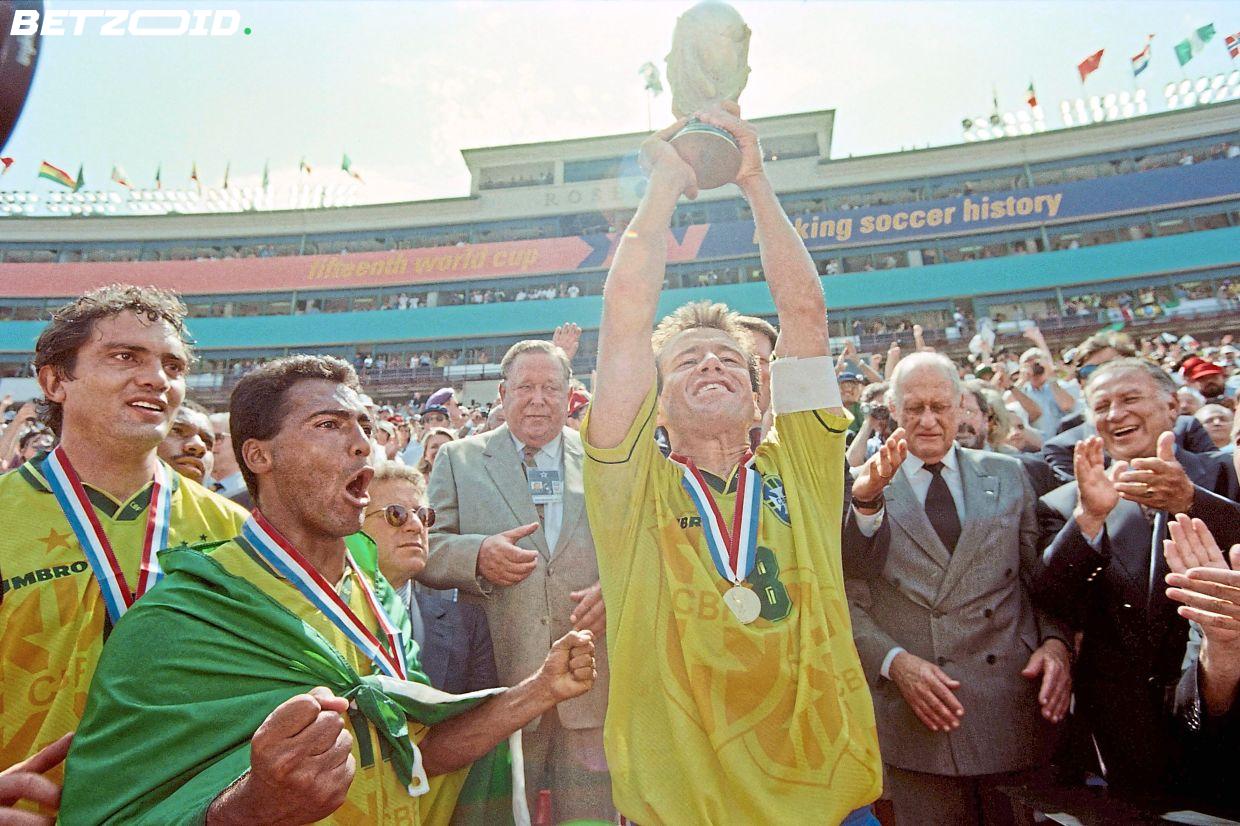
Roberto Baggio stepped up to take the most important penalty of his life, in a goalless World Cup final, under the midday sun in Pasadena — and skied it over the bar. Brazil were champions. The Divine Ponytail stood with his hands on his knees, and the whole world felt it.
That was July 17, 1994. Thirty-two years later, the World Cup is back in North America. And it's worth understanding what happened last time before getting swept up in the 2026 hype machine.
What the 1994 World Cup actually was
It wasn't pretty. The final ended 0-0 after 120 minutes of dehydrated, sluggish football — no water breaks, midday kick-off, Rose Bowl heat. The players looked like they were running through sand. It remains the only World Cup final decided by a penalty shootout, and it got there for understandable reasons.
The tournament had everything else, though. Bebeto's baby-rocking celebration — his son Mattheus born two days before his quarter-final goal against Holland — is still one of the most joyful moments in the competition's history. Romario terrorised defences from start to finish. And then there was Maradona, the defending champion's talisman, thrown out mid-tournament after testing positive for drugs. Argentina, bundled out in the last 16 by Romania. The greatest disgrace a defending champion has suffered at a World Cup.
England and France didn't even qualify. The crowd still showed up — 3.5 million paying spectators across the tournament, an average of 69,000 per match. No World Cup has matched that attendance figure since.
There's one more detail that tells you everything about where football was heading. In the crowds before the final, Brazil fans weren't chanting for Romario or Dunga or Taffarel. They were carrying life-sized posters of a 17-year-old who hadn't played a single minute. Ronaldo Nazario. El Fenomeno hadn't done anything yet. They just knew.
What 2026 inherits — and what it needs to prove
The 1994 tournament didn't just entertain. It rebuilt American football from the ground up. The $50 million surplus it generated seeded Major League Soccer, which launched in 1996 and has grown steadily ever since. Pele and Beckenbauer came to the NASL in 1975 to sell the sport to Americans, and it didn't stick. One World Cup did what two decades of celebrity signings couldn't.
Now Lionel Messi is at Inter Miami, and the conversation around American soccer has shifted again. The 2026 edition — 48 teams, shared between the US, Mexico, and Canada — arrives at a moment when the domestic market is genuinely more receptive than it has ever been.
That said, 48 teams means a longer, more diluted group stage, and midday kick-offs scheduled to serve European broadcast windows mean players will again be competing in conditions that favour survival over quality. Some things don't change.
- Brazil enter 2026 still searching for the kind of identity they had in 1994 — their odds reflect the uncertainty
- Argentina, as defending champions, carry a target Maradona's side famously couldn't handle in the same role
- The US, playing at home with genuine MLS-developed depth, could be a disruptive force in the knockout rounds for the first time
The 1994 final was an anti-climax. But everything around it — the stories, the chaos, the Maradona drama, the emergence of Ronaldo as a name before he was a player — made it one of the most memorable tournaments ever staged. Whether 2026 can do the same depends less on the half-time shows and more on whether the football delivers what the spectacle promises.
Baggio never got another final. He came back in 1998, ponytail gone, different player. Some moments don't repeat. The question for 2026 is whether it creates its own.