

Most cricket betting sites in the UK look interchangeable on the homepage — the same match-winner price, the same "bet £10, get £30" banner — and then diverge sharply the moment a Test reaches day four or an IPL chase goes wrong. The differences that actually decide things are market depth (a marquee Test can carry well over 150 markets while a County Championship game might get 30 to 40), whether live streaming covers the competitions you follow, and whether cash out is partial or strictly all-or-nothing.
The Betzoid editorial team compares operators on those points rather than on the headline bonus, because a £30 free bet tied to 2.00 minimum odds and a seven-day expiry is worth less than a book that prices Test session markets sensibly all summer. Our shortlist sits just below, and the sections that follow walk through the checks behind it: licensing, cricket-specific coverage, in-play tooling, app quality and the small print attached to qualifying bets.
Recommended Cricket Betting Sites (October 2026)







What Separates Cricket Betting Sites From the Rest?
Cricket depth, not general sportsbook polish. Every operator you can legally use here holds a UK Gambling Commission licence, so you are not sorting scams from safe sites — you are deciding which licensed book treats cricket as a core sport rather than a seasonal add-on.
The quickest tell is what happens outside the big weeks. Plenty of sites go deep for an Ashes Test or an IPL final and then offer little more than a winner and a top-batter market for a Vitality Blast group game or a women's international. If domestic and second-tier fixtures still carry player props, innings totals and next-wicket markets, the trading team is genuinely covering cricket. If they vanish, you will be stuck shopping elsewhere for two-thirds of the calendar.
Streaming rights are the second divider, and they are contractual rather than technical. One book may carry overseas franchise cricket while another shows none of it, so "has live streaming" means very little until you check the specific competition. The third is in-play behaviour: how quickly markets reopen between overs, and whether suspensions last one ball or three.
Newer arrivals complicate the picture. New cricket betting sites in the UK often launch with sharp pricing to buy market share but thinner coverage of anything outside internationals. If you would rather assess one brand in detail than compare a whole field, our Grosvenor Sport review takes that single-operator approach.
Which Markets Should You Expect to Find?
Match winner should be maybe a fifth of what a serious cricket book offers. The rest is where pricing effort — and value — varies most, because player and phase markets get less attention from both bettors and traders than the headline result.
Expect four families of market on any well-covered fixture. Result markets cover winner, tie, draw in Tests, and series or tournament outrights. Method markets narrow the outcome: a team to win by 6 or more wickets, or by 100-plus runs, priced longer than the straight winner because you are taking on the margin as well as the result. Totals markets cover match runs, team innings totals, individual player runs and wickets, sixes, extras and the like. Player markets cover top batter, top bowler, player of the match and method of dismissal, usually for the top six or seven in the order and the four or five frontline bowlers.
Price differences bite hardest in that last group. Say a top-batter selection is 4.20 at one book and 4.80 at another. A £50 stake returns £210 at the first and £240 at the second — the same bet, £30 apart. Spread that over a season of Test and T20 betting and shopping around matters more than any welcome offer.
Bet builders sit alongside all of this, letting you combine a result with a player total and a match sixes line at boosted odds. Useful when you have a genuine multi-angle read on conditions, less so as a habit: every leg has to land, so you are building a same-game accumulator with accumulator risk. Check whether builder selections count toward bonus wagering before you lean on them, because plenty of terms exclude them.
Test Match Depth and Session Betting
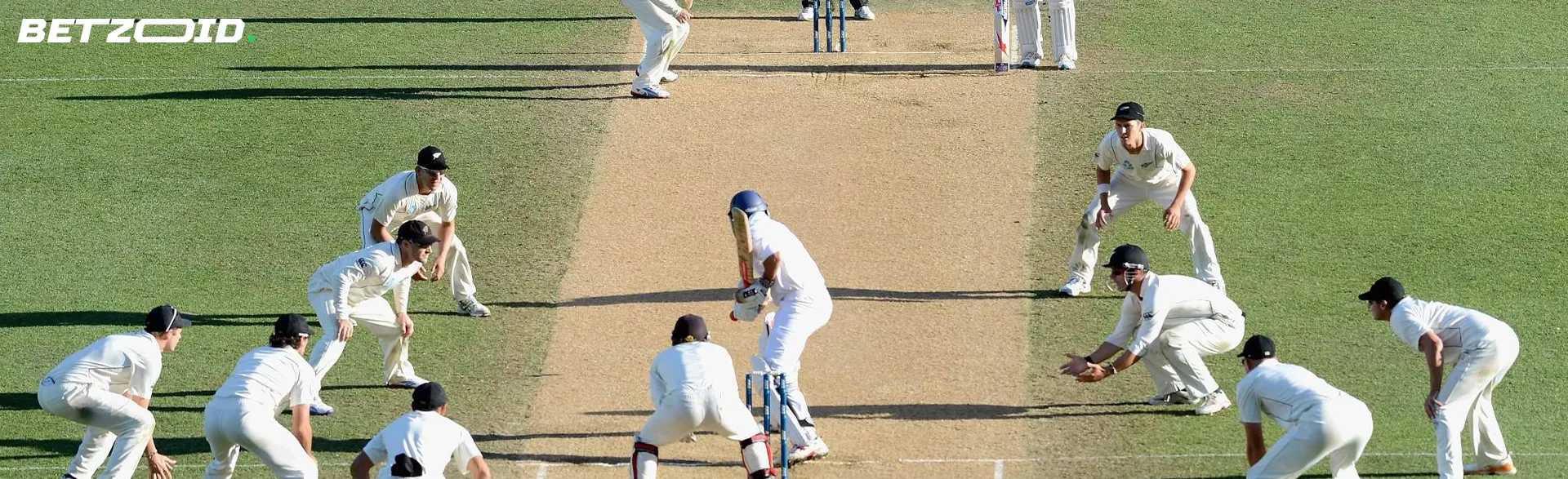
Five days of play is what makes Test betting different: your position is never fixed for long. Session markets — runs scored in a defined 20-over period, wickets in a session, a specific innings total — settle within hours instead of tying up a stake until Sunday evening.
That changes how you use the draw. On a flat surface with rain in the forecast, a draw price of around 4.50 turns £30 into £135 if nobody forces a result, and it can be hedged later once a fourth-innings target appears. Cricket betting sites that cover Test matches properly also keep session and innings markets live for the fourth and fifth day, when many books quietly shut them down.
IPL, T20 and The Hundred Coverage
Short formats push almost all the action in-play, because a chase can swing from comfortable to lost inside two overs. Look for powerplay markets (runs, wickets and boundaries in the first six overs, or first 25 balls in The Hundred), team totals with lines that move ball by ball, and next-over runs.
Coverage quality is competition-specific. Books often price the IPL tightly because volume is enormous, while the same operator can be slower on The Hundred or a Caribbean T20 fixture. If you bet one competition heavily, judge a site on that competition's market list rather than its overall cricket reputation.
How Do Live Streaming and Cash Out Work Together?
They are two halves of the same tool: the stream tells you what is happening, cash out decides what you do about it. Streams embedded in a sportsbook usually run ahead of a standard broadcast feed, which is why UK cricket betting sites with live streaming are worth more to in-play bettors than to pre-match ones. Watching on delay while the market has already reacted to a wicket is the worst combination available.
Cash out mechanics matter just as much as the video. Partial cash out gives you options a full exit cannot: with England needing 40 with four wickets left, closing £70 of a £100 stake banks a guaranteed return while the remaining £30 rides at improved odds. Full cash out forces one decision on the whole stake, which wastes the leverage a close finish creates.
| In-play tool | What it actually changes | When it earns its keep |
|---|---|---|
| Embedded live stream | You see the ball before the market reprices | T20 and Hundred run chases |
| Partial cash out | Banks part of a position, leaves the rest live | Final three to five overs of a tight finish |
| Auto cash out rules | Executes at a preset profit or loss level | Overnight overseas play you cannot watch |
| Fast market reopening | Shorter suspensions between deliveries | Next-over and next-wicket betting |
The table hides one trade-off: streaming access is often conditional. Some books require a funded account, a settled bet in the last 24 hours, or restrict the feed by competition — and geo-blocking can remove a match you expected to watch. Auto cash out solves the opposite problem, letting you set exit levels before an overnight session so a tour of Australia does not cost you sleep. If you want in-play markets and cash out to be genuinely usable, confirm the streaming condition and the partial cash out availability on cricket specifically, not on football.
How Do You Compare Odds Before You Commit?
Compare the same three markets across three books on a live fixture, then repeat it on a quiet one. Anyone can look sharp on an England international; consistency on a County or associate-nation game is what tells you where to keep your main balance.
- Pick one benchmark fixture and note the match-winner price at each site. Differences here are usually small, which is exactly why they set the baseline for everything else.
- Check a player market next — top batter or a runs line for the same player. This is where gaps widen, and where a 0.30 difference in decimal odds turns into real money on a £50 stake.
- Test an in-play price during an innings break or between overs, comparing team-total lines rather than just odds. A shorter price on a better line can still be the stronger bet.
- Repeat on a low-profile match in the same week. Sites that widen their margin on domestic cricket are fine for finals and expensive for everything else.
- Log the winner per market type. Most bettors end up with two accounts: one for internationals, one that prices domestic and player markets better.
That five-minute routine beats trusting any "best price guaranteed" badge, because cricket margins shift by competition rather than by brand. Our wider comparison of bookmakers with the best odds applies the same logic across sports, and the habit transfers directly: line shopping compounds far faster than bonuses do.
Where Do Free Bet Offers Lose Their Value?
In the qualifying conditions, almost always — not in the headline amount. A £30 free bet and a £30 free bet can differ by half their value once minimum odds, expiry and market exclusions are applied, so read the terms in this order before depositing.
- Minimum odds on the qualifying bet. A 1.80 or 2.00 floor rules out short-priced favourites, which in cricket often means you cannot use the market you actually wanted. It also pushes you into riskier selections purely to unlock the offer.
- Expiry window. Seven days is common and awkward: it rarely covers a full Test, so you end up forcing bets into whatever T20 happens to be on. A 30-day window lets you wait for a fixture you have an opinion on.
- Market and bet-type exclusions. Cash-out bets, bet builders and system bets are frequently excluded from qualifying. If you mainly bet in-play, an offer built around pre-match singles is worth less to you than to someone who bets before the toss.
- How the free bet settles. Most return winnings only, so a £10 free bet at 3.00 pays £20, not £30. Some split the credit into smaller tokens with their own odds rules, which quietly reduces flexibility.
- Qualifying deposit and stake size. A £10 deposit plus a £10 qualifying bet is the standard shape. If that is more than you want tied up, comparing bookmakers built around low minimum deposits is a better starting point than chasing the biggest promotion.
Judged this way, free bet offers separate into two groups: those where the offer is a mild bonus on top of decent pricing, and those using it to disguise a wide margin. Recurring tournament promotions — enhanced prices, acca insurance, profit boosts during a season — usually outperform a one-off welcome credit, because they keep paying out after your first week.
Are Mobile Apps Worth Choosing a Site For?
If you bet in-play, yes. Cricket rewards speed: a market that reopens for 40 seconds between overs is a different proposition on a well-built app than on a mobile browser that reloads the bet slip after every selection.
Three things separate a serious app from a wrapped website. First, a bet slip that holds your stake and handles price changes with a clear accept-or-decline step rather than silently rejecting the bet. Second, push notifications for wickets, innings breaks and price moves on markets you already hold, so you are not watching the screen through a whole day's play. Third, stable streaming on mobile data, since a feed that stalls is worse than no feed at all.
Battery use is a real constraint for Test cricket specifically — a session runs two hours, a full day close to six. Tablets handle that better and let you keep the stream, live odds and bet slip visible at once. Biometric login and a saved favourites list for teams and competitions are the small features you notice daily.
Which Checks Matter Before Your First Deposit?
Run these five before money moves, not after a withdrawal stalls. All of them take minutes and each one has cost bettors time at some point.
- Licence verification. Find the Gambling Commission account number in the footer and check it on the Commission's public register. UK licensed operators also hold customer funds separately from operating capital — the footer states the protection level, and "medium" or "high" is what you want to see.
- Identity documents up front. Photo ID and proof of address are required by law before you can bet or withdraw, so no UK book lets you skip that step — one reason the promise of betting without registration needs a closer look at the terms. Uploading documents on day one avoids the classic delay where a first cash-out request triggers verification on a Friday afternoon.
- Payment method and withdrawal route. Deposits and withdrawals normally have to use the same method, and debit cards, e-wallets and open banking clear at different speeds. Check minimum withdrawal amounts too, which can exceed the minimum deposit. If the entry cost is your sticking point, operators without a fixed minimum deposit are worth a look.
- Deposit and loss limits. Set them in account settings before your first bet. Decreases apply immediately while increases carry a cooling-off delay, which is exactly the friction you want in the wrong moment.
- Cricket-specific coverage you will actually use. Open the cricket tab and confirm the competitions and market types you bet on are there today, in the off-season as well as during a marquee series.
Work through that list and you end up with a shortlist built on verifiable conditions rather than marketing. It is also why we compare cricket betting sites on licensing and terms first, with promotions treated as a tiebreaker.
Choosing a cricket book comes down to three decisions: a licence you have checked, market depth that survives the quiet weeks of the calendar, and in-play tools — partial cash out and a stream for your competitions — that match how you actually bet. Pricing follows from there, and the five-minute odds comparison across a marquee fixture and a domestic one will tell you more than any welcome offer.
Start with the shortlist above, open two accounts rather than one so you can line-shop player markets, and set your deposit limit in account settings before the first bet of the season.
FAQ