

PaysafeCard betting sites run on a simple trade: you hand the bookmaker a 16-digit PIN instead of a card number, and your bank never appears in the transaction. Vouchers sell in the UK in fixed £10, £25, £50 and £100 values, credit your balance in seconds, and — the part that catches most first-timers out — cannot be used to take winnings back out again.
The Betzoid team compares banking pages, bonus terms and cashier limits rather than marketing copy, because that is where prepaid users get treated differently: an inflated minimum on vouchers, a promotion that quietly excludes them, or a processing charge that a debit card user never pays. The operators below are the ones we rate for voucher deposits, and the sections after that cover the practical detail — where PINs are sold, what the deposit screen actually asks for, and the payout method you need on file long before you have anything worth withdrawing.
Top PaysafeCard Betting Sites in the UK (October 2026)










Why PaysafeCard Deposits Appeal to UK Bettors
Two reasons dominate: the bookmaker never sees your banking details, and the voucher puts a hard ceiling on the session before you log in. Since the Gambling Commission banned gambling on credit cards in April 2020, British accounts are funded almost entirely from debit cards, e-wallets and open banking transfers — all of which leave a trail through the account you pay your rent from. A prepaid PIN bought with cash sidesteps that entirely.
That matters to people sharing a joint account, to anyone who would rather not have a column of gambling merchant entries on statements a mortgage adviser will read, and to punters trialling two or three unfamiliar sportsbooks without spreading card details around. The self-limiting side is just as useful: a £25 voucher is £25, full stop, with no second deposit available at 11pm without leaving the house.
Be precise about the privacy, though. The PIN is anonymous; your betting account is not. Every UK-licensed operator must verify your name, address and date of birth before you stake, which is why genuinely registration-free betting does not exist under UKGC rules. PaysafeCard keeps your banking private from the bookmaker — it does not keep you anonymous from it.
What a PaysafeCard Voucher Gets You at a Bookie
A redeemed PIN becomes ordinary cash balance, not a restricted voucher wallet. Once it lands, it behaves like any other deposit: you can back a 2.15 handicap chase, build a five-fold, cash out early or leave it sitting until Saturday. Deposits usually land instantly, which is the point — you are not waiting on a bank transfer while the price on your selection shortens.
What the voucher does not get you is a return route, and at most UK bookmakers that accept PaysafeCard the withdrawal list simply does not include it. Markets and pricing do not change. Voucher-funded accounts get the same football, tennis and racing books, the same in-play coverage and the same promotions as card users at the sites worth using.
If racing is your main interest, the deposit screen looks the same everywhere, so let pricing decide which voucher-friendly bookmaker gets your money: early prices, Best Odds Guaranteed and each-way terms move returns far more than the cashier does. Our breakdown of bookmakers with consistently competitive odds is the better filter once you have a shortlist that takes vouchers.
£10, £25, £50 and £100 Voucher Amounts
Retail vouchers come in those four fixed values, and £100 is the usual ceiling on a single PIN. The mismatch to watch is between denomination and cashier minimum: a £25 voucher against a £10 minimum leaves £15 stranded on the code until you redeem the remainder somewhere. Some cashiers accept a partial redemption and keep the balance on the PIN; others take the lot in one go. If you want to start small, pair a £10 voucher with one of the bookmakers that genuinely accept £10 deposits rather than those quietly demanding £20 from prepaid users.
Where to Buy Vouchers in the UK
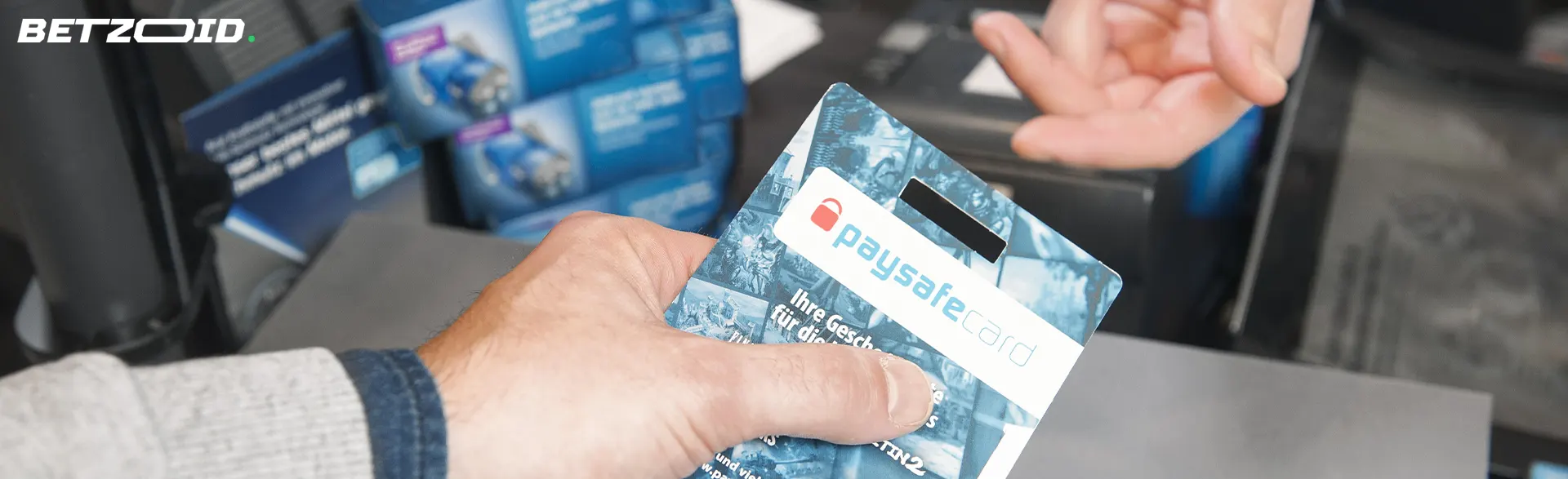
- Supermarkets and convenience stores: larger chains and independents running PayPoint or Payzone terminals print vouchers at the till, paid for in cash or by card, with the PIN on the receipt.
- Newsagents and petrol stations: the widest coverage for a late purchase, though smaller outlets sometimes stock only the £10 and £25 values.
- Online and in the app: buying digitally is quicker but links the purchase to a card or bank account, which removes most of the privacy benefit.
- The official store locator: check availability near you before travelling, since retailer participation changes.
Cash at a counter is the only route that keeps the deposit fully off your bank statement. Expect to be asked for age ID, and keep the receipt intact until the code is fully spent — a smudged PIN is an unusable PIN.
How to Deposit with PaysafeCard Step by Step
Depositing with PaysafeCard at a bookmaker takes about a minute once you have the code. The sequence barely varies between operators, and the one place people slip is step four.
- Open the cashier and pick the method. PaysafeCard is usually filed under prepaid or vouchers rather than next to Visa and Mastercard, so scroll the full list before assuming it is unavailable.
- Enter the amount you actually want to stake. Type the deposit figure first — if the site is running a welcome offer with a qualifying minimum, match or beat it here rather than topping up later.
- Key in the 16-digit PIN. Copy it exactly from the receipt or app; the digits are grouped in fours and a single transposed character returns a generic failure message that tells you nothing useful.
- Check the confirmation screen for charges. Standard voucher deposits should carry no fee. If the summary shows a percentage added by the operator, cancel and use a site that does not levy one.
- Confirm and check the balance. Funds normally appear immediately. If a partial amount was used, note the remaining value on the PIN or register it to a my paysafecard account so it is not forgotten.
The common failure point is a voucher bought in the wrong currency — a euro-denominated PIN redeemed at a sterling account gets converted at paysafecard's rate, quietly shaving a few pounds off your deposit. Buy in GBP for a GBP account, and keep one PIN per deposit where possible so the maths stays clean.
Can You Withdraw Winnings to PaysafeCard?
In almost all cases, no. Ask whether you can withdraw winnings to PaysafeCard at UK bookies and the cashier answers for you: the method appears on the deposit list and is absent from the withdrawal list. When we go through banking pages at UK-licensed operators, PaysafeCard is consistently listed as deposit-only.
The reason is regulatory rather than technical. Anti-money-laundering rules require an operator to return funds to a verified, named source wherever possible, and a bearer voucher has no name attached — whoever holds the PIN can spend it. Bank accounts, debit cards and identity-verified e-wallets all satisfy that test; a scratch-off code does not. A verified my paysafecard account sits closer to an e-wallet and works as a payout destination in some markets, but do not assume a British bookmaker supports it. Check the withdrawal screen of the specific site before you plan around it.
So prepaid punters run a split setup: anonymous money in, conventional money out. That is a fair trade for most people, provided you understand it before you are sitting on a £300 balance you cannot reach.
Lining Up a Payout Method Early
Add and verify a withdrawal method the same day you deposit, not the day you win. Most bookmakers also run source-of-funds and identity checks at the first withdrawal request, and documents can take longer to clear than the payout itself. Debit card returns commonly take one to three working days; e-wallet payouts are usually the quickest option where the site supports them. Doing the paperwork on a quiet Tuesday beats doing it while a Saturday accumulator settles.
Which Welcome Bonuses Accept Voucher Deposits?
Qualifying payment method clauses are the single biggest trap for anyone hunting betting sites with a PaysafeCard welcome bonus. Many promotions exclude prepaid vouchers alongside Skrill and Neteller, and the exclusion typically appears in the terms rather than in the headline. The pattern below reflects how offer types generally treat prepaid funding — always confirm against the specific terms on the day you sign up.
| Offer type | Typical UK structure | How voucher deposits usually fare |
|---|---|---|
| Deposit match | Matched percentage up to a capped amount, with wagering attached | Most likely to carry a payment-method exclusion — read the qualifying deposit clause |
| Bet £10 get free bets | Qualifying stake at minimum odds, free bets credited on settlement | Usually fine, since the trigger is the bet rather than the deposit route |
| Refund if first bet loses | Stake returned in cash or free bet up to a set limit | Mixed — some terms restrict the refund to the original payment method, which vouchers cannot receive |
| Price boosts and acca insurance | Event-specific enhancement with a maximum stake | Generally open to everyone, as eligibility is tied to the market, not the cashier |
The table points to a rule of thumb the headline figures hide: offers triggered by a settled bet suit voucher users better than offers triggered by a deposit. A stake-based free bet only needs your £10 to reach the account somehow, whereas a matched deposit is priced around the funding method itself.
Before redeeming a PIN, open the full terms and search for "qualifying deposit" or "excluded payment methods". If vouchers are named as excluded, deposit elsewhere. If the terms list accepted methods and PaysafeCard is missing, treat that as an exclusion too, and ask live chat for it in writing.
What Can Go Wrong with Prepaid Deposits?
The failures are small but avoidable. Dormancy is the most expensive: paysafecard applies a monthly maintenance fee to balances left unused beyond a set period, so a half-spent £50 voucher in a kitchen drawer shrinks month by month. Redeem codes promptly and pool leftovers rather than hoarding them.
Then there is the stranded-balance problem. Split a £100 voucher across two bookmakers and you are relying on both cashiers to handle partial redemptions cleanly; if one takes the full value, your second deposit disappears. Currency conversion bites the same way, as does a torn receipt where the final digits are unreadable — there is no chargeback and no card issuer to argue with, because the voucher functions as cash.
Finally, watch where you type the PIN. Anyone asking for a code by email, chat or over the phone is running a scam; a legitimate deposit only ever happens inside a logged-in cashier. If you want to trial a site for less than a full voucher, bookmakers with no set minimum deposit may suit you better, since a card top-up avoids the denomination mismatch entirely.
Checks to Run Before Redeeming Your First PIN
Five minutes of checking beats an afternoon with support. Run through these before the code leaves the receipt.
- Licence first: confirm the operator holds a current UK Gambling Commission licence and check the number on the regulator's public register rather than trusting the footer logo alone.
- Minimum deposit for vouchers specifically: some cashiers set £5 or £10 for cards but push prepaid users higher, which changes how far a £10 voucher goes.
- Fees on the confirmation screen: standard voucher deposits should cost nothing; any percentage added by the bookmaker is a reason to pick another site.
- Bonus eligibility in writing: find the qualifying payment methods clause before depositing, not after, and screenshot it if you intend to claim.
- A working withdrawal route: add and verify a debit card or e-wallet at sign-up, since your voucher cannot receive the payout.
The licence and the withdrawal method are non-negotiable; the rest determine how much of your £10, £25 or £50 actually reaches the betting market. Sites failing two or more of these tend to be the same ones treating prepaid customers as an afterthought across support and payouts, which is exactly why we weight cashier terms as heavily as headline offers when comparing betting sites that accept PaysafeCard.
Prepaid vouchers solve one problem neatly — keeping your bank out of the bookmaker's records while capping the session at the value in your hand — and create one you must plan for, because the money has to leave by another door. Pick an operator with a £10 voucher minimum, no added deposit fee and a bonus whose terms do not exclude prepaid funding, then verify a debit card or e-wallet the same day you sign up. Use the comparison above to narrow the list, set a deposit limit in your account settings alongside the natural ceiling the voucher already gives you, and buy the next PIN only when you meant to.