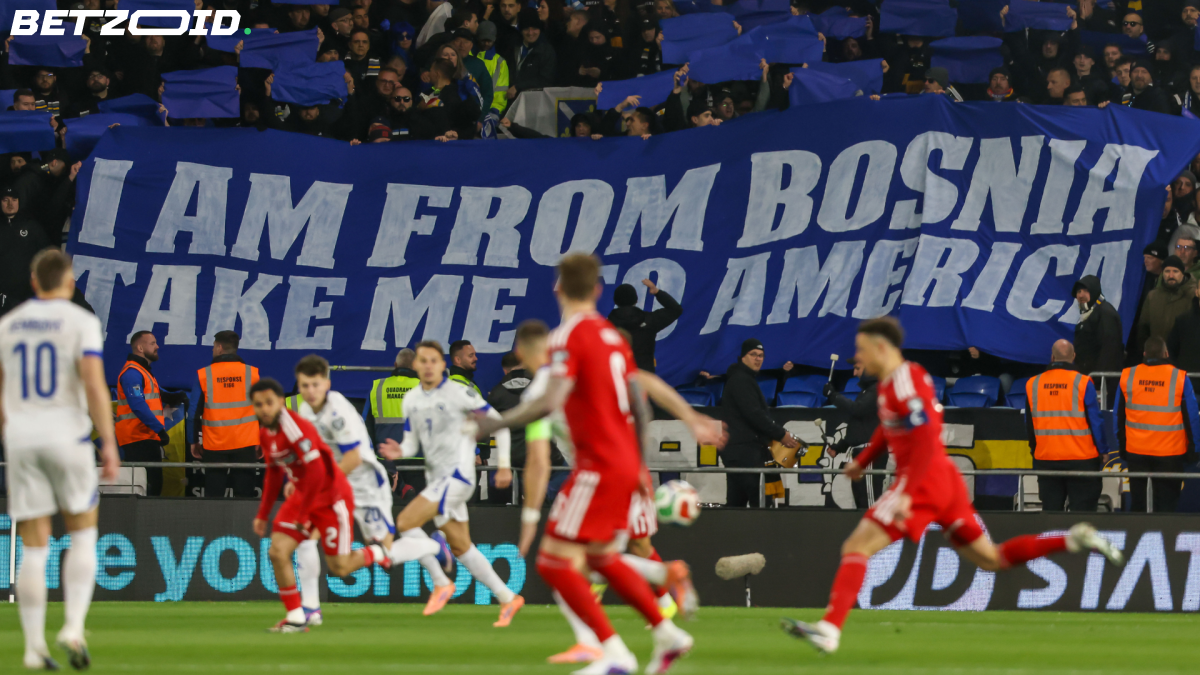
"There's no chance that we're gonna win, but let's have fun. Take us to America." That was the spirit behind the banner. Nobody expected it to become the defining sound of a nation's first-ever World Cup knockout run.
Dubioza Kolektiv's song "I Am From Bosnia, Take Me to America" — originally written 15 years ago under the title "U.S.A." — started as exactly the kind of dark, self-deprecating humor Bosnians have weaponized for decades. A 20-meter banner unfurled in the Cardiff stands the day before a playoff game against Wales that Bosnia were widely expected to lose. The fans weren't delusional. They just wanted to laugh in the face of it.
Then they beat Wales. Then they beat Italy on penalties. Then Esmir Bajraktarevic — born in Wisconsin, a former U.S. youth international — scored the decisive spot kick. The joke stopped being a joke.
A song that means two different things at once
Bassist and co-founder Vedran Mujagic is quick to flag that most people singing along have never heard the original. The football version is a trimmed, repurposed chant. The actual song is something sharper — a satire of naive emigrant fantasies, not a celebration of them.
"In the original song, it's the complete opposite," Mujagic explained. "This song describes a very typical and very naive worldview of a person who is not satisfied in his own country and wants to go find his American dream abroad."
So the line "Take me to Golden Gate, I will assimilate" — which sounds triumphant bouncing around a stadium — is actually the punchline. The irony got lost in translation somewhere between the stands and the streaming charts, but Mujagic doesn't seem to mind. People discovering the chant go back and listen to the full song. The reach is the reach.
Now the match against the United States takes place at Levi's Stadium in Santa Clara, California. A song about wanting to go to America, sung by Bosnians who've made it to America, against the American team. The full-circle quality of it is almost too neat to be real.
What Bosnia's run actually represents
The team is based in St. Louis for the tournament — one of the largest Bosnian diaspora communities in the United States. That's not a coincidence. It's a deliberate grounding point for a squad that increasingly reflects the children of refugees rather than refugees themselves. The generational shift is visible on the pitch and in the stands.
"When people stop having the first association when they hear Bosnia and Herzegovina being war," Mujagic said, "and they realize that Bosnia is associated with good football players, crazy supporters which are your neighbors, and a very fun, loud, and crazy positive group of people — that's the result we hope for."
That rebranding is already happening. And a deep World Cup run — with a proper anthem behind it — accelerates it faster than any diplomatic effort could. Bosnia's odds of advancing further depend on what happens on the pitch in California. But the cultural ground has already shifted. The song that was written in the shadow of genocide is now the soundtrack to something a country gets to feel proud of.
"After this World Cup," Mujagic said, "it will get another life."