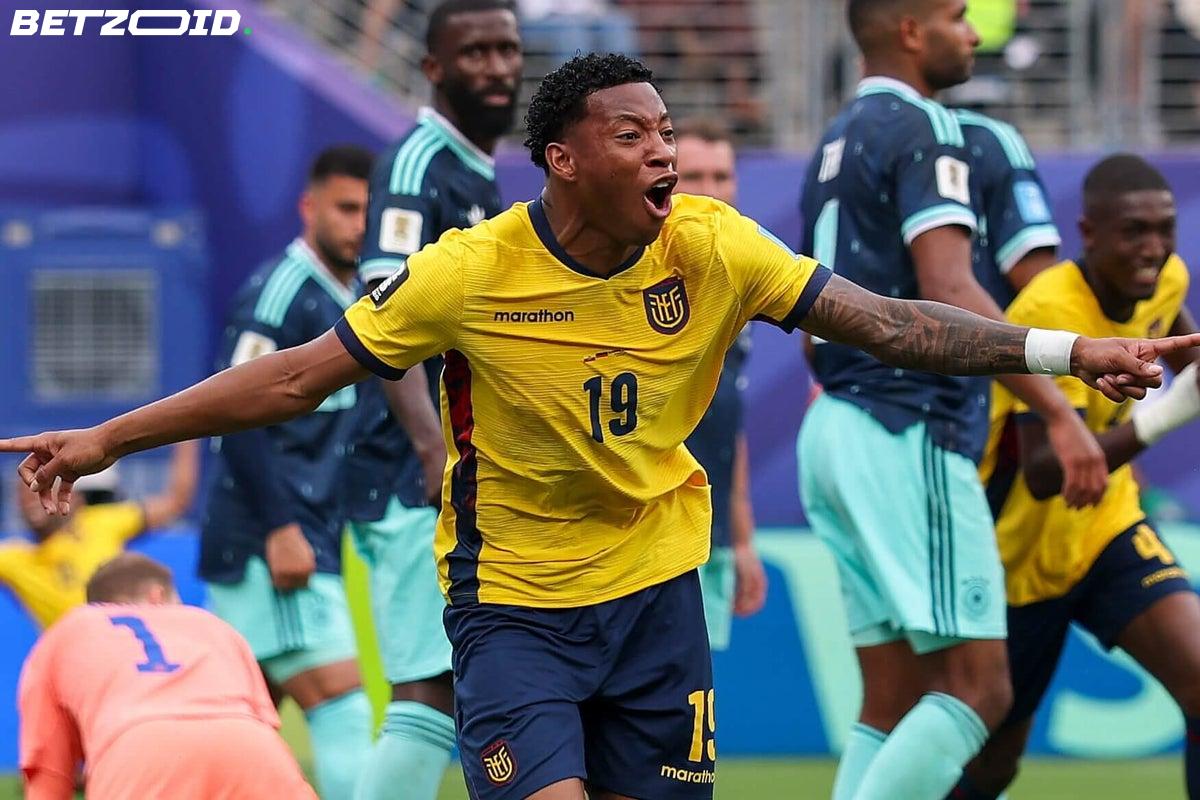
177 goals. We're still in the group stage, and this World Cup has already produced more goals than any edition in the tournament's 96-year history.
The expansion to 48 teams plays an obvious part — 60 games have already been played, more than the entirety of 15 previous tournaments combined. But that alone doesn't explain it. The goals-per-game rate of 2.95 is the highest recorded since 1970. Something else is going on.
What the expected goals model tells us
When you run the 1,469 shots taken so far through an xG model and simulate them 100,000 times, the probability of reaching this tally of 165 non-own-goal strikes lands at just 2.9 per cent. To put that in context: a return eight goals below xG was considered equally as likely as what we've actually seen. This isn't a minor overperformance. It's a genuine statistical outlier.
Some of it comes down to talent gaps. Germany putting seven past Curacao — whose goalkeeper Eloy Room plays second-tier American soccer — is the kind of mismatch that inflates any aggregate figure. But that only goes so far as an explanation.
The header theory doesn't hold either. Headers account for 14 per cent of goals this summer, actually lower than 2022 (16 per cent) and 2018 (19 per cent). And long-range efforts? Same rate as 2022 at 37 per cent of shots from outside the box — nothing out of the ordinary there.
Is the Adidas Trionda ball the wildcard?
Former England goalkeeper Joe Hart has pointed a firm finger at the official match ball, the Adidas Trionda. "I honestly feel as though this ball is coming onto the goalkeeper quicker than they feel it is off the foot," he said on BBC. His examples aren't easy to dismiss — Mbappe's long-range finish against Senegal, where Edouard Mendy got close but couldn't adjust his hands in time. Messi's opener against Algeria. England's Pickford potentially caught out by Baturina's effort against Croatia.
The argument is subtle but plausible: if the ball's trajectory behaves even fractionally differently to what goalkeepers are calibrated to expect, those split-second hand adjustments — the ones that separate world-class keepers from everyone else — start going wrong more often.
- 177 total goals scored in the group stage — a World Cup record
- 2.95 goals per game, the highest rate since 1970
- Only a 2.9% probability of reaching 165 non-own-goal strikes, per xG simulation
- 14% of goals via headers — lower than both 2022 and 2018
The rate will almost certainly drop in the knockout rounds, when the mismatches dry up and the margins tighten. But the overperformance relative to xG is real, it's statistically rare, and the ball Hart is flagging deserves more scrutiny than it's getting. Anytime goalkeepers at this level are being caught out by trajectory, the over/under markets for the knockout stage are worth a second look.