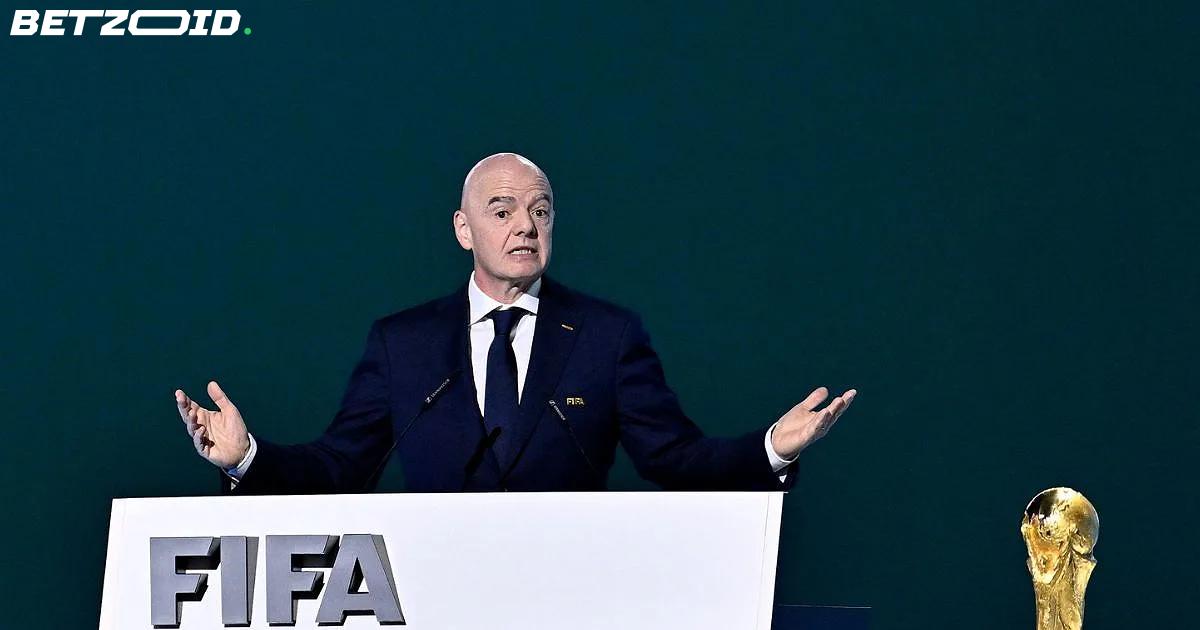
The 48-team World Cup has barely finished and Gianni Infantino is already pitching the next size up. Speaking to Swiss television during the tournament, the FIFA president floated a 64-team World Cup as something worth examining — 128 matches, potentially six-plus weeks, and a global football calendar that would need to be gutted and rebuilt around it.
UEFA's Aleksander Ceferin said last year he wasn't supporting the idea. The Asian Football Confederation's Sheikh Salman has questioned where the expansion logic ends. FIFA, asked for comment, said nothing. That silence is doing a lot of work.
The money angle is the real story
Infantino's stated case is straightforward enough: smaller nations deserve a seat at the table, and without World Cup access they lose the motivation to develop. Fine. But the financial architecture underneath this proposal tells a different story.
If qualification becomes easier for every major footballing nation, qualifying campaigns lose commercial value. Broadcasters pay less. The confederations — UEFA, AFC, CONMEBOL, the rest — see their own revenues shrink. And who fills that gap? FIFA, through its own distributions. A 64-team World Cup wouldn't just make the tournament bigger. It would make regional football more financially dependent on the global governing body. That's a power shift dressed up as inclusion.
France's football federation budgeted 24.5 million euros to participate in this year's 48-team tournament and reckoned they'd probably need a semi-final run just to break even. Scale that up to a longer, larger competition and the costs for smaller federations become genuinely prohibitive — the very nations this expansion is supposed to help.
Saudi Arabia's 2034 problem just got bigger
Saudi Arabia is hosting the 2034 World Cup alone, with 15 venues already proposed for the 48-team format. Ramadan is expected to fall in mid-November that year, which makes the November-December window Qatar used extremely difficult to replicate. A 64-team tournament layered on top of those logistical constraints — more stadiums, more hotels, more transport, more weeks — isn't a scheduling challenge. It's a different category of problem entirely.
The 2026 tournament in the US, Canada and Mexico ran to 104 matches across more than five weeks. At 128 matches, you're either compressing the schedule to breaking point or adding another week minimum. Elite players, already grinding through congested domestic calendars that leagues like the J-League and MLS are reshaping around a European August-to-May model, would face a workload that the game's medical staff will have strong opinions about.
- A 64-team World Cup means 128 matches — double the old 32-team format
- That's 24 more games than the 2026 tournament
- Six host nations are already planned for 2030; 64 teams across that many countries is an organisational scale with no precedent
- Saudi Arabia's 2034 solo hosting bid already has Ramadan timing complications baked in
Whether this goes anywhere depends largely on how the football world judges the first 48-team edition once the dust settles. If the expanded format is seen as diluted and over-long, the case for going further falls apart. If it lands well commercially, Infantino will have his argument. Either way, Ceferin's line from last year still cuts through: "I don't think it's a good idea for the World Cup itself, and it's not a good idea for our qualifiers either."
That's not just a sporting objection. It's a financial one.