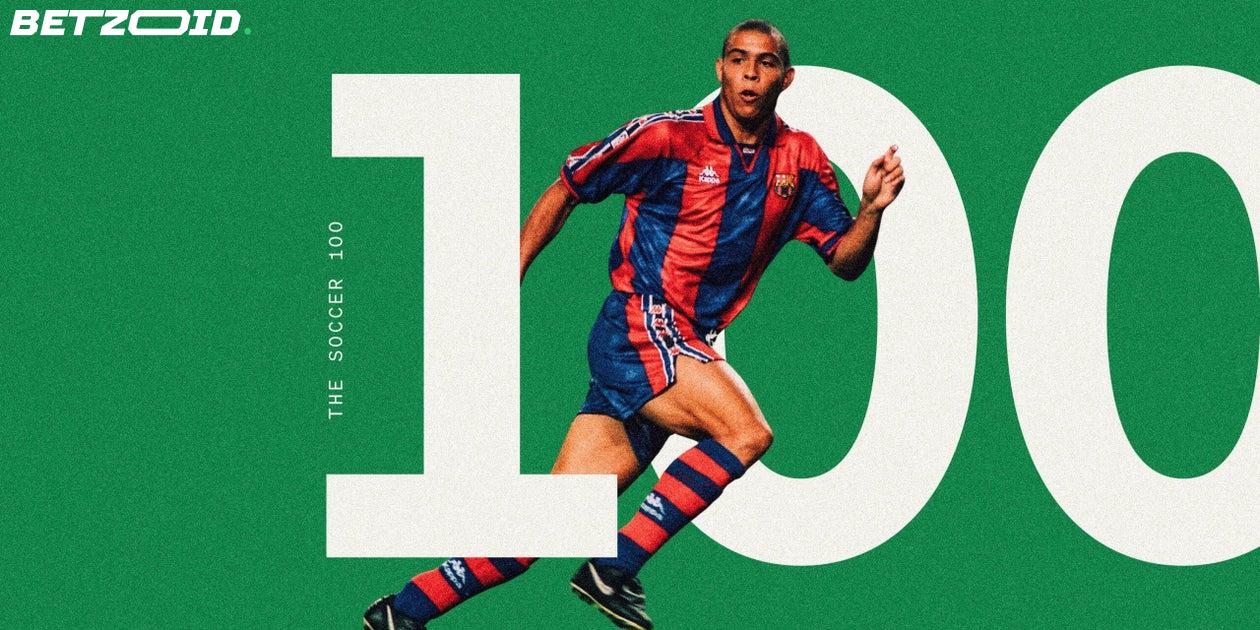
"I've never seen anything like Ronaldo." That's Óscar García — a man who worked daily alongside Lionel Messi at his absolute best. Let that settle for a moment.
The Soccer 100, The Athletic's definitive ranking of football's greatest players, has been excerpting chapters ahead of the 2026 World Cup. And when it gets to Ronaldo — the real one, R9 — the focus lands squarely on that single season at Barcelona. One year in Catalonia. Forty-seven goals in forty-nine games. The most dominant individual season a centre-forward has ever produced, by almost any measure.
The goal that made the world stop
Bobby Robson fought for him. Barcelona president Núñez was uncertain about paying $20 million for a 20-year-old with a dodgy knee and only PSV on his CV. Robson told him to do it anyway, knowing full well his job was on the line. "Bobby, you know your job depends on this?" Núñez reportedly warned him, finger wagging.
It took five minutes of Ronaldo's debut — a Spanish Super Cup tie against Atlético Madrid — for anyone watching to understand what had just arrived in Spain.
Then came October 12, 1996, and Compostela. A goal so absurd that describing it almost undersells it. Two defenders collide before he even touches the ball. A midfielder grabs a fistful of his jersey and it does absolutely nothing. He accelerates, gets into the area on a tight angle, his feet become a blur — the ball whipping back and forth faster than the eye can track — and then he sweeps it into the corner. Robson leapt off the bench and clasped his hands to his head like a man witnessing something he couldn't rationally explain. "Can anybody, anywhere, show me a better player?" he asked the press afterwards.
Nobody could.
The knee that changed everything
Here's the cruel context behind that Barcelona season: Ronaldo was already broken, just not visibly yet. He had Osgood-Schlatter disease. He had trochlear dysplasia — a condition causing his kneecap to, as his specialist described it, "dance on the femur." Both conditions were worsened by exactly what made him terrifying: twisting and turning at full speed. Neither could be fixed surgically. They just had to be monitored and hoped about.
Those trips back to Brazil that irritated Barça fans? He was seeing a knee specialist named Nilton Petrone, not partying — though the Rio Carnival photos didn't help his case with the supporters.
In November 1999, at Inter, his knee gave way against Lecce. That was bad. Six months later against Lazio, returning from injury, his foot planted in the turf and the rest of his body kept moving. His kneecap tendon tore completely. The kneecap, according to Petrone, "actually exploded and ended up in the middle of his thigh." He was 23 years old.
He was never quite the same player again. The pace dropped a few clicks. The explosiveness dulled. What's extraordinary — and this is the number that matters for any historical argument about his greatness — is that a diminished Ronaldo still scored twice in a World Cup final in 2002 and finished as the tournament's top scorer with eight goals. He finished the season at Barcelona with a Ballon d'Or, the youngest player ever to win it at the time, and a UEFA Cup Winners' Cup goal in the final against PSG. He left for Inter that summer having reneged on a nine-year contract extension, making himself deeply unpopular on his way out the door.
The author's question is worth sitting with: would Ronaldo be considered an all-time great if his career had stopped in 1999, before the World Cup, before Real Madrid, before the hat-trick against Manchester United? Probably not. The later years, even at reduced capacity, gave us enough to triangulate just how good the earlier version had been.
But that Barcelona season alone — 47 goals, a Cup Winners' Cup, and footage of that Compostela goal that still doesn't look real — makes the argument for him almost without needing anything else.
"He did things I'd never seen before," said Luis Enrique. "We're now used to seeing Messi dribble past six players, but not then."
Not then. And honestly, not quite since.