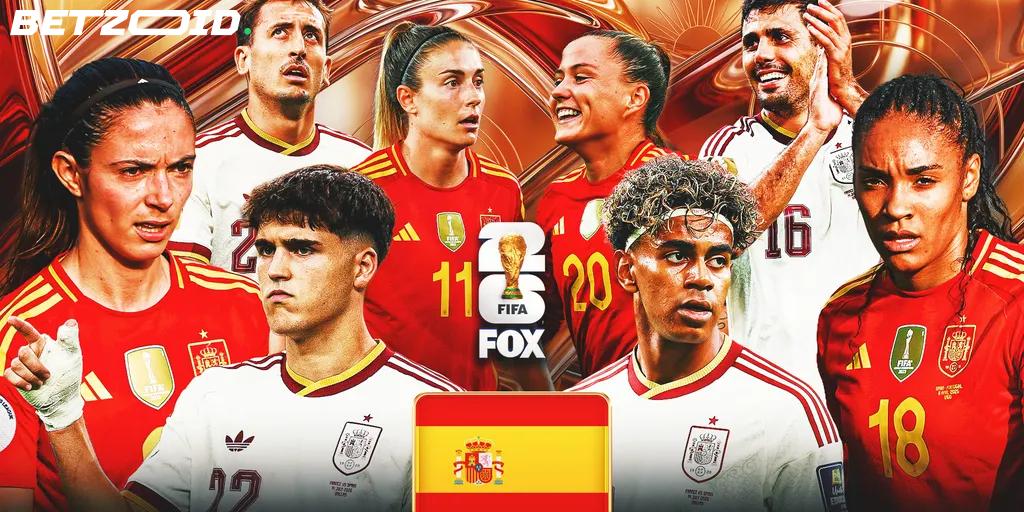
"This is the only country that starts a philosophy and an identity at a young age, and they're all doing the same things from 9 years old and up, both the men's and women's side." Carli Lloyd said that. She played against Spain, watched them evolve, and she's right — and the numbers back her up.
Spain's men are in the World Cup final. The women won the 2023 World Cup and the 2025 Euros. Barcelona, the club that essentially functions as the women's national team's spine, has won three of the last four Women's Champions League titles. No nation has ever simultaneously held the men's and women's World Cup trophies. Spain is one result away from making that history.
La Masia: the machine behind the movement
The foundation is La Masia, Barcelona's academy, which has been producing elite footballers for decades. Nine of the players on the field in this World Cup final came through it — Messi for Argentina, and Lamine Yamal, Gavi, Pau Cubarsí, Dani Olmo, Alejandro Grimaldo, Marc Cucurella, Víctor Muñoz for Spain. La Masia only opened its doors to women residents in 2021, and it's already shaped Aitana Bonmatí (three Ballon d'Or wins), Alexia Putellas (two), Clàudia Pina, and Ona Batlle.
That's not coincidence. That's infrastructure.
The consistency extends to coaches too. Luis de la Fuente spent nearly a decade winning with Spain's U-19, U-21, and U-23 sides before taking the senior job in 2022. The philosophy doesn't reset when a new manager walks in — it compounds.
Lloyd put it plainly: "There is something to be said for even the coaches being educated on that philosophy and that identity and working themselves from youth levels on up. I just don't know anywhere else in the world if that could be replicated."
What Spain actually looks like on a pitch
The style has evolved. This isn't the possession-for-possession's-sake Spain of the late 2000s. De la Fuente's men are more vertical, more clinical, and willing to hurt you on the counter. Their semifinal against France was the clearest example — Pedro Porro and Dani Olmo's quick combination for the second goal was the kind of move that doesn't get coached in a single training camp. It's years of shared language between players who grew up in the same system.
"They'll kill you with 1,000 passes in possession," Lloyd said. "Their movement is not really about being in sync. It's about where the next one or two passes should be, and they all know what to do."
De la Fuente credited the academies directly after beating France: "That's the fruits of our labor in the academies — all the coaches in Spain, we really value what we're doing at that level."
- Spain women won the 2023 World Cup and 2025 Euros
- Barcelona won 3 of the last 4 Women's Champions League titles
- 20 of Spain's 26 World Cup men's squad players were part of the Euro or Olympic-winning squads
- Nine La Masia alumni feature in this World Cup final
If the men win this final and the women defend their World Cup title in Brazil in 2027, the word "dynasty" stops being premature. Spain's betting odds across every major tournament reflect a program that doesn't rebuild — it reloads. That's what a unified philosophy from age nine looks like when it matures.
Germany's men and women have each won two World Cups, but never at the same time. Nobody has. Spain is about to find out if they can be the first.