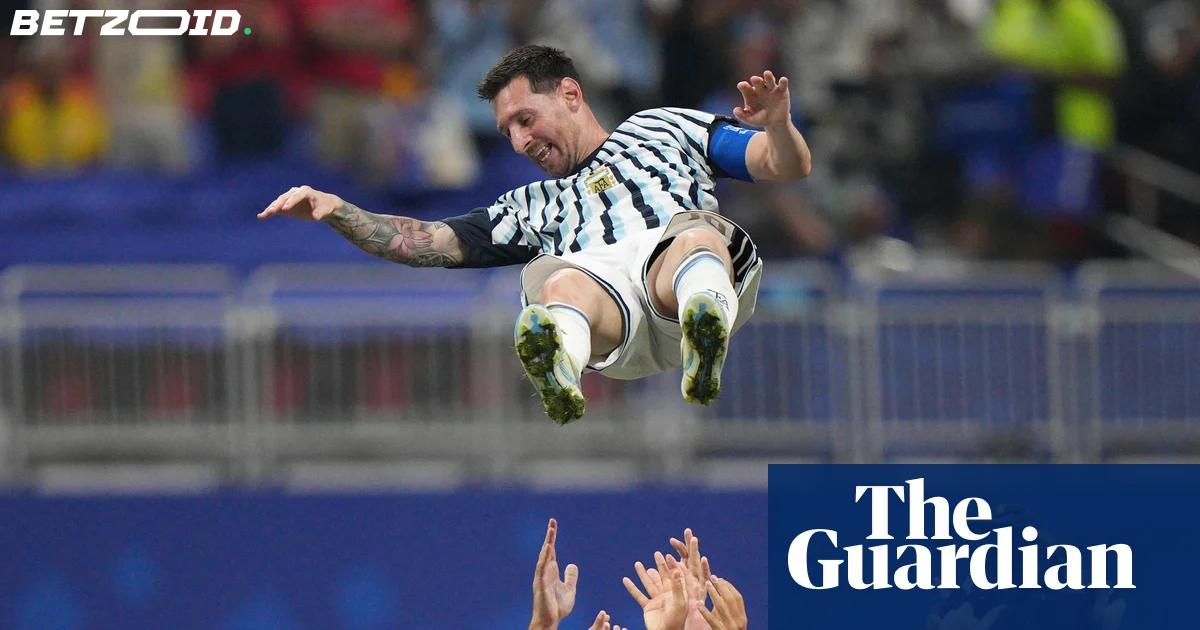
Six weeks. That's how long Lionel Messi was a retired Argentina international. Then he came back, and spent the next decade dismantling every narrative that had been built around him.
The night he walked away in June 2016 is easy to remember. Same venue that hosted this year's World Cup final — East Rutherford, New Jersey — same result. Argentina lost. Messi missed his penalty in the shootout. It was the third consecutive major final they'd lost, following the 2014 World Cup and the 2015 Copa América. The jeers from the crowd were real. The tears were real. He was 29, already arguably the best player who ever lived, and the one thing that seemed to define him internationally was silver medals.
Then he came back. And everything changed.
The numbers that make the second act staggering
After unretiring in August 2016 — framing it as necessity with Argentina struggling in World Cup qualifying — Messi played 95 more caps and scored 70 more goals with 31 assists. For context: Miroslav Klose scored 71 goals across his entire 137-cap Germany career. Luis Suárez needed 143 Uruguay appearances to reach 69. Pelé scored 77 goals in 92 caps total before retiring at 31. Messi matched or topped all of them in what was essentially the back half of an international career most thought was over.
Only 23 men in history have scored 70 or more goals across a full international career. Messi did it after his first retirement.
The trophies followed. His first-act cabinet already held five Ballon d'Ors, a U20 World Cup, an Olympic gold, and a World Cup Golden Ball. His second act added three more Ballon d'Ors, a World Cup, two Copa Américas, a Finalissima, and another World Cup Golden Ball. It's the kind of haul that makes you re-read the list twice.
From villain to the man they wept for
The transformation wasn't only statistical. A decade ago at the same New Jersey stadium, crowds jeered him after a shootout miss. This July, after Argentina lost the World Cup final, they wept with him. That shift — from scapegoat to national saint — is as significant as any trophy.
For years Messi lived in Diego Maradona's shadow domestically, his club brilliance treated almost as a foreign currency that didn't exchange well on Argentine soil. Every major tournament exit tightened that narrative. His return, and what followed, didn't just loosen it — it burned the whole thing down.
"My love for my country and this shirt is too great," he said when he reversed his retirement in August 2016. That line reads differently now. At the time it felt like a reluctant obligation. In hindsight, it was the opening sentence of the sport's greatest second chapter.
Messi retired from international football at 29 already carrying the weight of being the best player alive. He came back, played almost entirely through his 30s, and built a body of work that doesn't just hold up against any player in history — it's genuinely better than most of their entire careers.