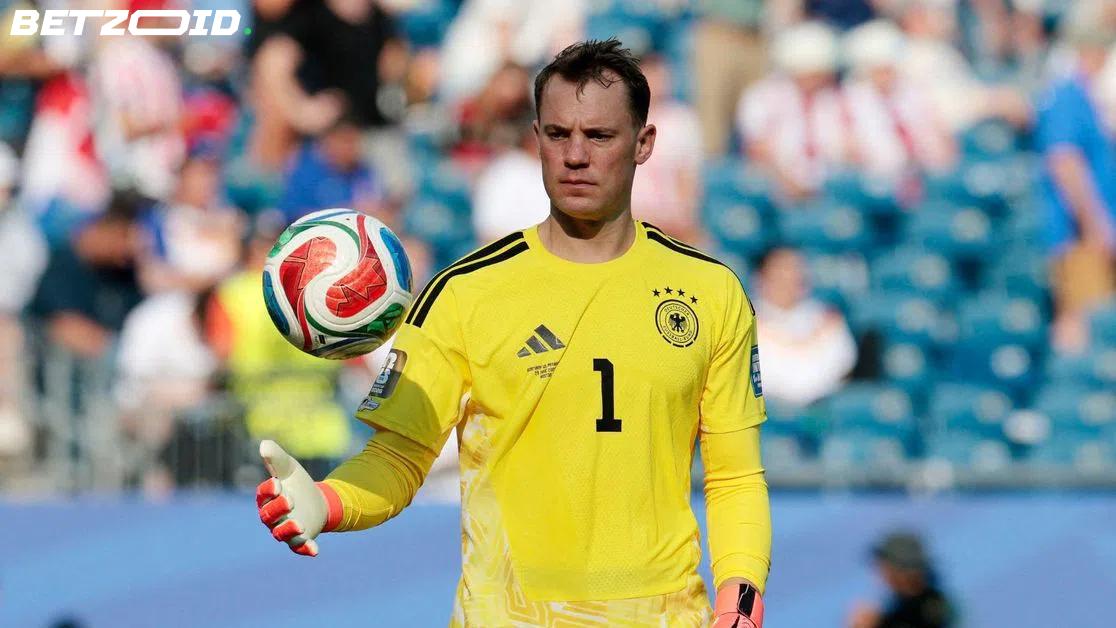
Germany lost to Paraguay on penalties at the 2026 World Cup. For the national team, it was another early exit. For Manuel Neuer, it was the final curtain — the 40-year-old confirming afterward that his international career had come to an end, for real this time.
He'd actually retired once before, only to reverse that decision weeks before the tournament when Julian Nagelsmann recalled him for experience. Instead, Germany crashed out in the Round of 32. That's not the ending anyone scripted, but it's the one they got.
The CV still reads well: 128 caps, a 2014 World Cup winner's medal, the Golden Glove from that same tournament, a Ballon d'Or third-place finish in an era completely owned by Messi and Ronaldo. For a goalkeeper to even appear on that shortlist tells you something about the scale of what he was doing.
The goalkeeper who made the position unrecognisable
Neuer's actual legacy isn't a trophy cabinet — it's a tactical shift that changed how coaches recruit, how defenders set their lines, and what clubs now demand from goalkeepers at every level of the game.
The Germany vs Algeria match at the 2014 World Cup remains the clearest exhibit. With Germany's defence pushed close to halfway, Algeria kept threading balls in behind. Neuer didn't wait. He charged out of his area, intercepted danger before it became chances, and operated more like a libero than a goalkeeper. Germany won 2-1 after extra time. The term "sweeper-keeper" went from tactical curiosity to mainstream expectation almost overnight.
Before Neuer, even the all-time greats — Yashin, Buffon, Casillas, Kahn — were judged almost entirely on shot-stopping, positioning, and penalty area command. Distribution was a bonus. Neuer made it a baseline requirement. He pushed his defensive line higher by eliminating the space behind it himself, which gave coaches the freedom to press more aggressively. The goalkeeper had effectively become an eleventh outfield player.
That blueprint is now standard. Ederson, Alisson, ter Stegen, Maignan, Diogo Costa — all are expected to receive under pressure, recycle possession, and initiate attacks from the back. None of that was normal two decades ago. All of it traces back to Neuer.
What comes next — for him and everyone else
His international career is finished, but his club career isn't. Neuer signed a one-year extension with Bayern Munich earlier this year, keeping him at the club until 2027. Jonas Urbig and Germany's younger options will inherit the international shirt. Bayern will hold onto their 40-year-old for one more season.
At club level, his record is similarly hard to argue with: 13 Bundesliga titles, two Champions League crowns, multiple DFB-Pokal wins, the Bundesliga's all-time clean sheet record. He arrived at Bayern from Schalke in 2011 — one of the most scrutinised goalkeeper transfers in German football history — and became the cornerstone of everything that followed.
The 2026 World Cup exit stings. Germany's record in penalty shootouts has long been a point of national pride — this was actually their first World Cup shootout defeat. That it came in the round of 32, with a recalled 40-year-old in goal, raises questions the DFB will be answering for some time.
But Neuer's reputation doesn't rest on Paraguay. Every young goalkeeper being coached to step outside their area, every pressing system designed around a ball-playing keeper, every recruitment spreadsheet that includes pass completion alongside saves — that's the world Neuer built. He just happened to play his last game in it too.