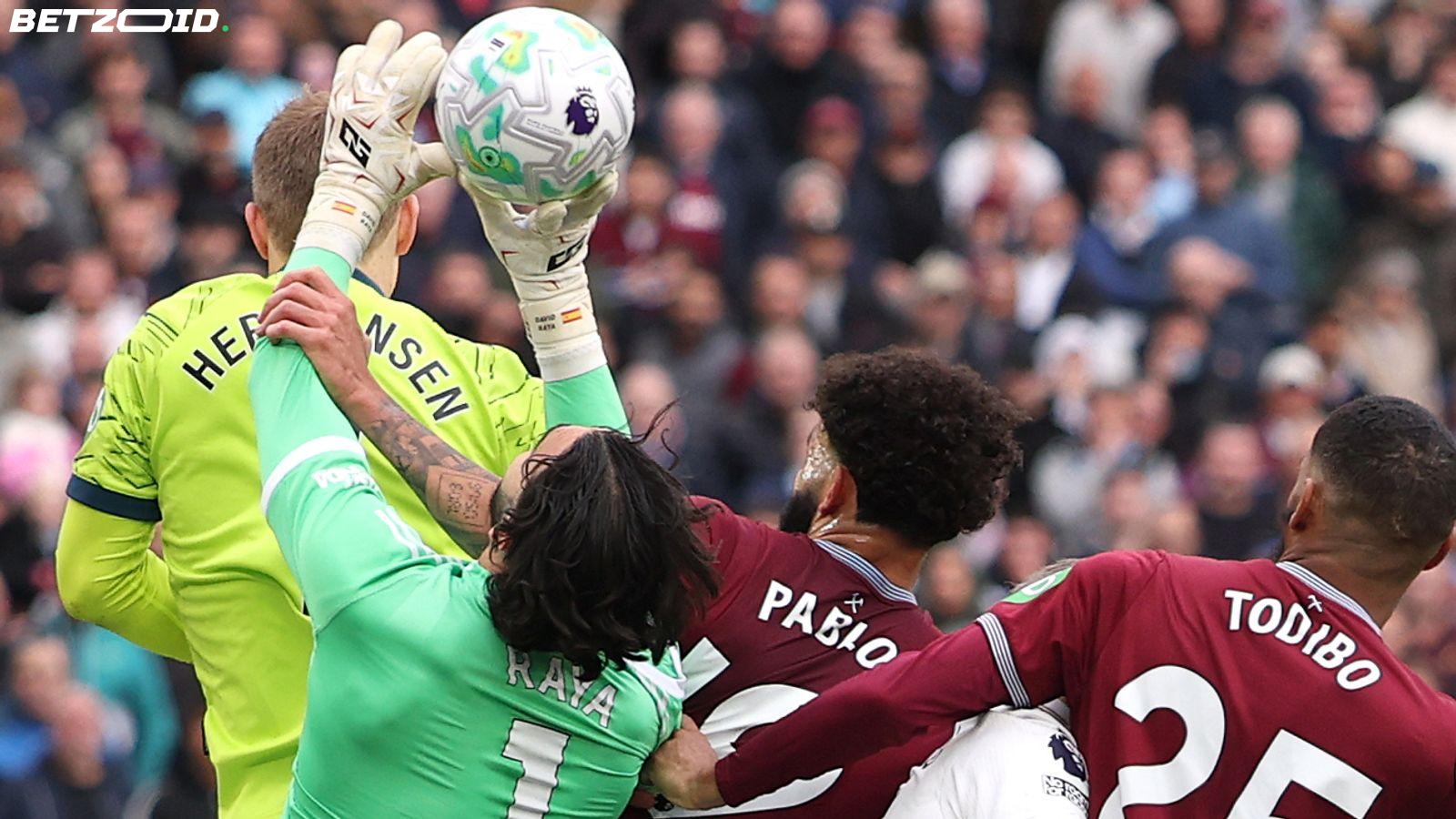
Roy Keane said it best: "Don't make it such an obvious foul." The irony is that it apparently wasn't obvious enough for anyone on the pitch to call it in real time — and that's the Premier League's problem in one sentence.
West Ham had a 95th-minute equaliser against Arsenal ruled out on Sunday after VAR Darren England sent referee Chris Kavanagh to the monitor to review a foul by Pablo on Raya. The check took four minutes and 17 seconds. Kavanagh watched 17 replays. Gary Neville needed two replays and under a minute to reach the same conclusion from a studio sofa.
The decision itself was correct — the process was a mess
Let's be clear: the call was right. Pablo had his arm fully extended across Raya, blocking him from attacking the ball. Jean-Clair Todibo was simultaneously pulling the goalkeeper's shirt. Dermot Gallagher explained the sequence correctly on Ref Watch — the foul on Raya came first, Rice's challenge on Mavropanos came after, and you have to rule in chronological order. West Ham's contact to PGMO requesting further explanation is unlikely to get far.
But West Ham have a legitimate grievance about something else entirely. Their argument — that this wasn't "clear and obvious" given how long it took — touches on a genuine inconsistency in how the standard is applied. If a decision requires 17 replays and four-plus minutes of deliberation, the bar for "clear and obvious" starts to look elastic.
Former referee Mike Dean didn't mince words: "I'm just annoyed that the guys are not making decisions. They are just not making on-field decisions." He's right. The on-field officials should have blown for this foul in real time. The fact they didn't — and that VAR had to rescue the situation — is the deeper failure here.
Grappling in the box has become a structured tactic
What Sunday really exposed is that penalty-area wrestling has become systematic in the Premier League. It's not incidental contact — players are coached to obstruct and hold at set pieces because the risk of punishment is low.
PGMO chief Howard Webb announced a "measured crackdown" on holding back in August. The threshold guidance states a penalty should only be given if the foul is "clear, impactful and sustained" — and if just one of those three factors is missing, no penalty. Through last month, only seven penalties had been awarded all season for holding or grappling. Seven.
The Premier League's own survey data tells you why Webb hasn't pushed harder. Clubs and stakeholders have consistently prioritised:
- A high threshold for handball decisions
- Minimal VAR intervention
- Tolerance for physical contact
The physicality of English football is a genuine selling point. But there's a difference between a physical league and one where shirt-pulling at corners goes unpunished by design. The current guidance essentially protects the tactic.
For betting markets, this matters more than it might seem. Corners and set-piece situations are major pricing inputs — if the enforcement of fouls in these moments is this inconsistent, the outcomes become harder to model. West Ham are in a relegation battle where a dropped point here could define their season. Arsenal could find themselves in a title race where a gifted equaliser would have changed the picture entirely. The stakes on Sunday were as high as it gets.
Gallagher called it "probably the most impactful decision VAR has made in the seven years it has been going." He might be right. And the league still doesn't have a coherent answer for how to stop it happening again.