"You can just see that it's not a normal game for them. There's a certain amount of desperation in the way they play. They have to be successful, and you can sense it." That's Colin Bell, a former South Korea women's national team manager, watching North Korea's youth sides operate. It's the most honest summary of what makes this programme different — and it cuts through all the state-media noise.
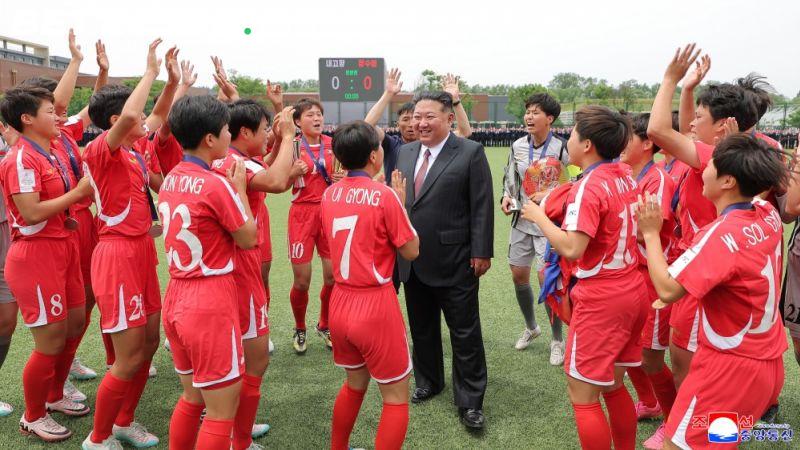
Let's set the scene. Pyongyang-based Naegohyang Women's FC just won the AFC Women's Champions League, beating Tokyo Verdy Beleza 1-0 in the final — played, pointedly, on South Korean soil. North Korea also hold the U-17 and U-20 women's world titles. The U-17s just added an Asian Cup to that haul, dismantling Japan 5-1 in the final. Kim Jong Un personally received the players, state media declared them "proud daughters of the motherland," and the whole country celebrated on cue.
The Women's World Cup in Brazil is next. And the question being asked more seriously now than at any point in the last decade is: can the senior team do what the youth sides have been doing to everyone else?
What actually explains the results
The infrastructure starts young. The Pyongyang International Football School, founded in 2013, takes girls and boys from age seven through to 17. The system is rigid, deliberate, and relentless. Captain Kim Kyong Yong — named MVP of this year's Champions League at 24 — began playing at 10 and has barely stopped since.
British coach Stephen Constantine, one of the few FIFA instructors allowed into the country in 2018, described training methods that raised eyebrows: players doing piggyback sprints from the goal line to the 18-yard box and back. "It was insane," he said. The physicality isn't incidental — it's the foundation everything else is built on.
But it's not just fitness. Rielly Chesna, a defender whose Ho Chi Minh City side lost to Naegohyang in the quarter-finals, put it plainly: "You could tell they know exactly where they're supposed to go, and they just flowed. Their passing on the ground and movement was perfect. It was definitely hard to track them."
Bell's assessment lines up: "It's drill, drill, drill from a very early age, and you just cannot compete with them at youth level." Every player runs the same way. The choreography isn't accidental — it's the product of a system that tolerates nothing less.
The senior team is a different puzzle
North Korea's recent history at senior level is messier. Five players failed doping tests at the 2011 World Cup — attributed, unusually, to traditional Chinese medicine involving deer musk glands after a lightning strike. They were banned from the next World Cup cycle. They withdrew from the 2019 East Asian Championship without explanation. They skipped the 2023 World Cup entirely, citing COVID.
The 2025 return has been encouraging. A new head coach, nearly half the squad refreshed, and a quarter-final appearance at the Women's Asian Cup where Australia's coach Joe Montemurro described them as "the best team in the tournament." They lost, but narrowly — and they've since qualified for Brazil.
The pipeline is clearly working. Several players making their senior debuts at the Asian Cup came straight from the youth system that's been winning everything in sight. Kim Kyong Yong is the most visible example, but she won't be the last.
Whether that translates at a World Cup is a different matter. Facing Brazil on home soil, the United States, or any of Europe's elite is not the same as dominating Asian age-group football. Bell is honest about it: "Are they able at some stage to dominate senior national football? I'm not sure if they can."
Freelance journalist Gina Bagnulo thinks they'll take points in the group stage, at minimum. That's a reasonable floor — and given where this programme was four years ago, it's a real statement of progress. North Korea as a credible World Cup dark horse shifts the tournament's calculus slightly, particularly in group-stage betting markets where an undervalued side with serious physical and tactical discipline can do damage.
The desperation Bell described isn't going anywhere. For girls in a country where sport is one of the few ladders available, winning isn't a goal. It's the only option.