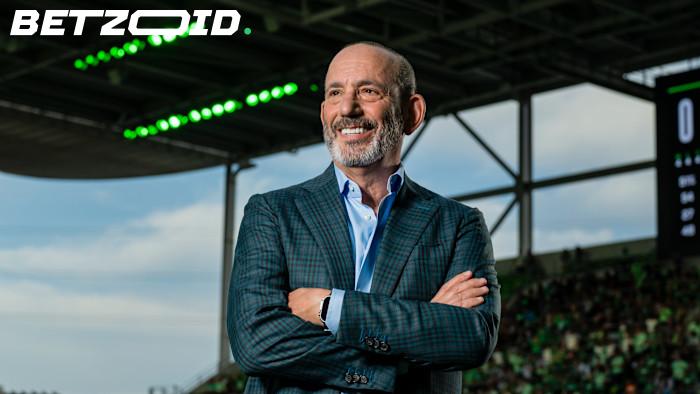
Over 50 million Americans watched the US get knocked out by Belgium 4-1. That's not a consolation prize — that's the most-watched soccer game in US television history, and Don Garber knows exactly what to do with it.
The MLS commissioner is calling the United States the "golden market for soccer globally," and after a World Cup that delivered record viewership, unprecedented revenues, and sell-out atmospheres from coast to coast, it's hard to argue otherwise. Several group stage matches drew viewing figures comparable to NFL games. That's the benchmark American sports executives spend decades chasing.
MLS is betting everything on this moment
The league has launched its biggest-ever marketing campaign — "Thanks World, We'll Take It From Here" — featuring Lionel Messi and David Beckham, timed to the MLS season resuming July 16. The pitch is simple: you just discovered you love football, now come watch it every week at your local stadium.
Whether it converts is the real question. European football has never been more accessible to American audiences, and Erling Haaland — a genuine World Cup phenomenon in the US — could drag his new fanbase straight back to Manchester City on NBC. Garber's answer to that? He's not bothered. Watch City in the morning, catch NYCFC in the evening. Both owned by the same group. Everyone wins.
It's a clever framing, though it sidesteps the harder truth: MLS still can't compete with Europe's top leagues on the pitch, and the perception of it as a final destination for ageing stars isn't going away anytime soon. Robert Lewandowski, 37, just signed for Chicago. Antoine Griezmann, 35, is headed to Orlando. Good players. Not exactly signals of a league ascending.
The structural work is real, even if the results take time
Garber has been building toward this moment for 25 years. Under his watch, MLS has grown from 10 to 30 clubs, constructed 26 football-specific stadiums, and secured an all-in streaming deal with Apple that made it the first sports league to put every game on one platform. Club owners have poured over $11 billion into football infrastructure across North America — the same infrastructure that hosted 12 national teams during this World Cup.
The league is also shifting to a summer-to-spring calendar from 2027, aligning with the global football schedule and making player recruitment from Europe significantly more practical. Private equity firm KKR has taken a stake in MLS Next Pro, the reserve league, with plans to expand into more than 100 US and Canadian cities that currently have no professional club. The pipeline is being built.
The youth development problem, though, is structural in a different way. Pay-to-play culture has locked the sport behind a financial wall, concentrating talent in affluent suburbs and cutting off entire communities. Garber acknowledges it directly — "more access for more players" and solving pay-to-play are his words — but he also admits that development model changes "take a generation to deliver." That's honest. It's also a reminder that the US men's team's ceiling won't be tested by marketing campaigns or streaming deals.
"This is the golden market for soccer globally," Garber said. FIFA's attendance and revenue figures from this summer suggest he's right about the appetite. Whether MLS can hold onto it once the World Cup glow fades is the bet worth watching.