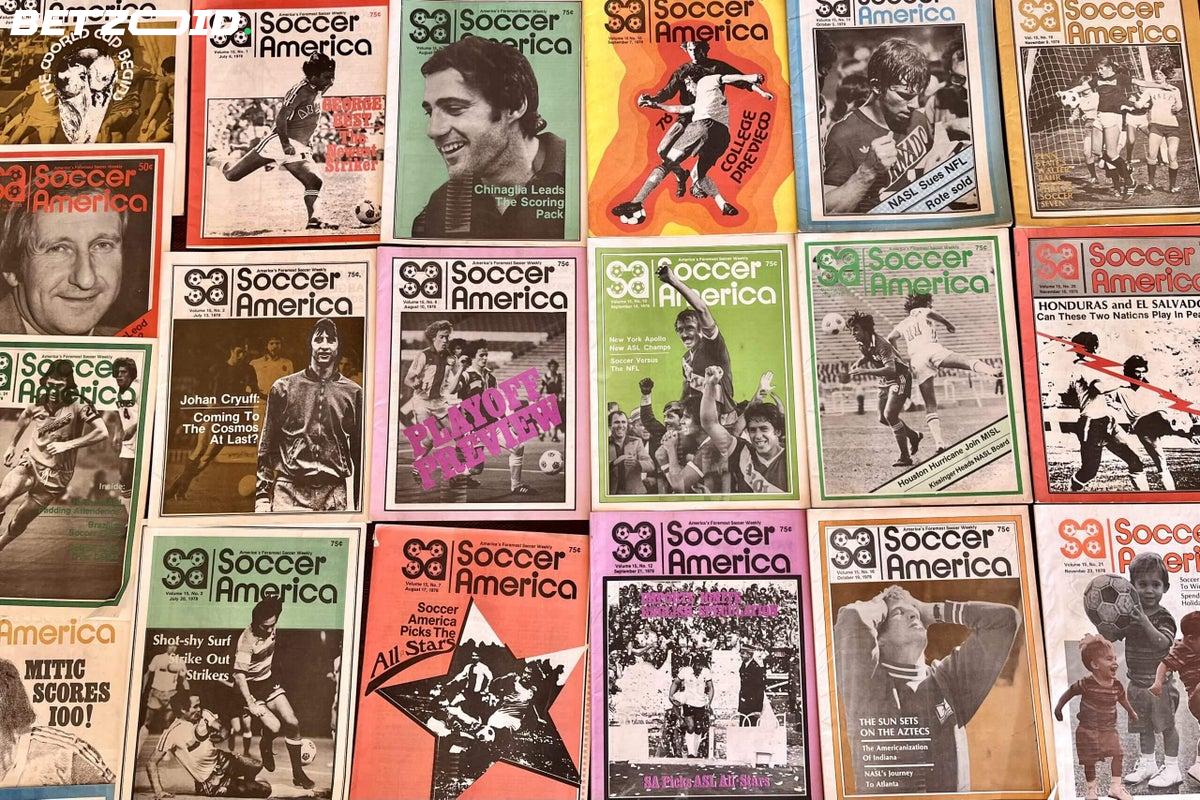
"Let's not kid ourselves!" Clay Berling typed on the first page of Soccer West's first ever issue in April 1971. "Soccer is hardly a household word in the United States at this time." Fifty-five years later, the U.S. is hosting a World Cup projected to generate $11 billion in revenue. That's the whole story, really — except the journey between those two points is where it gets interesting.
Berling was a State Farm insurance agent from Albany, California. Father of six. No soccer background whatsoever. He stumbled into the sport through a cheap family ticket deal to Oakland Clippers games, fell completely in love, and started typing up a biweekly newsletter because he couldn't find anyone else covering it. He never took a salary. He laid out issues on his kitchen table, in his insurance office, in a rented Sunday school room. Soccer West became Soccer America, which became the definitive U.S. authority on the game for decades.
The NASL planted the seed — then pulled it up too soon
In 1971, American professional soccer was one struggling league of eight clubs averaging around 4,000 fans per match. Then Pelé arrived in 1975, and suddenly the New York Cosmos owned Manhattan. Average NASL attendance quadrupled through the decade. The league tripled in size. It felt like a revolution.
It wasn't. The NASL paid twice the market rate to import global stars and pennies to everyone else. It had no homegrown pipeline, no sustainable structure, and a desperate habit of Americanizing the sport with cheerleaders, live animals, and rule changes that horrified purists. When the novelty wore off, the league collapsed in 1984.
But it mattered anyway. The foreign pros who came over didn't just play — they ran clinics, visited schools, coached youth camps. "The players and coaches who stayed on in the small league, the Ron Newmans and Gordon Bradleys, would spend their weekdays going from school to school doing show-and-tell soccer sessions," Soccer America editor-in-chief Paul Kennedy recalls. "They were hugely important." Millions of kids picked up the sport throughout the 1970s and 80s. The Olympic Development Program launched in 1977. College programs multiplied. A generation of genuinely good American players started to emerge.
On the women's side, they became 1991 world champions. On the men's side, Paul Caliguiri's dipping half-volley in Trinidad in 1989 sent the USMNT to their first World Cup in 40 years. Lynn Berling-Manuel, Clay's eldest daughter and longtime Soccer America CEO, watched it on TV and sat there crying. "That was the gamechanger," she says.
1994 changed the commercial picture permanently
FIFA had already seen the opportunity at the 1984 Los Angeles Olympics and awarded the U.S. the 1994 World Cup — despite the country not even having a professional league at the time. The doubters were loud. The tournament silenced them. Nine host cities filled with flags and face paint and genuine fever. Reporter Mike Woitalla walked laps around stadium concourses before every match and saw parents, kids, immigrants, lifelong Americans, all there for the same sport. "There's so many people here interested in soccer," he says. The numbers backed him up.
MLS launched two years later, in 1996, with 10 teams and serious money behind it. Woitalla sat in the stands at Spartan Stadium for the inaugural match among 31,000 fans rather than in the press box, because he'd been waiting his whole career for this. Kennedy cried when Colombian star Carlos Valderrama was introduced. "It just touched me — that this was real," he says.
Then the slog began. Interest faded. Teams folded. In the early 2000s, the remaining owners met at Philip Anschutz's Colorado ranch and seriously considered shutting the whole thing down. Instead, they doubled down — built soccer-specific stadiums, youth academies, reserve teams. MLS now has 30 clubs and has averaged over 21,000 fans per game for more than a decade. The model works.
The complication is the internet. MLS built itself in the era when American fans could suddenly watch the Premier League, Champions League, La Liga, and Liga MX on demand. It was never going to have the NASL's accidental monopoly on accessible soccer. That's changed the competitive landscape for eyeballs permanently — and it's a big reason the 2026 World Cup arrives not as a growth catalyst, like 1994, but as a full commercial harvest. FIFA expects $3 billion from tickets and hospitality alone. America is, as MLS commissioner Don Garber put it, "the ATM for the soccer world."
Kennedy, now 71, still stays up past 3 a.m. filing coverage. He was up past 6 a.m. one recent Saturday when he finally just grabbed his phone, opened the NBC Sports app, and watched Bournemouth — featuring Tyler Adams, raised an hour from where Kennedy grew up — beat Arsenal. Within seconds. From bed. "The sport is so easily accessible to watch," he says, with something between wonder and exhaustion.
Soccer America helped build the pipeline that made that moment possible. Clay Berling, who died in 2017 at 86, never lived to see 2026. His daughter thinks he would have loved it. "It's still unformed in many ways," Kennedy says of American soccer, "and it might not get to where we would like. But that doesn't mean it isn't amazing."