The 2026 World Cup was always going to be more than football. The first 48-team edition, stretched across three countries and tangled in geopolitical complications, has delivered exactly that — and the tournament is barely underway.
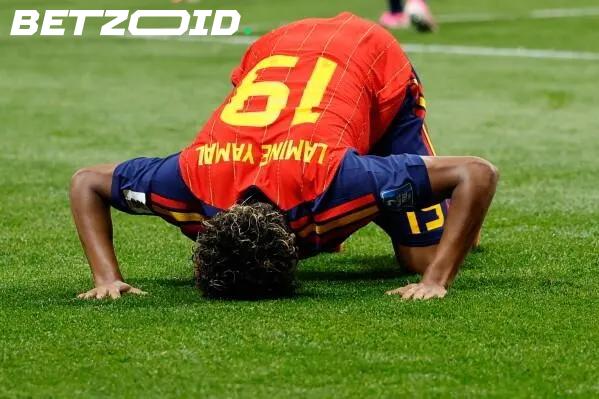
Yamal's sujood heard around the world
Spain's Lamine Yamal scored the opening goal against Saudi Arabia on June 21 — ending a 299-minute World Cup scoring drought — and immediately dropped to the turf in sujood, the Islamic prostration of gratitude. The image went everywhere within minutes.
He's 18 years old. He's the second player that age or younger to open the scoring in a World Cup match, the first since Pelé in 1958. Those are the football facts. But the moment was about something else.
Yamal, whose father is Moroccan, arrived at this tournament wearing boots bearing the flags of Morocco and Equatorial Guinea — his parents' heritages — which sparked a nationalist backlash in Spain's right-wing press. Months earlier, after anti-Muslim chants at a Spain vs. Egypt friendly, he posted on Instagram: "I am a Muslim, thank God... using religion as something to mock people in a football stadium leaves you as ignorant and racist people." The celebration on the biggest stage in football wasn't spontaneous emotion dressed up as meaning. It was consistent with everything he'd already said.
For Spain's tournament odds, the real news is simpler: their 18-year-old is healthy, scoring, and evidently unbothered by pressure. The drought is over.
The "Vinícius Law" gets its first red card
Paraguay's Miguel Almirón became the first player ever sent off for covering his mouth during an altercation, dismissed in the Group D match against Türkiye on June 20. He covered his mouth while speaking to right back Mert Müldür after a foul. Müldür appealed. Referee Ivan Barton went to video review and showed red.
The rule traces directly to a Champions League knockout playoff in February between Benfica and Real Madrid. Benfica winger Gianluca Prestianni pulled his shirt over his mouth while speaking to Vinícius Júnior. Vinícius reported it, play stopped for ten minutes under UEFA's racist abuse protocol, and because Prestianni had covered his mouth, there was no evidence to act on — though he was still sanctioned for discriminatory conduct. FIFA proposed the rule change shortly after. IFAB ratified it unanimously ahead of the World Cup.
Gianni Infantino's framing was blunt: "If you do not have something to hide, you don't hide your mouth when you say something." Paraguay coach Gustavo Alfaro accepted the decision but pushed back on the logic: "The fear I have is that football loses its essence. In football, there's frictions, fights, clashes."
He's not entirely wrong. But Almirón's red card is now the case study this rule will be taught through for years.
Vozinha: 56,000 followers to 14 million in one night
On June 15, Cape Verde goalkeeper Vozinha had roughly 56,000 Instagram followers. By the time he went to sleep, he had 14 million — more than Travis Kelce, Patrick Mahomes, and Victor Wembanyama.
He's 40 years old. He started playing professionally at 25. His career has passed through Portugal, Moldova, Angola, Cyprus, and Slovakia. His one trophy: the 2018-19 Cypriot Cup with AEL Limassol. None of that prepared anyone for what he did against Spain — the second-ranked team in the world — making seven saves, denying 27 shots, and keeping the European champions to a 0-0 draw in Cape Verde's first-ever World Cup match.
Brazilian broadcaster CazéTV encouraged its viewers to follow him during the match. The response was immediate. A million new followers arrived within minutes of the final whistle.
After the match — named Man of the Match — he explained why he'd been in tears on the pitch: "I cried because I grew up with my grandparents and unfortunately they were not here; they died a few years ago. I also cried because my mum didn't manage to be here because of the visa. Because of the money we had to pay for the visa, we didn't manage [to get it done] on time."
Spain's odds took a hit. Cape Verde's story took off.
Algeria and Lawrence, Kansas
Nobody could have scripted this. The Algerian national team — Les Fennecs — based themselves in Lawrence, Kansas, home of the University of Kansas Jayhawks, and the city embraced them completely. Fans waited out thunderstorms to watch the team arrive after midnight on June 8. Algerian players kicked field goals, threw American footballs at the under-construction Kansas Memorial Stadium, and hit the batting cages at Hoglund Ballpark. Artist Stan Herd created a giant Algerian flag on KU grounds in their honor.
"Rock Chalk Algeria" — a riff on the KU cheer "Rock Chalk Jayhawk" — spread across social media within hours. Mayor Brad Finkeldei put it plainly: "We've embraced them, and they've embraced us."
In a tournament shadowed by visa denials and political tension, the Algeria-Lawrence story has been the thing people needed to see. It felt spontaneous because it was.
Iran's tournament — played at borders as much as on pitches
No situation at this World Cup has been harder to watch. Iran's training base was moved from Tucson, Arizona, to Tijuana, Mexico. Their ticket allocation was revoked days before the tournament. Portions of their coaching and administrative staff were denied visas entirely. Iranian authorities threatened withdrawal multiple times before confirming participation.
All three of Iran's group matches are on U.S. soil. The team is not permitted to stay in the country. Team official Abolfazl Pasandideh confirmed the arrangement directly: "We can enter in the morning and we must leave the same day." After their opening 2-2 draw with New Zealand, the squad was told immediately after the final whistle to board a plane. Captain Mehdi Taremi described five hours of travel and security checks for what is normally a short journey from the Los Angeles area to the border.
Iran's players received their U.S. visas as late as June 5 — ten days before group play began. Coach Amir Ghalenoei didn't dress it up: "I think perhaps our team is the most oppressed team in the whole World Cup."
Mexican President Claudia Sheinbaum offered the sharpest contrast to U.S. policy: "We have no problem. There is no reason to deny them the possibility of staying in Mexico."
One part of the bracket has a college town hanging flags and learning cheers for a country it barely knew existed in football terms. Another part has a national team flying 140 miles home by plane the same night as their matches because they're not permitted to sleep in the country hosting them. The 2026 World Cup contains both of those things simultaneously, and neither cancels the other out.