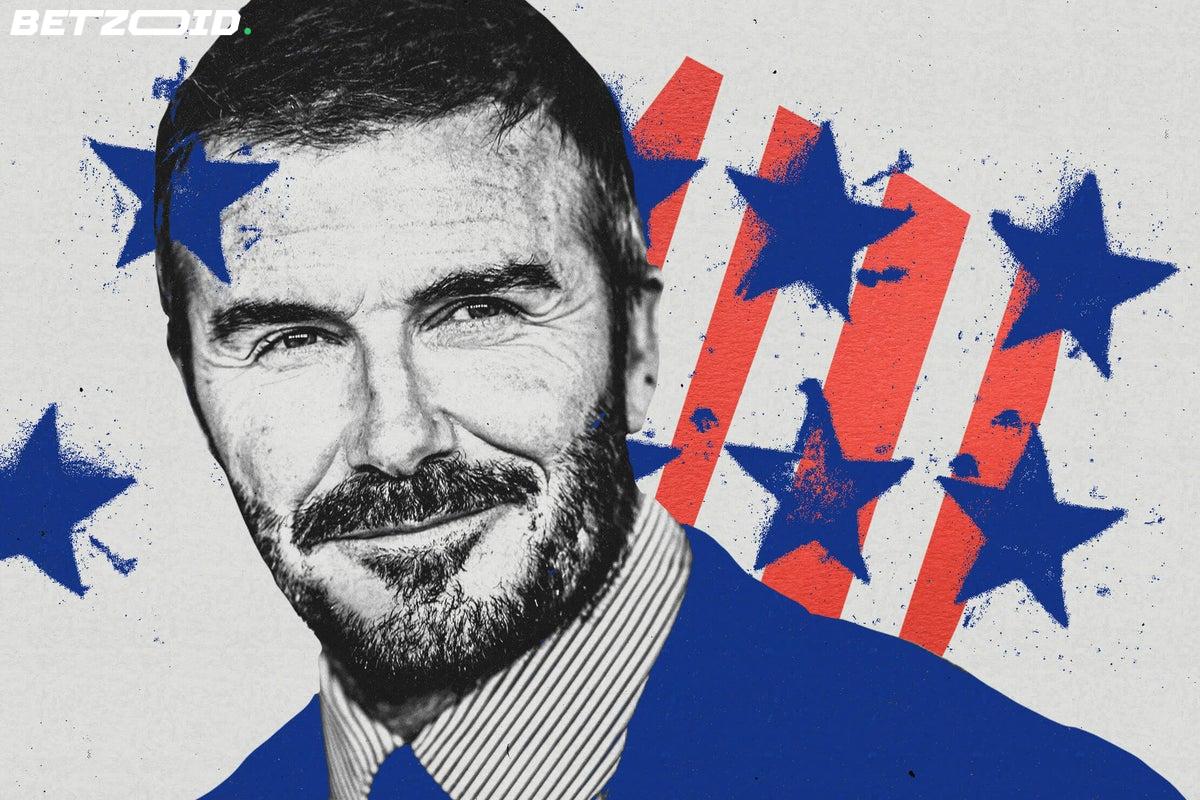
"10 heroic lions, one stupid boy." That was The Mirror's front page after Beckham's red card at the 1998 World Cup in France. Twenty-seven years later, Tom Cruise is introducing him at a Walk of Fame ceremony on Hollywood Boulevard. The trajectory is worth sitting with for a moment.
Beckham is everywhere at this World Cup. Pitchside for the USMNT. In the stands for England. Down in Miami watching Messi and Argentina. Then back in the commercials when the game cuts to break. No other figure — not a current player, not a FIFA suit, not a media personality — occupies the same cultural space at this tournament. He is, genuinely, the face of it.
That doesn't happen by accident, and it doesn't happen just because he was a good footballer.
The long game nobody else was playing
When Beckham left Real Madrid for LA Galaxy in 2007, Madrid president Ramon Calderon's verdict was withering: "David Beckham will be a B-list actor living in Hollywood." Beckham had just helped deliver a La Liga title, then walked straight into what looked like a vanity project in a league nobody took seriously.
What Calderon missed — what most people missed — was that Beckham wasn't making a football decision. He was making a 20-year business and cultural decision, with MLS as the platform. He'd been obsessed with America since watching the NBA as a kid in Leytonstone. The No.23 shirt he chose at Madrid wasn't random — it was a direct reference to Michael Jordan. "He showed that you could be more than just an athlete," Beckham said. He took that lesson seriously in a way almost no European footballer of his generation did.
The Designated Player rule — universally known as the Beckham Rule — arrived two months before he signed for Galaxy. It gave every MLS team one slot for a player earning above the salary cap. That mechanism eventually brought Zlatan, then Messi. The rule exists because Beckham was considered valuable enough to build a structure around.
MLS had 13 teams when he arrived. It now has 30.
Inter Miami, Messi, and the $1.45 billion franchise
The shrewdest part of the Galaxy deal wasn't the contract — it was the clause buried inside it. Beckham negotiated an option to buy an MLS expansion franchise at a fixed price once he retired. That option was $25 million. Sportico now values Inter Miami at $1.45 billion, currently the highest in the league.
Messi's arrival in 2023 wasn't luck. It was the culmination of a deliberate franchise-building strategy, a Miami location chosen for its cultural weight and growth trajectory, and a stadium — finally opened this past Easter after years of legal battles over land — that gave the club a permanent home. "Once Victoria woke up properly, she hugged me, and that's when I got emotional again," Beckham said about the night Messi's signing was announced. He'd been up since 5am in Japan, glasses on, reading the news on his phone.
Now he watches Messi score at a World Cup being played in his adopted country, as co-owner of the club Messi calls home. That's not a coincidence of circumstance. It's the endpoint of a strategy that looked eccentric in 2007 and looks visionary now.
His holding company DRJB posted a $45 million pre-tax profit last year. Revenues hit $92.3 million. Authentic Brands Group — the company behind the commercial rights to Muhammad Ali, Elvis Presley and Marilyn Monroe — approached him for a deal, taking 55 per cent of David Beckham Ventures. Their pitch, delivered by CEO Jamie Salter, was direct: "David Beckham is effectively Mickey Mouse." Harvard Business School agreed it was worth a case study.
- $25m option to buy Inter Miami → franchise now valued at $1.45bn
- MLS expanded from 13 to 30 teams since his Galaxy arrival in 2007
- $92.3m revenue and $45m pre-tax profit reported by DRJB in 2024
- Walk of Fame star presented by Tom Cruise at the start of this World Cup
The commercial picture matters for anyone watching MLS ownership stakes and sponsorship markets. Inter Miami's valuation has made the entire league look like a viable investment — which is exactly why U.S. private equity has piled into European football too. Beckham's success is part of why those bets got made. If Miami's valuation continues to climb on the back of Messi's presence and a functioning stadium, expansion fee expectations across MLS shift upward with it.
As for the World Cup itself — Beckham is an ambassador without the constraints of a formal ambassador role. Qatar 2022 kept him busy with activations in a small country. This tournament spans an entire continent, and his presence is selective, high-profile, and entirely on his own terms. Pitchside at SoFi Stadium with Tom Cruise for the USMNT opener. In a VIP section in Miami with Diego Simeone — the same Simeone he kicked at in Saint-Étienne in 1998, the incident that got him sent off and made him a tabloid villain for a summer.
"Bumped into an old friend in Miami," he posted on Instagram. Both of them smiling.
The stupid boy grew up. The experiment worked.