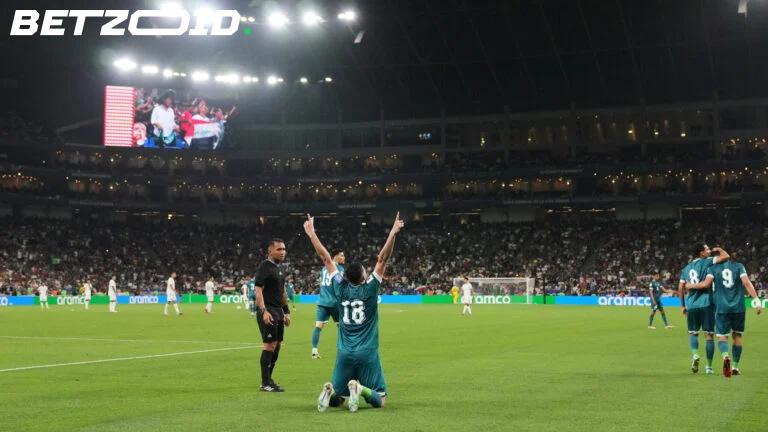
Aymen Hussein's father left home on July 22, 2008 to run an errand. His mother asked his younger brother to call and ask about light bulbs for their new house. Someone else answered the phone. His father was in the morgue — shot in the back, killed by Al-Qaeda elements who had been threatening the Iraqi Army officer for months.
Six years later, Aymen's brother, also in the army, was abducted by ISIS and never seen again. The family home his father built was destroyed. His mother fled. And Aymen Hussein — ungainly, goalless, mocked by political satirists — was somehow supposed to become Iraq's World Cup talisman.
He did. His goal against Bolivia in Monterrey sent Iraq to their first World Cup since 1986. Forty years. A record 21 qualifying games. And more suffering packed into one nation's journey than most squads will experience in a generation.
A squad built from Iraq's modern history
This isn't just Aymen's story. Midfielder Zaid Ismail dedicated the qualification to his father, a deputy intelligence officer martyred in 2006 when Zaid was four years old. Ali Al-Hamadi — the first Iraqi international to play in the Premier League — scored the first goal in Monterrey with tears in his eyes. His father had been imprisoned for peacefully protesting Saddam's government, eventually fleeing to Toxteth, Liverpool, where Ali grew up.
The team is called Asood Al-Rafidain — the Lions of Mesopotamia. The name came from the side that won the 2007 Asian Cup, a tournament victory that remains one of the more extraordinary results in football history: a war-ravaged country, daily car bombings, a nation fracturing along sectarian lines, and somehow a continental title. This generation carried that legacy into qualifying.
It nearly fell apart entirely. A year before Monterrey, Iraq lost to Palestine for the first time ever — collapsing in Amman, conceding two late goals in a result that felt terminal. Spanish coach Jesus Casas was sacked. Crisis.
Arnold, a penalty, and ten minutes of stoppage time
Then Graham Arnold arrived. The same Graham Arnold who had resigned from Australia after a poor start to their own qualifying campaign. The same man who watched Iraq beat his Australia side 3-1 in that 2007 Asian Cup run. He believed Iraq had enough fight left. He was nearly wrong several times.
They were edged out of direct qualification by Saudi Arabia on goal difference — one goal — in Jeddah. Then came a two-legged playoff against the UAE. A 1-1 draw in Abu Dhabi. Then the UAE took the lead in Basra. Iraq equalised. The UAE thought they'd won it five minutes from time, only for VAR to rule out the goal for offside. Then, in the last seconds of ten minutes of added time, a handball. Penalty.
The man who stepped up was Amir Al-Ammari — born in Sweden to parents who had fled Kuwait after the 1991 Gulf War. Before the kick, he used breathing exercises he'd recently learned. He had noticed the keeper dived early, so he waited, and rolled it right. A nation erupted.
Getting to Monterrey itself was its own ordeal. War broke out in the Middle East in February, airspace closed, flights grounded. Arnold, stuck in a UAE hotel, demanded FIFA postpone the game. Eventually the squad made a 12-hour drive from Baghdad to Amman, then a 17-hour flight to Mexico. They arrived ten days before kick-off.
Iraq scored early, Bolivia equalised, and then Aymen Hussein — the striker once so ineffective his own coach sprinted onto the pitch to stop him taking a penalty — scored the winner. "It was a dream I've lived since childhood," he said afterwards.
He was given three cars, a villa, an apartment, a 21-karat gold iPhone, and a plot of land. He is now among Iraq's top five all-time goalscorers.
Group of Death, nothing to lose
At the 2026 World Cup, Iraq face France, Norway and Senegal — drawn into arguably the most punishing group of the tournament. On paper, they are the sacrificial lamb. Their odds of advancing from the group will reflect that bluntly.
But Arnold made his position clear after Monterrey: "We've got nothing to lose, so we're going to play without fear, shock the world and enjoy it while we're doing it."
Iraq open against Norway in Boston on June 16. No one expects them to win. Then again, no one expected them to be there at all.