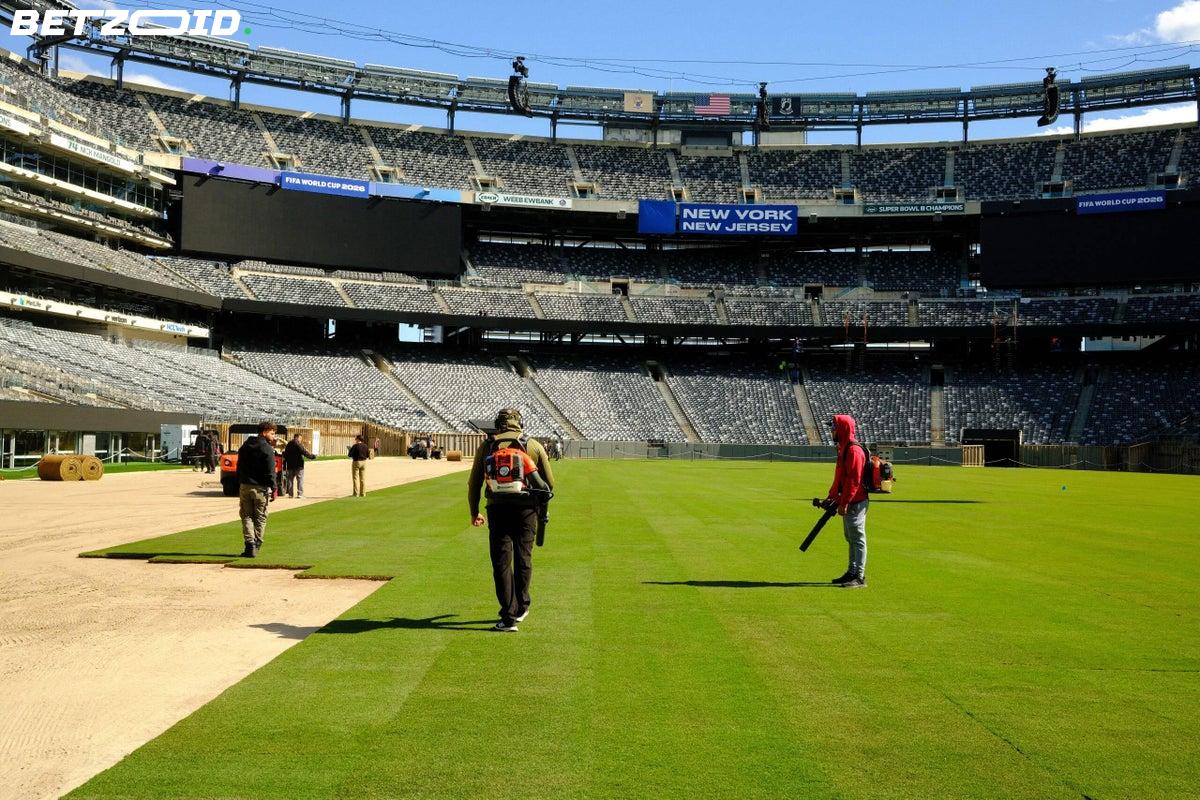
"It's only justice that the best players on the planet hopefully get the best grass on the planet." That's David Graham, FIFA's senior pitch manager, standing inside MetLife Stadium this week as workers rolled out the turf that will eventually host the World Cup final on July 19.
The installation started Wednesday at 5 p.m. Twenty-seven trucks made the roughly 12-hour journey from Carolina Green Turf Farm outside Charlotte, North Carolina — a last-minute pivot after New Jersey's brutal winter (54+ inches of snowfall in Newark alone) wrecked the original supply from Tuckahoe Turf Farms in Hammonton. Workers ran 8-to-10-hour overnight shifts, knocking off at 2 a.m. before returning eight hours later. Next week, a Zamboni-like machine stitches the seams together. Then the real work begins.
What's actually under your feet
The setup beneath the Tahoma 31 Bermuda Grass is more sophisticated than most people realize. Below the sand layer — 18 to 24 inches of it — sits a full irrigation system, a vacuum ventilation system to push oxygen to the grass roots, and HVAC units pumping warm or cold air around the pitch perimeter. It functions like a greenhouse that happens to be open to the sky. The kind of system, Graham noted pointedly, that didn't exist at MetLife during last summer's Club World Cup.
That tournament was a mess by comparison. FC Porto and Palmeiras coaches criticized the surface after the very first game there. Players called it "dry." FIFA took the heat and, to their credit, took notes. The difference this time: FIFA has had access to the stadium since the NFL season ended. They've had 38 days before the first ball is kicked — June 13, Morocco vs. Brazil — compared to roughly two weeks of runway last summer. The pitch will be bedded in longer before a single competitive minute is played than the entire duration of the Club World Cup.
Graham was blunt about the contrast: "That was a temporary overlay field. It didn't even have an irrigation system."
The schedule — and what's riding on it
MetLife — rebranded "New York New Jersey" for the tournament — hosts eight matches in total:
- June 13: Morocco vs. Brazil (Group Stage)
- June 16: France vs. Senegal (Group Stage)
- June 22: Norway vs. Senegal (Group Stage)
- June 25: Ecuador vs. Germany (Group Stage)
- June 27: Panama vs. England (Group Stage)
- June 30: Round of 32
- July 5: Round of 16
- July 19: World Cup Final
A deliberate two-week gap sits between the last group-stage match and the final, giving the pitch management team time to get the surface into peak condition for the one game that matters most. Given how severely pitch quality can influence play — and, more seriously, injury risk — that buffer isn't caution for its own sake. It's the difference between a final played on a proper surface and one where a hamstring goes on a bobble.
Any team you're watching in that final will have prepared for weeks at regional training bases, not on this pitch. Morocco and Brazil are both based in New Jersey — Morocco at The Pingry School, Brazil at the Red Bulls' new facility in Whippany. They won't touch this surface until the pre-match field walk. Whether it holds up through a humid New Jersey July, with thunderstorms a near-certainty, is the one variable nobody fully controls.
"This is as real an institute as you could possibly get," Graham said. The Club World Cup proved what happens when you cut corners on a pitch at this level. FIFA clearly doesn't want that conversation again — especially not in the final.