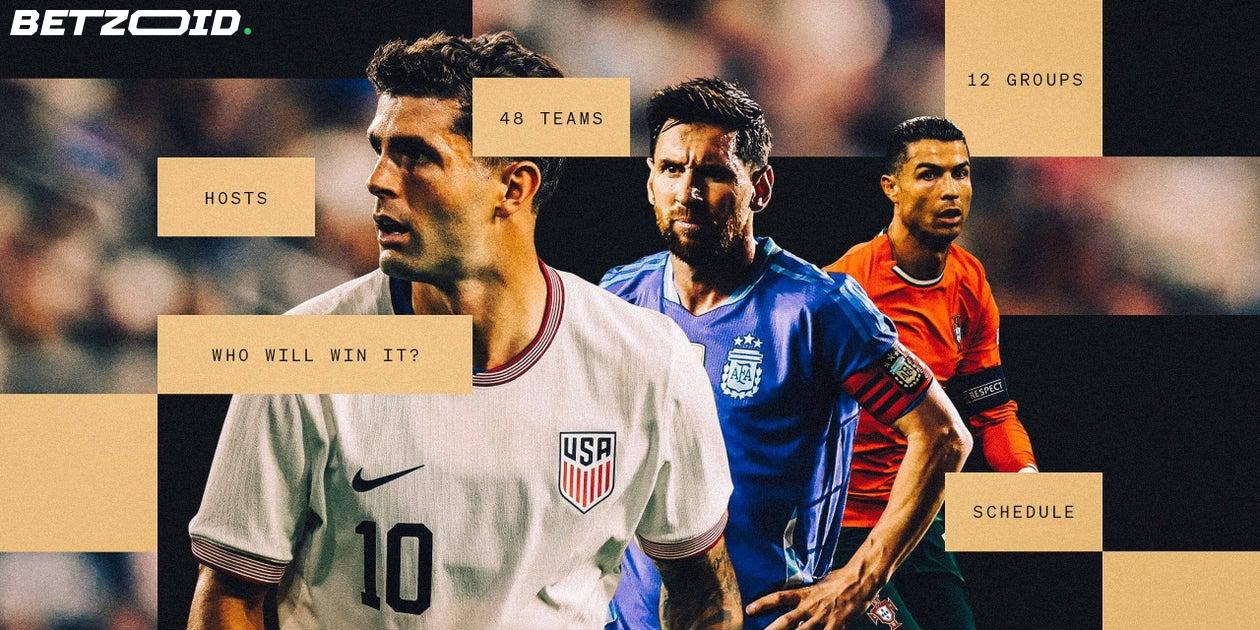
After years of planning, the World Cup is finally almost here. This summer's tournament in North America will likely be the most-viewed sports event ever, watched by billions of fans across the globe.
But here's the thing - this World Cup offers a huge opportunity to attract new fans, especially in the United States where soccer is still rising. We've put together this massive guide to answer literally everything you could want to know about the tournament.
The World Cup is the most beloved soccer tournament out there. It pits the best men's national teams from across the globe against each other for about a month every four years. Think of it as soccer's ultimate championship.
It all kicks off at Estadio Azteca in Mexico City on June 11, when Mexico faces South Africa. From there, we get a full summer of soccer, ending with the final on July 19 at MetLife Stadium in New Jersey. That's 39 days and 104 games total.
How Popular Is This Thing Really?
When Argentina beat France in the 2022 World Cup final, FIFA said it reached 1.42 billion viewers globally. The tournament had five billion views at some point during matches. Each semifinal drew over 300 million viewers worldwide.
To put that in perspective, the Super Bowl - America's biggest sporting event - peaked at just under 138 million viewers last year. The World Cup absolutely dwarfs it on a global scale. Soccer is truly a worldwide sport, while the NFL is primarily American.
FIFA expects to generate a record $13 billion in revenue during this cycle, and this summer's World Cup will be the single biggest driver of that number. It's massive business.
What You Need to Know About Format and Teams
This year, 48 teams will compete - up from 32 at previous tournaments. They're split into 12 groups of four teams each. Every team plays its three group opponents once.
The top two finishers from each group advance automatically. Then the eight best third-place teams also move forward to create a round of 32. It's a new format that should create plenty of drama.
Games last 90 minutes - two 45-minute halves with a 15-minute break at halftime. The referee usually adds extra time at the end of each half to make up for stoppages. Expect games to run around 100 minutes total.
Spain looks like the frontrunner right now. They won the European Championship in 2024 and have maintained incredible form. France is dangerous too - they were world champions in 2018 and runners-up in 2022. Argentina will defend their title, though they have some defensive questions. England under new coach Thomas Tuchel could be real contenders this time.
For betting purposes, those four teams should get the most action. But don't sleep on Brazil, despite their inconsistency lately. They always find a way to be dangerous at World Cups.
The United States has a decent shot at making a deep run as hosts. They've found their form under new coach Mauricio Pochettino, going unbeaten in five straight games against World Cup competition. Christian Pulisic is their star player - watch him closely.
Tickets have been incredibly expensive and hard to get. FIFA's three lotteries have already happened. Your last chance is a "last-minute sales phase" starting in April. If your game is sold out, you'll need to use resale sites like SeatGeek or StubHub.
Honestly, these are the most expensive World Cup tickets ever by a huge margin. Many longtime fans are furious about it. But FIFA says the prices reflect the American market for major sporting events.
All 16 stadiums will install special hybrid natural grass fields for the tournament. Eight venues normally have artificial turf, but FIFA is spending millions to ensure quality grass pitches. They've learned from past issues at US tournaments.
Games will be played across 16 cities in three countries. Eleven are in the US, three in Mexico, and two in Canada. The final is at MetLife Stadium in New Jersey, home of the NFL's Giants and Jets.
Every team will play at least three group stage matches. Assuming the favorites advance, we could see some massive matchups. Brazil versus Morocco on June 13 should be incredible. Colombia versus Portugal in Miami on June 27 will have an electric atmosphere.
For bettors, pay attention to travel schedules. Some teams will log thousands of miles between games, while others stay more regional. That could create fatigue advantages worth exploiting.
Also watch the weather. Games in Arlington, Kansas City, Houston, Atlanta, and Miami could see temperatures above 90°F. That favors teams used to heat and could impact fitness in knockout rounds.
The altitude in Mexico City and Guadalajara will definitely affect performance too. Sprinting becomes harder and maintaining intensity for 90 minutes gets tougher. Teams that prepare for it will have an edge.
This tournament should be absolutely massive. Get ready for an incredible summer of soccer.