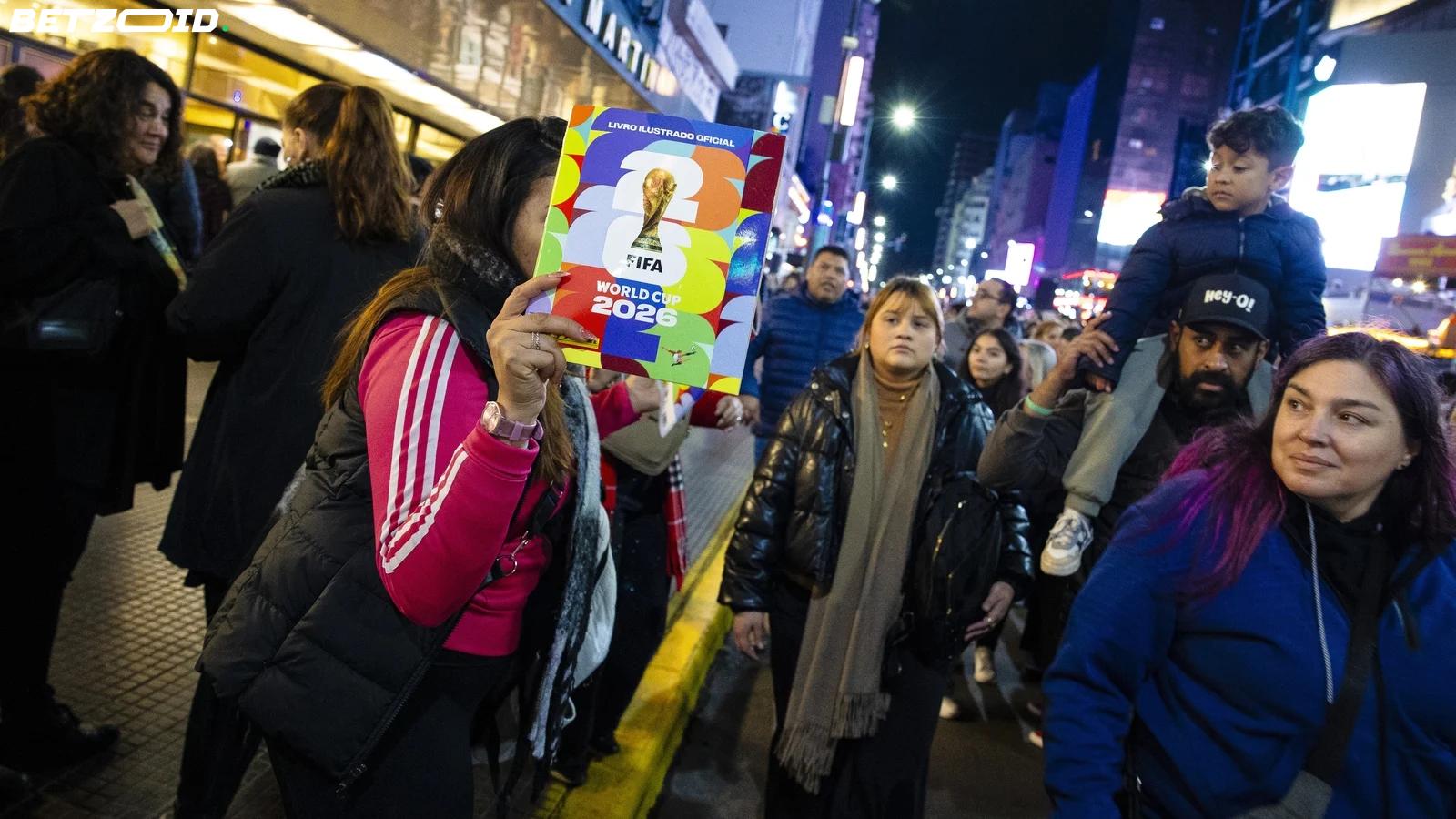
"An excuse for real-life interactions where the barriers between the generations melt away." That's how Argentine journalist Hernán Panessi describes what happens when thousands of collectors descend on Buenos Aires' Parque Rivadavia to swap Panini stickers. It sounds almost absurd — until you see the queues snaking around the block outside sweet shops, and kids voluntarily putting their phones down to haggle over duplicate figuritas.
This is sticker culture in Argentina, and it runs deeper than nostalgia.
980 stickers, one obsession
The 2026 World Cup album features 980 individual stickers — a jump driven by the tournament's expansion to 48 teams. Completing it through normal retail purchases alone is statistically close to impossible, which makes the informal swap meets not just popular but necessary. Parque Rivadavia, historically a market for books and records, has become the spiritual home of this exchange economy. Young collectors, grandparents, office workers on lunch breaks — all converging to trade duplicates of Pedri for a missing Mbappé.
The mania has already caused genuine political fallout. Ahead of the 2022 Qatar tournament, sticker shortages became a national crisis — blamed on distribution changes — serious enough that the Argentine government intervened to mediate between wholesalers and vendors. A football sticker, a cabinet-level issue. That's how much this matters there.
The internet feeds the fire rather than replacing it. WhatsApp groups and online forums coordinate the physical meetups. And then there's the Tim Payne story: New Zealand's defender had fewer than 5,000 Instagram followers when Argentine influencer Valen Scarsini pointed out he had the lowest count of any player at the tournament. Within a week, Payne had over five million followers. A Panini sticker, a football nobody outside New Zealand had heard of, briefly became one of the most viral stories of the World Cup.
Beyond Argentina
The phenomenon isn't confined to one country. Mexico, Chile and Peru have all seen the same surge — Chile despite not even qualifying for this year's tournament, Peru after their 2018 qualification ended a 36-year absence. Throughout Latin America, the sticker album functions almost as a parallel tournament, running alongside the real thing.
This year brought a sharper edge too. Argentine artist Ariel Cuadra created an unofficial Panini-style album honouring the Mothers and Grandmothers of the Plaza de Mayo — human rights organisations formed during the 1976-83 military dictatorship. The album, titled Madres y Abuelas, is stamped with "Nunca Más" (Never Again) in a mock-Panini logo, with members' images available as free downloadable PDFs. A collector's format repurposed for memory and resistance.
Panini issued its first World Cup album for the 1970 tournament in Mexico. The 2030 edition — to be hosted across Morocco, Portugal and Spain — will be its last under the current FIFA licence, after which rival company Fanatics takes over. After 60 years, the original sticker empire is on borrowed time. Argentina will probably still be queuing around the block regardless.