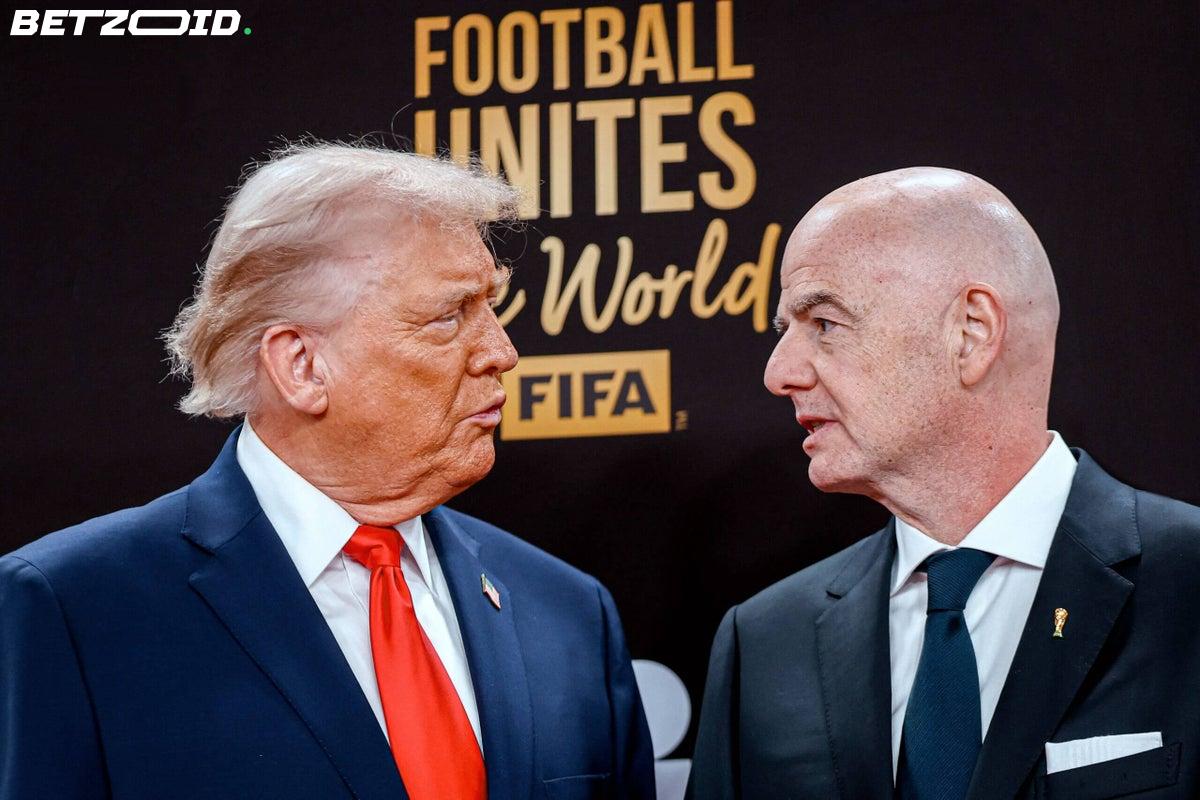
"The president called the president." That one line from The Athletic's Adam Crafton cuts through all the legal noise and diplomatic doublespeak surrounding the biggest story of this World Cup. Donald Trump rang Gianni Infantino. Folarin Balogun then played against Belgium. Draw your own conclusions.
The facts are stark. Balogun was shown a straight red card by referee Raphael Claus on July 1 against Bosnia. It was the first red card at a World Cup since 1962 to not result in at least a one-game ban — a 64-year, 172-red-card streak, broken. Not because the decision was overturned. FIFA have never said the sending-off was wrong. The punishment was simply... suspended. No explanation beyond vague language about "specific circumstances."
Mauricio Pochettino insisted there was nothing extraordinary about it. He was wrong. This was extraordinary by any measure.
How the U.S. pulled it off
Once it became clear that a standard appeal route wasn't available, U.S. Soccer's legal team began building a case around VAR protocol concerns — specifically whether slow-motion replays had distorted the severity of the challenge on Bosnia's Tarik Muharemovic. Simultaneously, the White House was running its own parallel legal operation. Trump's Commerce Secretary Howard Lutnick and Andrew Giuliani from the World Cup Task Force were feeding material to lawyers. Two separate institutions, converging on the same outcome.
Then came the phone call. Trump confirmed it himself in the Oval Office: he rang Infantino, told him he didn't think it was a foul, and asked for a review. "I didn't tell him what to do," Trump said. He didn't need to. When the President of the United States calls the President of FIFA to flag a specific disciplinary decision involving his country's best player, the inference writes itself.
FIFA cited Article 27 of their disciplinary code — essentially a catch-all clause that gives the committee discretion to do what it wants with suspensions. It's technically a lawful mechanism. Whether it was used appropriately is a different question entirely, and one FIFA has shown no interest in answering publicly.
Belgium won the match. The argument is still running.
The outrage was global and immediate. UEFA called it "unprecedented, incomprehensible and unjustifiable" and warned it had "crossed a red line." Wayne Rooney called it an "absolute disgrace" on the BBC. Gary Neville said he'd be "absolutely raging" in Belgium's position. Centre-back Chris Richards — part of the USMNT squad celebrating Balogun's return — admitted they'd had to check the news wasn't AI-generated.
Belgium challenged his eligibility right up to kick-off. FIFA dismissed it seven hours before the match on the grounds that Belgium had "no standing to appeal." So Balogun played. He got his first shot on target in the 82nd minute. The U.S. lost 4-1 and went home.
The decision has already sent ripples through the rest of the draw. France appealed Michael Olise's yellow card — though they insist it wasn't triggered by the Balogun precedent — and had it upheld. England looked at options over Jarell Quansah's two-game ban; FIFA upheld that too. Seventeen players are entering the quarter-finals on a yellow card. Every marginal booking, every borderline red now exists in a landscape where the rules feel negotiable depending on who's applying the pressure.
"It has opened this Pandora's Box where people now feel like they can appeal anything," Crafton said. He's right. And FIFA's refusal to clearly explain the Balogun decision makes it worse, not better. Ambiguity from a governing body isn't neutrality — it's an invitation for chaos.
Belgium beat the U.S. anyway and move on to face Spain. But their federation has made clear they're not letting this go quietly. "Regardless of the sporting outcome," their statement read, "the RBFA will continue to advocate for the correct and consistent application of these principles by FIFA." UEFA is watching. Member associations are watching. And the quarter-finals are still to come.
The USMNT's tournament is finished. This story has weeks left in it.