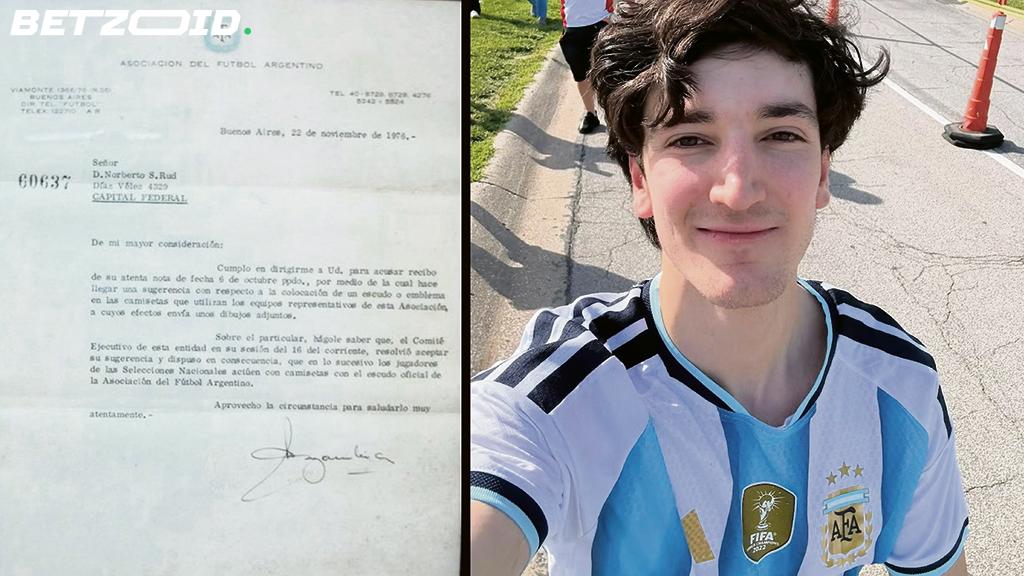
Every time Lionel Messi pulls on that blue-and-white shirt, he's wearing the work of a Jewish fan from Buenos Aires who thought his national team deserved better than just a striped jersey.
Norberto "Toto" Rud was in his late 20s, a member of Club Náutico Hacoaj — a Jewish sports club in Buenos Aires — when he submitted roughly 20 design proposals to the Argentine Football Association in 1976. His crest was chosen. It debuted on November 28, 1976, days after the AFA approved it, and it has remained essentially unchanged ever since.
Where the idea came from
The logic behind it was simple and sharp. Watching international football on black-and-white television, Rud noticed that teams like West Germany (the eagle) and the Soviet Union (CCCP lettering) were instantly recognizable, while Argentina's blue-and-white stripes could be confused with any number of club sides. The national team had one of football's great traditions. It had no visual identity to match.
So he built one. The vertical shield, the laurel branches representing victory and glory, the three stars now standing for three World Cup titles — all of it traces back to one man's frustration with an unmarked jersey.
Rud lived to see Argentina win the World Cup in 1978 and 1986, both times under his crest. He died in 2010, aged 61, and is buried at La Tablada, Latin America's largest Jewish cemetery. He never saw the third star added after Qatar 2022.
A legacy stitched into every shirt
"Every time I see the crest, I feel a little piece of him in my heart," his son Oliver said. That crest now sits on one of the most commercially distributed football shirts on the planet — worn by hundreds of millions of fans across three World Cup-winning generations.
Club Náutico Hacoaj's president Osvaldo Ofman put it plainly: "A small part of Hacoaj and the Jewish community lives on in an emblem recognized around the world."
Toto Rud didn't play a single minute for the Albiceleste. He designed the badge they all wore. That's not a footnote — that's a legacy.