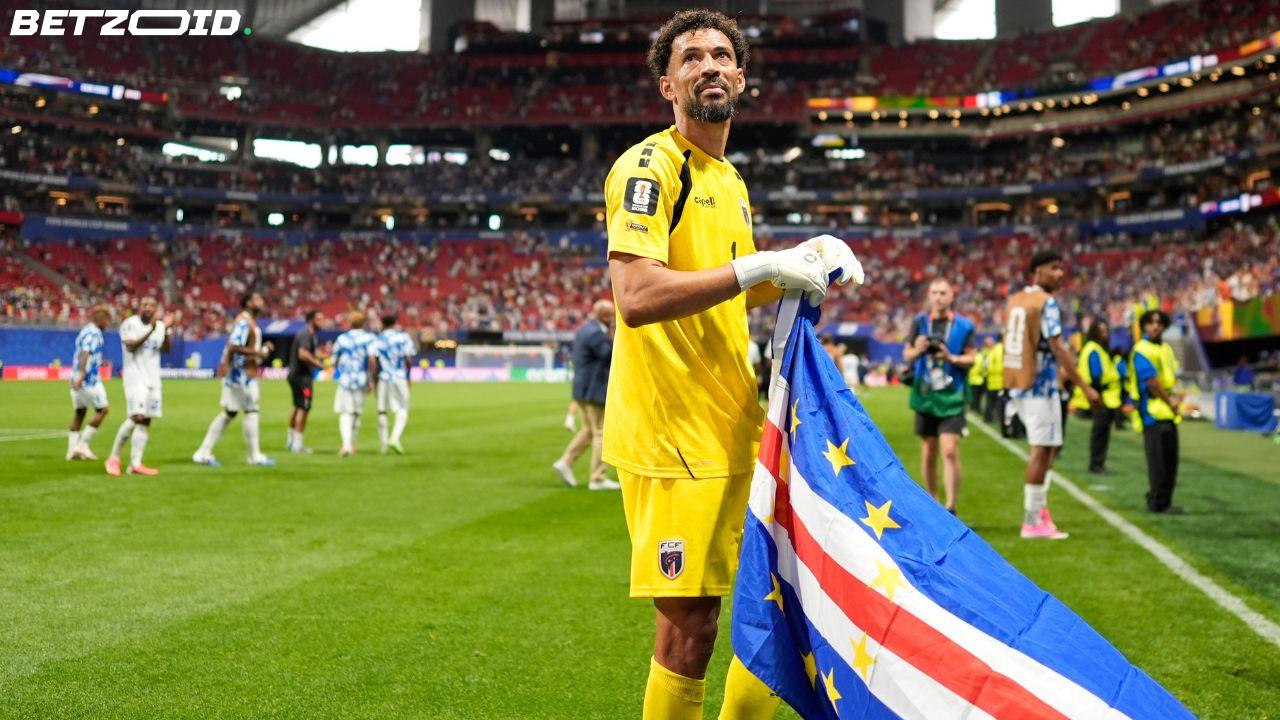
Vozinha was 40 years old, playing second-division Portuguese football, and had 50,000 Instagram followers. Then he kept a clean sheet against Spain. He has 15.6 million followers now.
That's the 2026 World Cup in a sentence. Small nations, unknown keepers, and stories so strange you'd reject them if they were fictional. Here are four of the best.
Alireza Beiranvand, Iran
Most people know Beiranvand's name from 2018, when he became the first goalkeeper in history to save a Cristiano Ronaldo World Cup penalty — a record that still stands. But the CV before that moment is something else entirely.
Born into a nomadic Kurdish tribe in 1992. Shepherding sheep by age three. A brief career as a striker before switching to goalkeeper at 12 and moving to Tehran alone to chase a football dream. Then homelessness. Then a factory. Then a car wash, where his six-foot-four frame made him a specialist SUV cleaner. A pizzeria. Street cleaning.
He signed his first professional contract in 2011. Since then he's won seven league titles in Iran — six with Persepolis, one with current club Tractor — with brief stints in Belgium and Portugal in between. He also holds two Guinness World Records: longest goalkeeper throw (61 metres) and longest dropkick (78 metres). At 33, he is exactly who Iran built their wall around going into this tournament.
Eloy Room, Curacao
Curacao is the smallest country to ever appear at a World Cup. Room is the reason they have a point.
His 15-save clean sheet against Ecuador — a 0-0 draw — set a World Cup record for most saves in a match not going to extra time. Fifteen. Against Ecuador. Alone.
What makes that number more striking: Room spent 2025 without a club after leaving Belgian side Cercle Brugge. While other keepers were training with squads, he was working with a personal trainer and a private goalkeeper coach, grinding toward one goal — making the World Cup. He got there. Then he put on one of the tournament's defining individual performances.
The 37-year-old, born in the Netherlands, chose to represent Curacao to connect with his island roots. He'd already written himself into that nation's history in 2019, making 13 saves to beat Honduras 1-0 at the Concacaf Gold Cup — their first-ever tournament win. He now plays for Miami FC in the USL, stays sharp with padel on the side, and apparently makes Lionel Messi pay compliments. Argentina beat Curacao 7-0 in a 2023 friendly, and Messi still sought Room out afterward, telling him he'd made some good saves. If that's the consolation after a 7-0, the saves must have been something.
Vozinha, Cape Verde
His real name is Josimar Jose Evora Dias. His father named him after a Brazilian right back. His teammates started calling him Vozinha — "granny" in Creole — because as a kid he'd get beaten up by older boys in street football, go home fuming, and sulk to his grandparents. The nickname stuck for 40 years.
He didn't turn professional until his mid-20s, starting with Angolan club Progresso before bouncing through Cyprus, Slovakia, Moldova and Portugal. He's currently at Chaves in the Portuguese second tier. Not exactly the trajectory that ends with stopping Spain cold in a World Cup group stage match.
He nearly wasn't there at all. Vozinha lost his starting spot to the younger Bruno Varela in 2025 and was considering walking away from international football entirely. His teammates talked him out of it. Varela's form dropped, Vozinha got the shirt back, and then he made seven saves against the tournament favourites in a result that turned him into a global name overnight — 50,000 Instagram followers to 15.6 million in roughly 90 minutes of football.
"We work in life to have moments like this," he said afterward. "I am 40 now, but I was not a professional until I was 25. This is a reward for all this journey."
He's now the second-most capped Cape Verde player of all time. And probably the most Googled goalkeeper on earth right now.
Luca Zidane, Algeria
The surname alone is its own kind of pressure. Luca Zidane — son of Zinedine — grew up in Madrid, trained through Real Madrid's youth system, and eventually ended up on the fringes of a first team managed by his own father. "At home he's your father, but when you go to Valdebebas he's just the coach," Luca said. "He could be a bit harder on you than on the other players."
He trained alongside Ronaldo, Modric and Benzema. He also accepted that Madrid wasn't going to be his long-term home. After loan spells at Racing Santander, Rayo Vallecano and Eibar, he's now with Granada in Spain's second division — and representing Algeria internationally, where his paternal grandparents were born.
Eight caps so far. A World Cup to announce himself. "When you're called Zidane, everything you do has more of an impact," he said. "People are waiting for something bad to happen, so they can talk about it. But I've had to deal with it since I was small, so it's natural for me."
"At the start, people see you more as someone's son. But I've always tried to make my own path."
The World Cup is the stage where that path either becomes his own or stays in his father's shadow. He says he's ready. Now we find out.