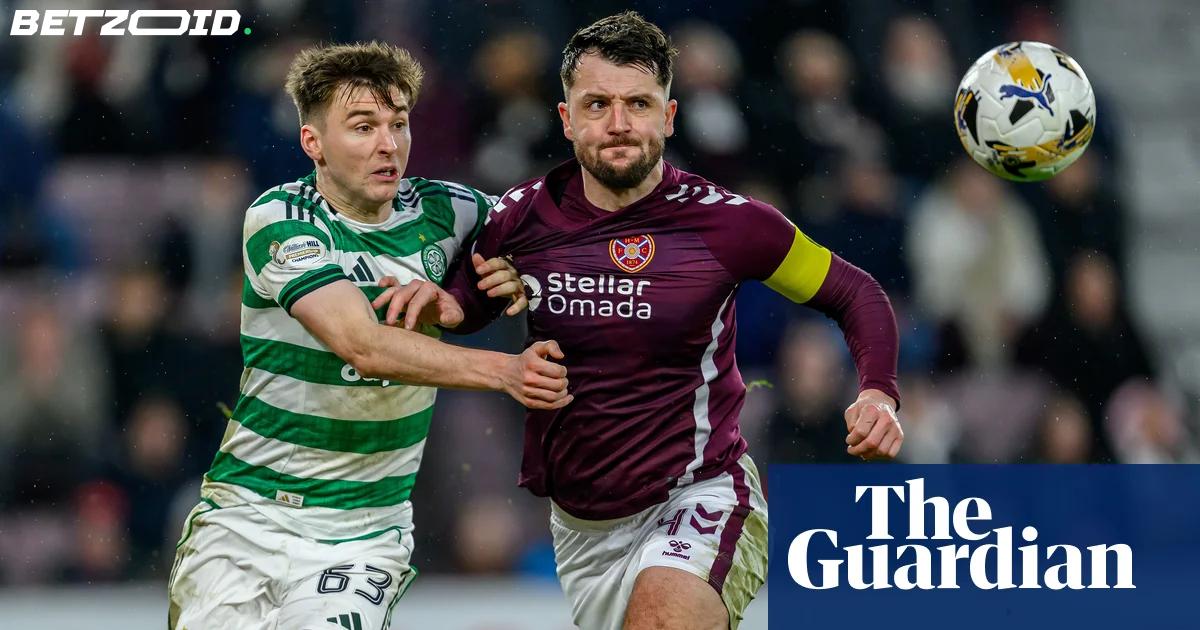
Tony Bloom said Hearts could challenge for the Scottish title this season, and Scotland laughed. The club hadn't even finished in the top half the year before. Nobody was getting their hopes up about Edinburgh.
Bloom, as it turns out, saw something nobody else did. Hearts won eight of their first nine league fixtures, went top, and haven't left since. They are now two wins away from ending a 66-year title drought and becoming the first non-Old Firm side to win the Scottish Premiership since Sir Alex Ferguson's Aberdeen in 1985.
This is not a fluke. And it's not a small story.
How Hearts actually built this
Bloom's Jamestown Analytics outfit has remade Hearts' recruitment from the ground up, following the same blueprint that worked at Brighton and Union Saint-Gilloise. Players sourced from the Norwegian second tier and the Slovakian top flight — names like Claudio Braga and Alexandros Kyziridis — have become first-team contributors. The model is deliberate, data-driven, and it's working.
Manager Derek McInnes is a slightly awkward fit for that profile. The 54-year-old is conservative by nature, experienced by trade, having managed Aberdeen, Kilmarnock and St Johnstone. His style is rarely pretty. But experience counts when Celtic and Rangers are breathing down your neck every week, and McInnes has kept the dressing room steady through a genuine title fight. Whether Jamestown's long-term vision includes him is a separate question. Right now, he could be two games from immortality.
The club itself carries real weight. Tynecastle Park has hosted football since the 19th century. Heart of Midlothian takes its name from a Sir Walter Scott novel. A battalion of Hearts players went to the First World War. The history is embedded. Winning this title wouldn't just be a sporting achievement — it would be one of Scottish football's defining moments in a generation.
Celtic's season has been a slow-motion disaster — and they're still in it
The remarkable thing about Celtic's position isn't that they're two wins from the title. It's everything they survived to get there. Brendan Rodgers was sacked early in the campaign after Celtic majority shareholder Dermot Desmond called him "divisive, misleading, and self-serving." Martin O'Neill, 73 years old and six years out of management, came back as interim. Then Wilfried Nancy was appointed in December, went six defeats in eight games, and was gone by January. O'Neill returned — his third stint, second in a single season.
The boardroom wasn't quieter. Chair Peter Lawwell resigned citing "abuse and threats." The Green Brigade was banned from home matches. The summer and January transfer windows were, by most accounts, a mess. Celtic fans had reasons to be furious, and they were.
And yet. Their squad is still the deepest in Scotland. Daizen Maeda scored an overhead kick in Sunday's Old Firm derby that won Celtic the match. Muscle memory and talent can carry a team a long way, even through institutional chaos. Celtic's title odds have shortened despite everything — which tells you something about the gap between them and the rest of Scotland that isn't Hearts.
That gap won't exist forever. Celtic's recruitment model — once one of the sharpest in Europe, responsible for launching Virgil van Dijk, Jeremie Frimpong, Odsonne Édouard, Moussa Dembélé and others — has clearly stopped functioning the way it did. A new permanent manager arrives this summer, but that's not nearly enough on its own. Something structural needs to change, title or no title.
What happens next
Hearts host Falkirk on Wednesday. Win that, and if Motherwell beat Celtic the same night, the title goes to Edinburgh. It's not a stretch — Motherwell have taken four points from Hearts and Rangers recently and beat Celtic at Fir Park earlier this season.
If it doesn't end Wednesday, it goes to Saturday. Celtic host Hearts in what would be a direct title decider. Hearts haven't lost to Celtic in three meetings this season and won on their last visit to Celtic Park. But playing the decisive match on your opponent's ground, in front of their crowd, is a different test entirely. Celtic may hold the edge simply by virtue of the venue.
Scotland's league format — a split where the top six play each other in the final rounds — was designed partly to generate exactly this kind of tension. For years it didn't, because Celtic simply ran away from everyone. This season, it's delivering. The best title race in European football right now isn't in England, Spain, or Germany.
It's in Edinburgh and Glasgow. And it ends Saturday at the latest.