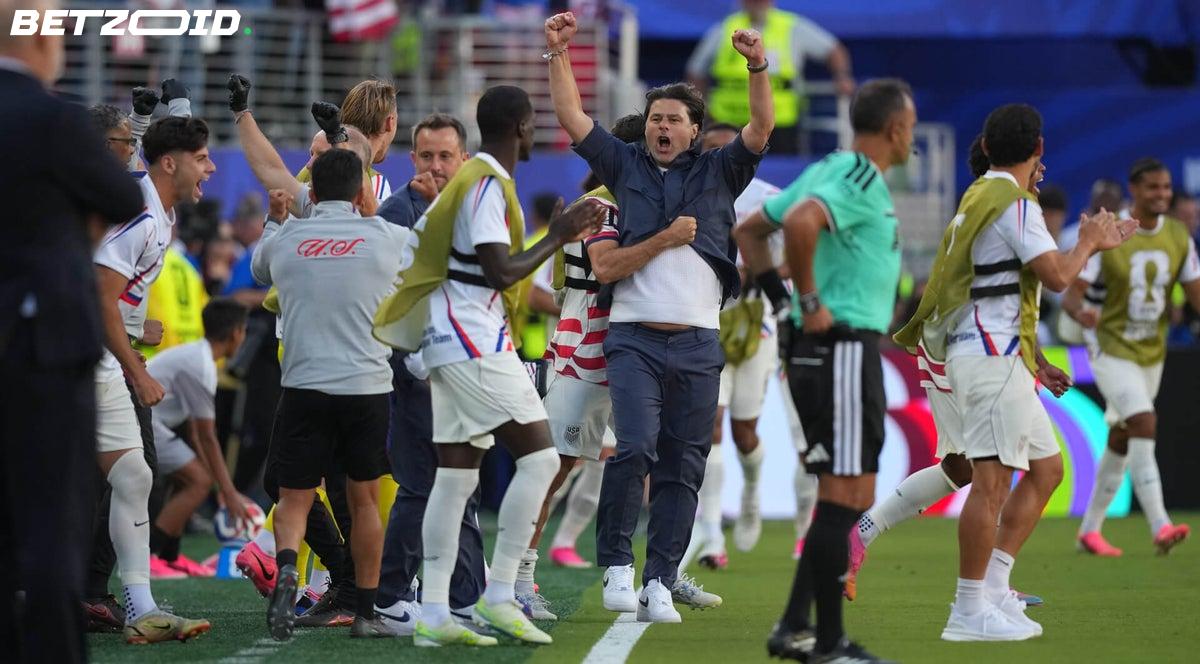
Every second-cycle USMNT coach has failed. Bruce Arena, Bob Bradley, Jurgen Klinsmann, Gregg Berhalter — all of them returned for a second run and all of them left worse than they arrived. Mauricio Pochettino just signed up to be next in that line.
That's not pessimism. That's the record. And Pochettino is returning on the back of a 4-1 round-of-16 hammering by Belgium at a home World Cup — a tournament the U.S. entered with more hype, more viewers, and more expectation than any in the program's modern history. Over 50 million people watched. What they got was a gaffe-riddled elimination against a team that simply had more quality.
Now the rebuild starts. The mandate is clear: go one round further in 2030, build genuine depth, and integrate a new generation of players fast enough that they're ready when qualifying gets serious. Christian Pulisic, Weston McKennie, Tyler Adams, Antonee Robinson — they'll all be 31 or 32 at the 2030 World Cup. The clock is running.
The September window matters more than it looks
Pochettino has four friendlies in the upcoming September-October window, and they shouldn't be used to reward the round-of-16 group. This is the moment to open doors. Zavier Gozo, Adri Mehmeti, and Julian Hall — none of them yet 20 — should be in the squad. Eighteen-year-olds Peyton Miller and Neil Pierre deserve looks. Tim Howard has publicly called for 16-year-old Cavan Sullivan to get the call now.
Landon Donovan put it plainly: "By the time you get to 2030, you need these guys to have played 20, 30, 40, 50 games. It can't be like your sixth game." He's right. Qualifying in CONCACAF is not a youth development exercise. You can't throw untested teenagers into a must-win qualifier and hope for the best.
Pochettino says the right things. He talked Monday about giving players who "didn't have time to be assessed" their chance, and about setting "principles" for the next generation. The question, as always with him, is whether the actions match the words over a sustained period — or whether familiarity with his trusted core pulls him back toward safe selections when the pressure rises.
The European question isn't going away
Then there's the elephant in the room that never really left.
While under contract with U.S. Soccer, Pochettino gave interviews about wanting to return to Tottenham, called the Premier League "the best league in the world," said he was "missing it," stated he intended to win the Champions League — and held talks with AC Milan just before the World Cup. That's not a coach who was fully locked in. That's a man keeping his options warm.
Now he's signed a four-year deal. He says he turned down "too many possibilities" without a contract and insists he only signs deals he intends to see out. But he also acknowledged, in the same breath, that "in life, nothing is sure. Less in football."
A buyout clause is only as good as the figure and the will to enforce it. If a top Premier League club comes calling mid-qualifying, U.S. Soccer's leverage depends entirely on how that contract was structured — and on whether Pochettino actually means what he's saying this time.
- Arena returned after 2002 and finished 25th of 32 teams in 2006
- Bradley was fired a year into his second tenure after a Gold Cup final loss to Mexico
- Klinsmann was sacked mid-cycle during 2018 qualifying
- Berhalter exited in the 2024 Copa América group stage on home soil
Pochettino's honest answer on the commitment question was this: "If we sign a four-year contract, we need to think to arrive there... but in life, nothing is sure." That's not exactly a declaration of undying loyalty. It's a realistic man telling you not to hold him to something he can't fully guarantee.
The USMNT program needs an all-in leader for a full World Cup cycle. Whether Pochettino can actually be that — not just say it — is the question that will define the next four years more than any roster call-up or tactical tweak.