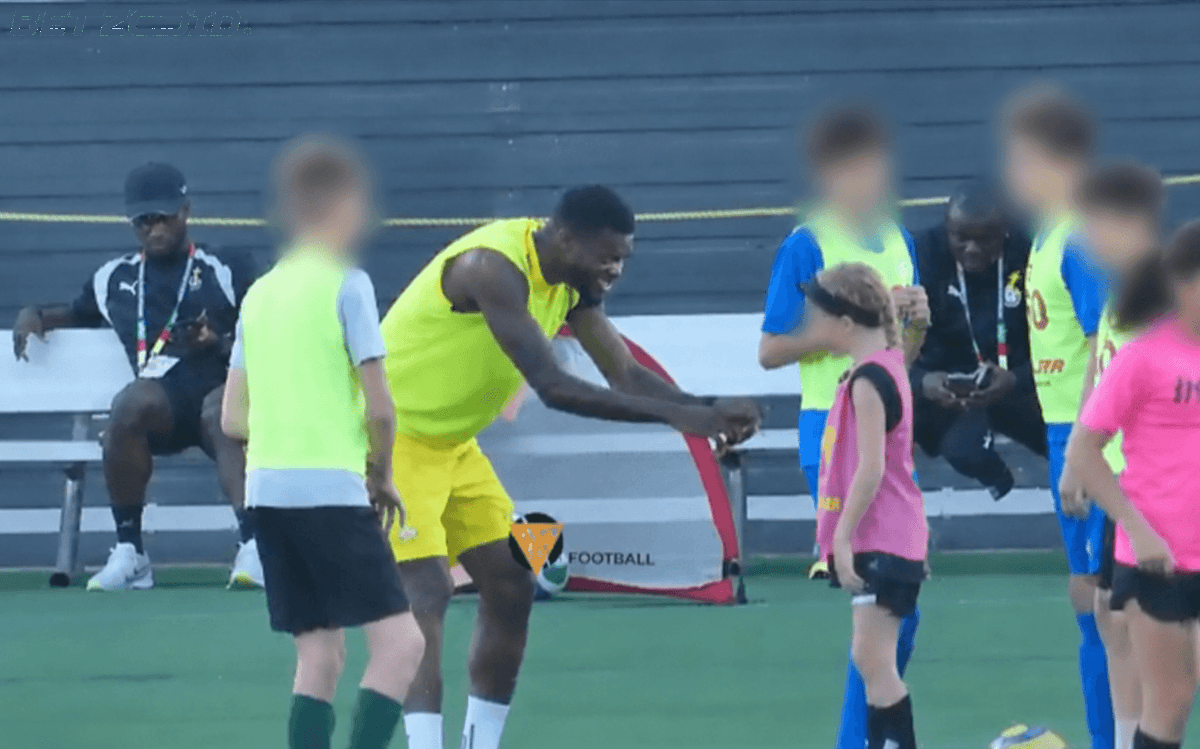
While Canada was busy denying Thomas Partey a visa over safety concerns, Bryant University in Rhode Island was hosting him at a children's community football session. The same day. No apparent warning to parents. No public disclosure to the youth coaches on campus.
Partey — facing seven counts of rape and one of sexual assault relating to four separate women, charges to which he has pleaded not guilty — was filmed interacting with girls in pink shirts during a "Community Day" at Ghana's official FIFA World Cup training base camp on Saturday. Bryant University later posted about the event on Facebook: "An evening filled with memories that will last a lifetime."
That line landed very differently once the footage surfaced.
The gap between policy and reality
Bryant University knew about the charges. They said so themselves, acknowledging in a statement to The Athletic that they were "aware of the legal charges facing a member of Team Ghana" and that "enhanced security measures" were in place. The plan, according to one university official speaking anonymously, was to keep Partey in a bubble — team bus drops players to an enclosed building, no contact with students.
That plan and what actually happened on Saturday are not the same thing.
Beyond the Community Day itself, the wider picture at Bryant is uncomfortable reading. Teenage girls attending a sold-out hockey camp — College Connection Showcase — were observed walking unattended through areas that were supposed to be off-limits to the public, including through car parks adjacent to Ghana's training setup. Two assistant coaches at the camp told The Athletic they had no idea Partey was on campus or what charges he was facing. One said: "Talking to the other counsellors, not a lot of people knew about the allegations."
The university did not answer questions about whether parents at the Community Day were informed of Partey's legal situation before their children attended. FIFA and the Ghana FA did not respond to requests for comment.
An impossible position that nobody handled well
The legal reality here is straightforward enough: Partey has not been convicted of anything. He strongly maintains his innocence, and his lawyer has said he "welcomes the opportunity to finally clear his name." His trial, originally scheduled for November, may now not take place until early 2027. In the eyes of the law, he is innocent until proven otherwise.
But safeguarding decisions don't operate purely in the courtroom. Canada made one call — barring him entry on the basis of "maintaining safety and security." U.S. immigration made another, granting him a visa. Bryant University made a third, deciding the bubble arrangement made hosting Ghana acceptable. Then a fourth decision, somewhere in the chain, resulted in Partey standing on a pitch with children while their parents had been told nothing.
These are not abstract institutional failures. Real children attended that event. Real parents dropped them off without knowing. The coaches running the hockey camp — whose teenage girls were walking through the same car park as Ghana's squad — found out from a journalist, not from the university.
Partey will stay behind in Providence when his Ghana team-mates travel to Toronto for their World Cup opener against Panama on Wednesday. He is eligible to feature in Ghana's second group game against England at Gillette Stadium on June 23. If selected, that will be his first appearance of the tournament — and the questions surrounding his presence at this World Cup will follow him onto the pitch.
The Ghana government, meanwhile, has announced it intends to pursue legal action against Canada over what it called an "extremely unfair" decision. Canada's immigration department responded by saying hosting a major event "does not change Canada's immigration laws."
Bryant University's statement closed by saying they "look forward to continuing to work closely with FIFA, State Police and other security officials to support a safe and secure World Cup 2026." They did not add anything further.