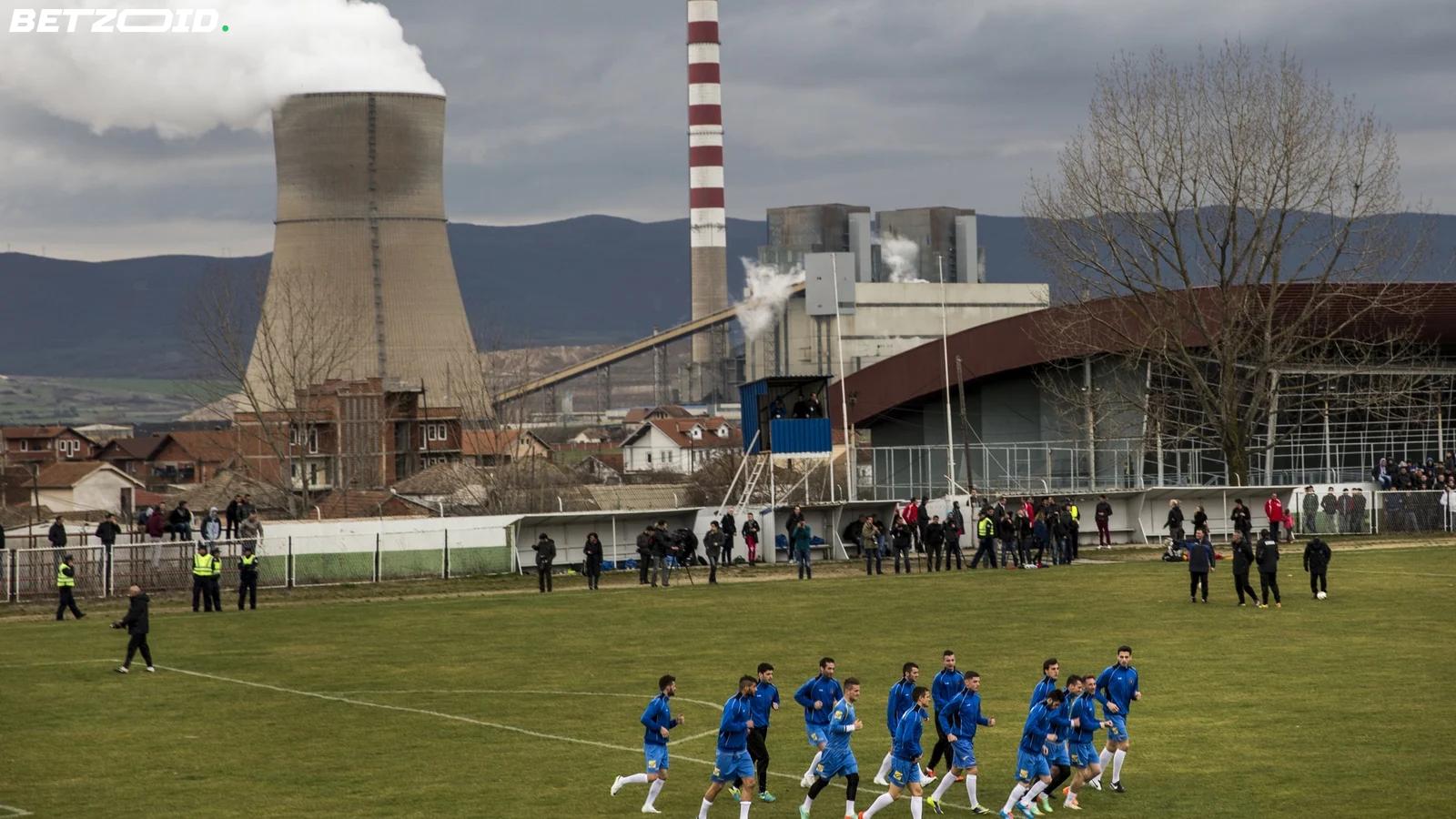
When the Republic of Ireland walk out in Pristina on Thursday, they'll face a Kosovo side that came agonisingly close to reaching the World Cup, falling to Turkey in a play-off final back in March. It's a remarkable position for a footballing nation that only joined FIFA and UEFA in May 2016 - and much of the credit for getting them there belongs to a man who spent years building a team that didn't officially exist.
Albert Bunjaki managed Kosovo for seven years before that recognition arrived, a period in which the side was largely a national team in name only as the country pushed for sporting and political legitimacy. Now head of academy at Swedish club IF Karlstad Fotboll, the 55-year-old fled Kosovo - then part of Yugoslavia - in 1991, and has lived in Sweden ever since.
That made Kosovo's recent World Cup qualifying campaign particularly surreal to watch from afar. A 2-0 win over Sweden in Pristina a year ago was followed a month later by a 1-0 victory in Gothenburg, a result Bunjaki found especially poignant given how far the country has come.
Ireland's visit carries its own significance. Ireland was among the small number of countries to recognise Kosovo's declaration of independence in 2008, something Bunjaki says hasn't been forgotten.
"I think the Irish people will feel free in Kosovo because we are thankful for everything Republic of Ireland did for Kosovo, and we will always remember that," Bunjaki said in an interview with the RTÉ Soccer Podcast, which explored what it took to build the Kosovo national team essentially from nothing.
From fleeing conscription to coaching in Sweden
Born in Pristina in 1971, Bunjaki came through the youth ranks at FC Prishtina while dreaming of becoming a doctor. At 20, he fled the country to avoid compulsory two-year conscription into the Yugoslav army - a decision that came with a heavy cost. A 20-year prison sentence for evading military service was imposed on him in absentia, ruling out any return home.
He watched from Sweden as tensions in Kosovo escalated into open conflict by the late 1990s, eventually prompting NATO intervention. Football offered an outlet. After playing in the Swedish lower leagues, Bunjaki moved into coaching around the turn of the millennium, including assistant roles at Degerfors and Kalmar, while also visiting post-war Kosovo to help develop youth football and coaching structures.
Building a team that didn't know if it would ever play
Bunjaki credits the late Fadil Vokrri, regarded as the greatest Kosovan player of his generation, as the driving force behind the project. Vokrri became president of Kosovo's football association in 2008, when it operated out of a couple of rooms in a Pristina apartment block with barely any resources.
"The biggest dream for a coach is to be head coach for the national team, but to be the coach for a national team which you will create for the first time, it's history," Bunjaki said.
While Vokrri lobbied for FIFA and UEFA recognition, Bunjaki's job was to build a squad without knowing if or when Kosovo would ever play official matches. With the domestic league underdeveloped, he turned to the diaspora, focusing on players in Switzerland, Norway and elsewhere in northern and central Europe.
"During that time, I remember in my room, I had a big map with nails everywhere," he said. "So when I started working with Kosovo, the first thing I was thinking was in a strategic way. We needed to have young players and the players needed to come from the youth and national teams from different countries."
He estimates that almost 90% of the players who eventually represented Kosovo had started their careers in the youth or national setups of other countries. Youth was central to the plan too, with Bunjaki thinking years ahead rather than focusing solely on the present.
Working for around €300 a month, he funded his own scouting trips around the continent, leaning on the Kosovar Albanian diaspora for help and on the advice of Tord Grip, the long-time assistant to Sven Goran Eriksson, who later became Kosovo assistant manager himself.
"I was talking with grandmothers, grandfathers. I was talking with agents. I was talking with teams," Bunjaki said. "You need to explain to them how important is to play one day for Kosovo... Everyone wants to be part of history."
The first match, and the real thing
In 2014, FIFA granted Kosovo the right to play friendlies against member nations, and that March they faced Haiti in Mitrovica in their first official fixture, a 0-0 draw. Bunjaki recalled preparing a squad of players who barely knew each other's names on a rough training pitch in Obilic, before matchday revealed just how much the fixture meant to supporters.
"It was raining all the time. It was cold. I woke up in the morning at the hotel and I heard a lot of fans outside... there were flags and people all the way to the stadium. And you just feel like 'this is big,'" he said.
With FIFA and UEFA membership secured in 2016, Kosovo were placed in a 2018 World Cup qualifying group alongside Croatia, Turkey, Ukraine and an Iceland side managed by Heimir Hallgrimsson. Their first competitive match came away to Finland in Turku that September, but hours before kick-off Bunjaki was still waiting to learn whether six key players would be cleared to play.
"I do remember the night before the game, I was in the room together with Tord Grip and we were planning how to start the game and the setpieces. And we couldn't do it because most of the players couldn't play," he said.
Clearance eventually came through, and Kosovo drew 1-1, with Valon Berisha - one of the six players whose eligibility had been in doubt - scoring the equalising penalty. It proved to be the only point Kosovo picked up in that qualifying group, after which Bunjaki stepped down as manager.
A debt of gratitude
Nine years on, Kosovo have built considerably on that solitary point, something Bunjaki takes pride in, particularly when he hears from the players he brought together in those early years.
"He brought us together and didn't have an easy job. We didn't have pitches. We didn't have a suitable stadium. We'd ride for hours in the bus to Shkoder in Albania to play our home games in the World Cup. Kosovo needs to always thank Albert," former goalkeeper and current Kosovo FA sporting director Samir Ujkani said in a 2019 interview with ESPN.
For Bunjaki, it's enough to have set the whole thing in motion. "I'm thankful for that but at the same time I think this is to be part of that history. It makes me honoured. It makes me emotional today. So I'm grateful," he said. "Everything didn't start in 2016, but the time that Kosovo was isolated, everything made it more difficult for us to restart. So I'm not surprised about the development of the national team."