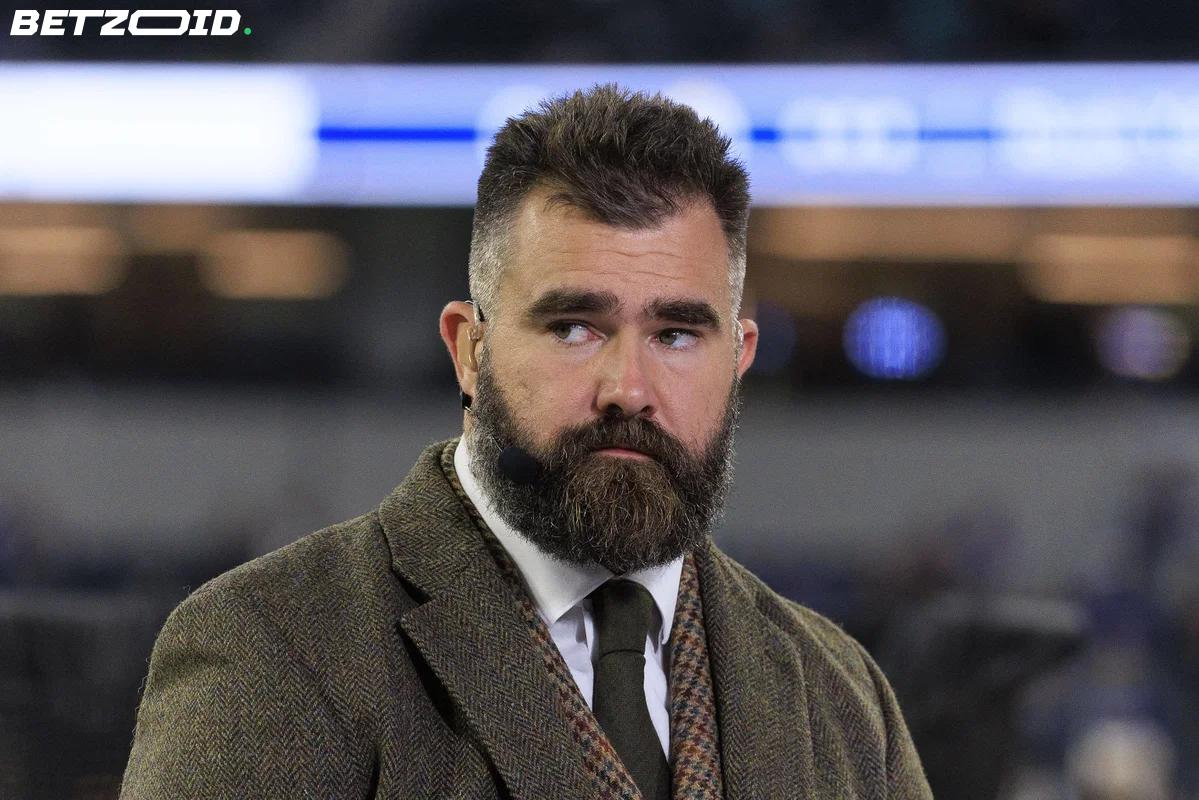
"I believe that we will win" is, according to Jason Kelce, "the f***ing most loser mentality chant I have ever heard in my entire life." That's the former Eagles center — a man who played in Super Bowls in front of 100,000 people — telling American soccer fans they've already got the wrong energy before a ball is even kicked.
He's not wrong. And his wider point about why the USMNT keeps running into a ceiling at the international level is worth taking seriously, especially with the US riding high after topping their group at the 2026 World Cup.
The best American athletes never make it to a soccer pitch
Kelce's core argument is simple: the US pool of elite athletes is enormous, but soccer doesn't get first pick. Football and basketball do. The scholarships are bigger, the cultural prestige is higher, and by the time a gifted 16-year-old has to choose, soccer is rarely the obvious path to wealth or recognition.
He illustrated it with a striking example. Jordan Mailata — a rugby league player from Australia — picked up American football essentially from scratch and started in the NFL. That kind of late-converting athleticism works in football. In soccer, it almost never does. The technical foundation has to be built before a player turns 12, let alone 18.
"There's a reason there's not players that start playing later in life, and they're some of the best soccer players in the world," Kelce said. It's a skill-ceiling argument, and it's one of the more honest assessments of American soccer's structural problem that you'll hear from someone outside the sport.
Soccer participation in the US is actually strong at youth level — kids aged 6 to 12 play in numbers that rival tackle football. The dropout happens at high school, when the best athletes drift toward sports with clearer professional pathways and cultural weight behind them. Until that calculus changes, the USMNT will keep developing solid players rather than generational ones.
What it means for this World Cup — and the odds around it
The USMNT topped their group and face Bosnia in the Round of 32. The optimism is real and not entirely misplaced — this squad has genuine quality and home tournament advantage. But analysts broadly agree the Quarterfinals represent the ceiling, and Kelce's structural argument explains why that assessment is difficult to dismiss.
A deep run — say, a Semifinal appearance — would shift the sport's profile in the country overnight. That's the feedback loop that could actually change things: success inspires investment, investment raises the floor, a higher floor produces better players. It's happened in other countries. But it requires breaking through first.
For now, the chant Kelce wants is something closer to: "I believe that we can f*** you up." Aggressive, confrontational, pointed at the opponent rather than inward. Whether the team can back that energy up against European opposition in the knockout rounds is the only question that matters.
"I felt like a complete loser," he said, recalling the one time he joined in the "I believe that we will win" chant. Hard to build a football culture on a foundation that makes your own fans feel that way.