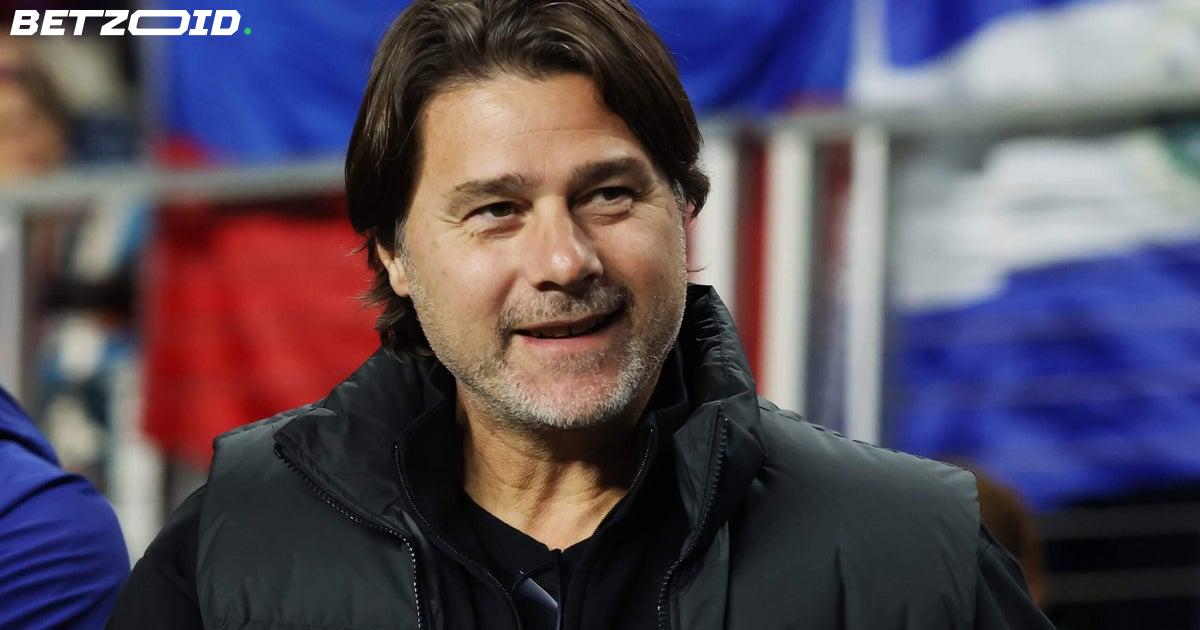
Mauricio Pochettino is leaving the U.S. men's national team for Manchester United without a trophy or any objective accomplishment to show for his time in charge, but U.S. Soccer says his real legacy is how he changed the profile of the national team coaching job itself.
"I think one of the most important things that Mauricio has done (is that he) has everyone believing in our player pool, everyone believing in our program," U.S. Soccer CEO JT Batson told TBS on Tuesday night. "And it's certainly elevated, for coaches around the world, that this is a great place to work."
When Pochettino took the job in September 2024, not long after leading Chelsea and Paris Saint-Germain, there was skepticism about hiring another high-profile foreign coach. Pochettino said he didn't feel the support he expected when he arrived, describing a kind of resistance that was partly shaped by the chaotic tenure of Jurgen Klinsmann, whose team failed to qualify for the 2018 World Cup.
Batson told The Athletic in June that given how high-profile the USMNT job would be this past summer, having a coach who had thrived in big, high-pressure environments like Pochettino's was important. Asked about U.S. Soccer's ambitions for the 2030 and 2034 World Cups, Batson said expectations should be higher because soccer in America is going to be bigger.
Bruce Arena, among the most prominent skeptics of hiring a foreign coach, argued in 2014 that an American should lead the national team because domestic coaches understand the culture and environment in a way outsiders can't. In the spring of 2025, with Pochettino's USMNT struggling, Arena reprised that view on a podcast, suggesting that coaching international football requires knowing the culture, pride and players in a way foreign coaches often lack. That September, the USMNT's Elo rating dipped to a new 21st-century low, and the skepticism around Pochettino seemed, for a time, justified.
The team rebounded, however, and Pochettino reshaped its culture while leaning into the program's American identity. "Even though he's an Argentinian coach, he made us even more proud to be American," midfielder Sebastian Berhalter said. "And I think that speaks volumes of who he is as a person and as a coach." Striker Folarin Balogun said last week that Pochettino had "definitely raised the standard."
Batson, reflecting on the 2024 hiring process, told The Athletic in June that a big name alone doesn't make someone the right fit, and that cultural and strategic fit with U.S. Soccer and the national team came first. According to the piece, U.S. Soccer has grown into a $300 million organization with more than 600 employees, a new national training center and billionaire donors, having shed what Batson called the "Little Engine That Could" mentality.
Who could replace him
Two people with knowledge of the federation's thinking independently indicated that, even with Pochettino moving on, the standard for who gets hired next is now different. Pep Guardiola is described as a top target for the role. Roberto Martinez and Julian Nagelsmann are said to be in the conversation, at least publicly, while former Premier League coaches Arne Slot and Eddie Howe could also be considered. None of this means any of them will be pursued or chosen, as fit still matters, but Pochettino's two years in the job have brought names of that caliber into the picture.