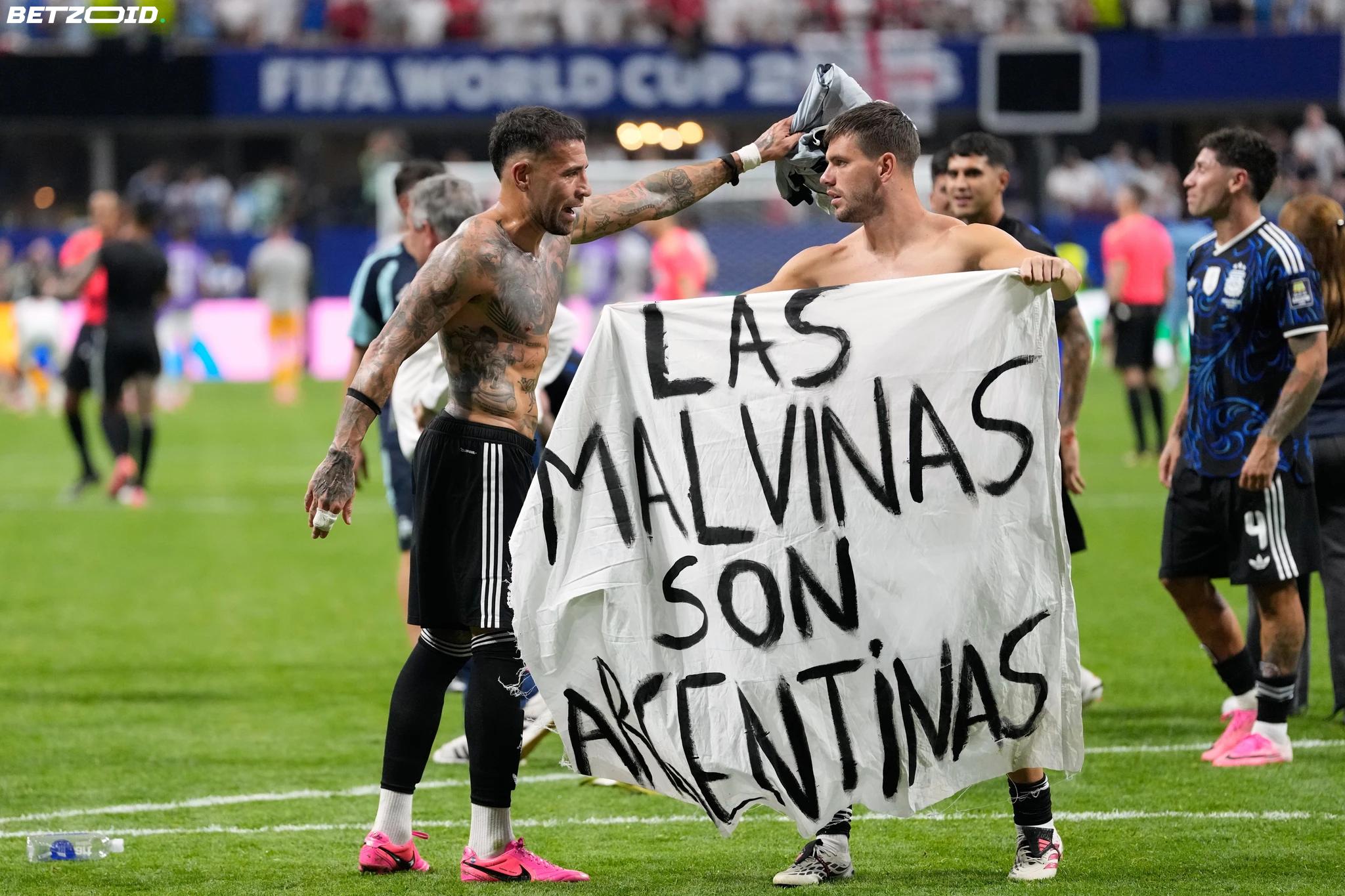
"We couldn't let the Argentine people down." That was Lisandro Martínez — Manchester United's own Lisandro Martínez — explaining why he and his teammates held up a banner reading "Las Malvinas son Argentinas" during post-match celebrations after beating England 2-1 in the World Cup semi-final. As football-political flashpoints go, this one hit differently.
The banner, handed to players by fans in Atlanta on Wednesday, claimed Argentine sovereignty over the Falkland Islands — a British overseas territory that Argentina invaded in 1982, triggering a 10-week war that killed 649 Argentine soldiers, 255 British service personnel, and three islanders. Britain won. The islands stayed British. The dispute never fully went away.
London calls for FIFA action
By Thursday, the British government was formally urging FIFA to investigate. Prime Minister Keir Starmer's spokesperson didn't mince it: "The World Cup might not be ours, but the Falkland Islands definitely are." UK Business Secretary Peter Kyle called the players' behaviour "entirely inappropriate" and told the BBC that "politics needs to be separate from football."
FIFA's disciplinary code is clear on this — banners of a "political, ideological, religious or offensive nature" are prohibited at stadiums. Fines range from around $5,000 to $20,000, though precedent suggests the federation itself could carry a heavier hit. Argentina were fined 30,000 Swiss francs after their players displayed the same slogan at a 2014 pre-World Cup warm-up in Buenos Aires. FIFA published that ruling after the tournament ended, which tells you something about how urgently they tend to move on these things.
Argentine President Javier Milei called the celebration "perfectly valid" while simultaneously predicting a fine. Vice President Victoria Villarruel posted the image directly to social media, captioning it: "The Malvinas are Argentine! They banned us from bringing signs into the stadium, forgetting that we carry them in our blood and in our hearts."
FIFA's credibility problem
Here's where it gets complicated. FIFA's supposed political neutrality is already shredded at this tournament. President Gianni Infantino's decision to defer Folarin Balogun's mandatory red-card suspension — widely seen as bending to pressure from Donald Trump — set a precedent that the rulebook is negotiable when powerful figures push back. Infantino is expected to sit beside Trump at Sunday's final.
That context matters enormously for how any Argentina ruling lands. If FIFA acts swiftly and firmly, they partially rehabilitate their independence. If they drag it out, reduce it, or bury it post-tournament as they did in 2014, the message is that the disciplinary process works selectively.
- South Korea's Park Jong-woo was banned for two World Cup qualifying games after holding a "Dokdo is our territory" banner at the 2012 London Olympics
- Serbia were fined 20,000 Swiss francs at the 2022 World Cup for a political Kosovo banner in their dressing room
- Argentina's federation were fined 30,000 Swiss francs for the same Malvinas slogan in 2014 — ruling published after the tournament ended
Argentina play Spain in the final on Sunday in East Rutherford, New Jersey. Whatever FIFA decides about the banner, it almost certainly won't be announced before kickoff. That's just how this organisation operates.
Leandro Paredes, for what it's worth, acknowledged the weight of it. "Sadly, it is a sad part of our history," he said in Atlanta, "for everyone involved in that chapter of, I repeat, our history. And it hurts. We knew we were playing for them, too."