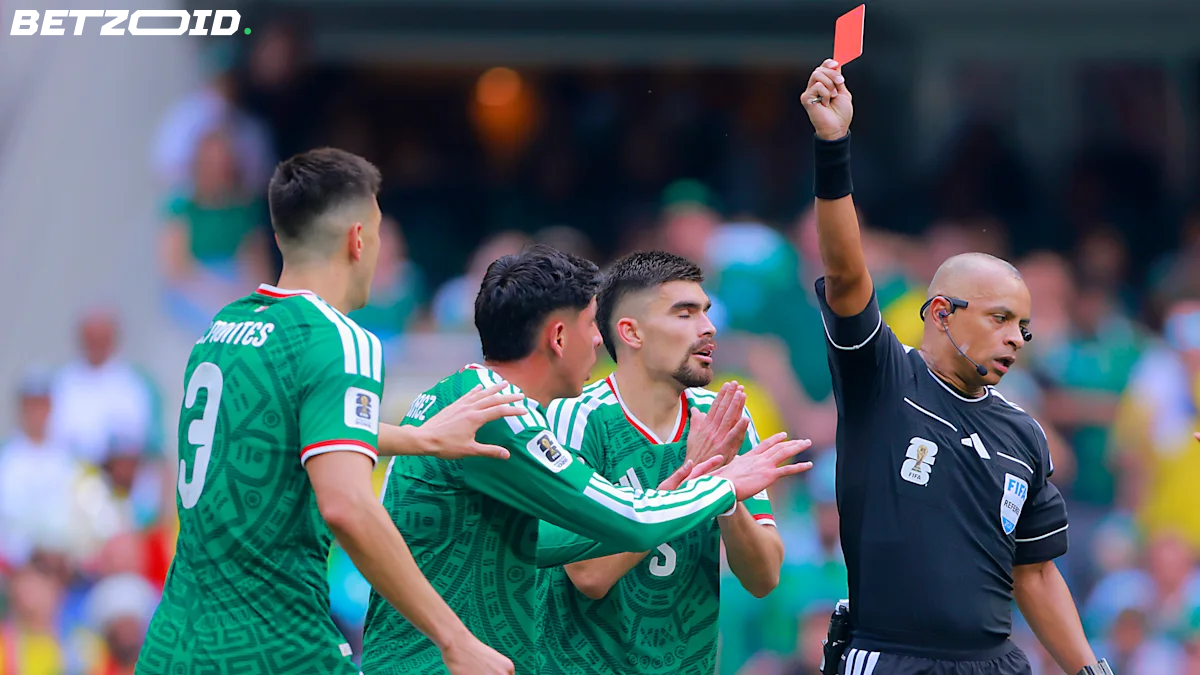
The 2026 FIFA World Cup hasn't even cleared its first week and it's already produced more off-pitch drama than most tournaments manage in their entirety. Visa denials, political protests, a referee accused of flashing hate symbols, record red cards, and stadium seats that are technically full — apparently. Here's what's actually been happening.
The moments that actually mattered on the pitch
The opening match between South Africa and Mexico set the tone immediately — and not in a good way. Three red cards. César Montes for Mexico, Sphephelo Sithole and Themba Zwane for South Africa, all gone. That's the most dismissals in a single World Cup game since the 2006 Battle of Nuremberg, when Portugal and the Netherlands had four players sent off in one of the ugliest matches in tournament history. For context: the entire 2022 Qatar World Cup produced just four red cards total. This game matched that in 90 minutes.
Those suspensions matter. Mexico already looked shaky in front of a home crowd. Losing Montes for the next game reshapes their defensive options at the worst possible time, and their odds of progressing comfortably from the group just got more complicated.
On the other end of the emotional spectrum: Cape Verde goalkeeper Vozinha, 40 years old, playing in his nation's first-ever World Cup match, pulled off seven saves against Spain — the reigning European champions — to earn a 0-0 draw and the player of the match award. He broke down in tears on the pitch afterward. His mother wasn't there. She couldn't get a U.S. visa in time due to the cost of the application process. "I would like her to be here," he said simply. That one stings.
The political mess running alongside the football
Iran's situation is the most layered. The team's base camp was moved from Arizona to Tijuana after the U.S.-Israel conflict with Iran began in February, and coach Amir Ghalenoei says his players were ordered onto a plane to Mexico minutes after their 2-2 draw with New Zealand — no recovery time, no overnight stay in California as planned. "They didn't even give us time to recover," he said. FIFA and the U.S. State Department haven't responded to requests for comment.
At the same match in Los Angeles, Iranian fans in the crowd were split down the middle — some supporting the national team, others booing them and waving the pre-1979 lion-and-sun flag as a protest against the current Iranian government. FIFA had attempted to ban such flags. Fans brought them in anyway.
Somali referee Omar Artan never even made it to a match. He was stopped at Miami International Airport and denied entry by U.S. Customs and Border Protection, which cited "vetting concerns" and alleged association with suspected terror organization members. Artan says he had the correct visa. He's back in Mogadishu now, where thousands greeted him at a stadium. He says he'll be at the 2030 World Cup in Spain, Portugal and Morocco instead.
Australian VAR official Shaun Evans spent part of the week denying that a hand gesture caught on camera during Germany vs. Curaçao was an intentional white supremacist symbol. FIFA investigated and found no breach of its disciplinary code. Evans called it "an involuntary, subconscious twitch" and pointed out that photos showed him making the same movement repeatedly while holding a pen. Anti-discrimination group Fare had called for his removal from the tournament. He remains.
Empty seats and eye-watering prices
Viral photos from the South Korea vs. Czech Republic match in Guadalajara showed large sections of empty seats. FIFA's response was that the stadium was nearly sold out and fans had simply chosen to watch from the concourses rather than sit in their assigned spots. Whether you believe that depends on your appetite for PR statements dressed up as explanations.
The same pattern — empty-looking seats, FIFA insisting everything was fine — appeared at Switzerland vs. Qatar and Japan vs. Netherlands. At the latter, volunteers were reportedly used to fill seats.
The pricing context makes it worse. Group-stage tickets started at $140 this cycle, up from $69 in Qatar. Final tickets at MetLife Stadium in New Jersey were initially listed at up to $8,680. That price has since been revised — upward — first to $10,990, then to $32,970. The 2022 final's most expensive ticket was around $1,600. FIFA has sold over six million tickets total, but "sold" and "occupied" are clearly not the same thing.
Three weeks of this left. It's going to be a long tournament.