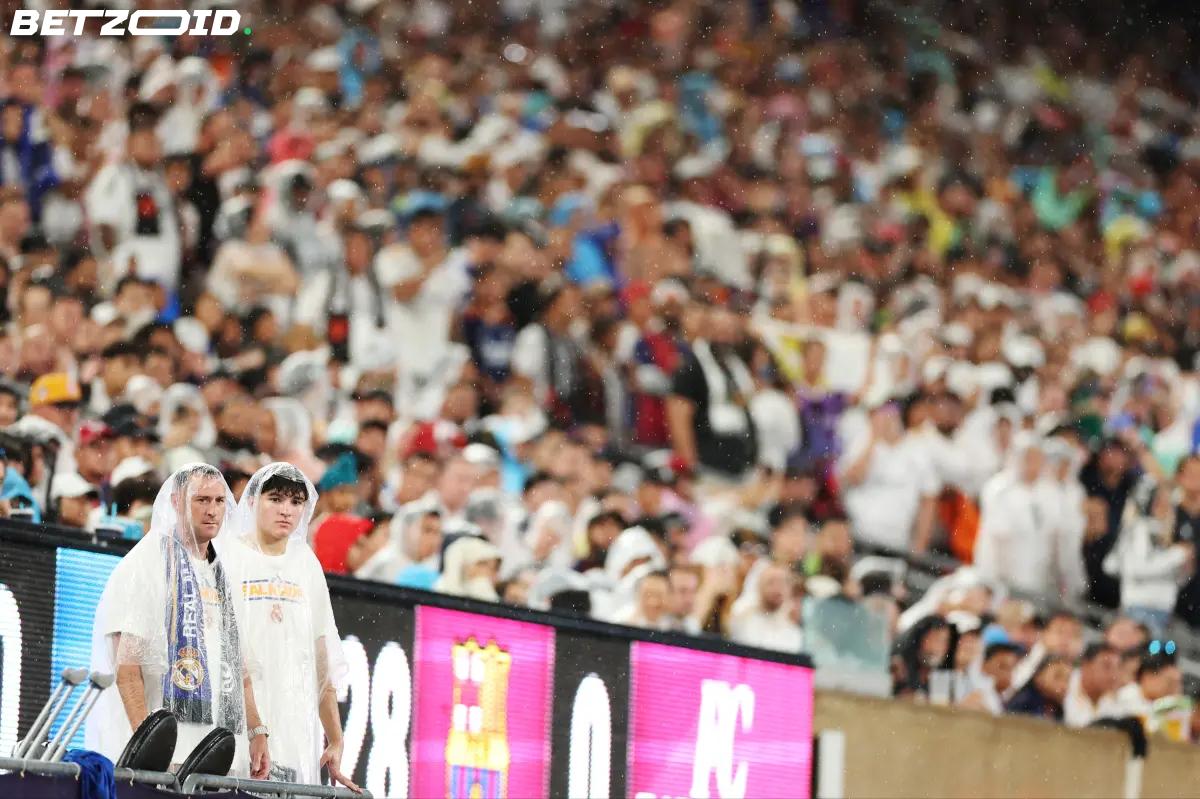
FIFA doesn't have a cut-off point for calling off matches due to weather. None. And with the World Cup landing in the United States in June and July — peak thunderstorm season — that's a serious structural problem waiting to play out on the biggest stage in football.
Here's how it works in America: any sporting event within eight miles of a lightning strike must stop immediately. The clock to restart doesn't start ticking until 30 minutes pass with no further lightning detected. If another bolt hits before that window closes, the count resets from zero. There is no upper limit on how long that loop can run.
Chelsea vs Benfica was the warning shot
This isn't a theoretical concern. Last summer's Club World Cup offered a preview nobody wanted. Chelsea's round of 16 clash against Benfica was suspended for nearly two hours due to storms. By the time the final whistle blew, over four and a half hours had passed since kick-off. Chelsea eventually lifted the trophy, but the delay was a logistical mess that left fans stranded and broadcasters scrambling.
Now scale that up. The United States hosts 78 of the tournament's 104 matches across 11 cities, with the competition running from June 11 through July 19. Miami. Atlanta. Houston. Kansas City. These are cities where summer thunderstorms aren't a risk — they're a routine. The Gulf Coast and Southeast see some of the most active lightning seasons in the world during these exact months.
MetLife Stadium hosts the final. It has a roof problem: it doesn't have one.
What this means beyond the inconvenience
For the millions of international fans making the trip, many will have never encountered this before. Rain doesn't stop a football match. Lightning does — the moment it's detected nearby, regardless of what the sky looks like directly overhead. That distinction is going to catch people off guard, repeatedly.
From a betting perspective, weather-suspended matches create real complications. In-play markets freeze. Accumulators involving delayed games become unpredictable. If a match kicks off in clear skies and then stalls for 90 minutes mid-game, the pre-match analysis becomes increasingly irrelevant — momentum, fitness levels, and tactical setups all shift during long suspensions in ways that are impossible to price accurately.
FIFA has managed extreme heat and heavy rain before. But a tournament where matches could legally be paused indefinitely, with no mechanism to call them off and restart later, is a different kind of chaos. One major storm rolling through Atlanta during a quarterfinal could turn a 90-minute match into a five-hour ordeal with no guarantee of resolution that night.
The tournament schedule has no buffer built in for this. And FIFA, for all its experience, hasn't offered a protocol that addresses it.