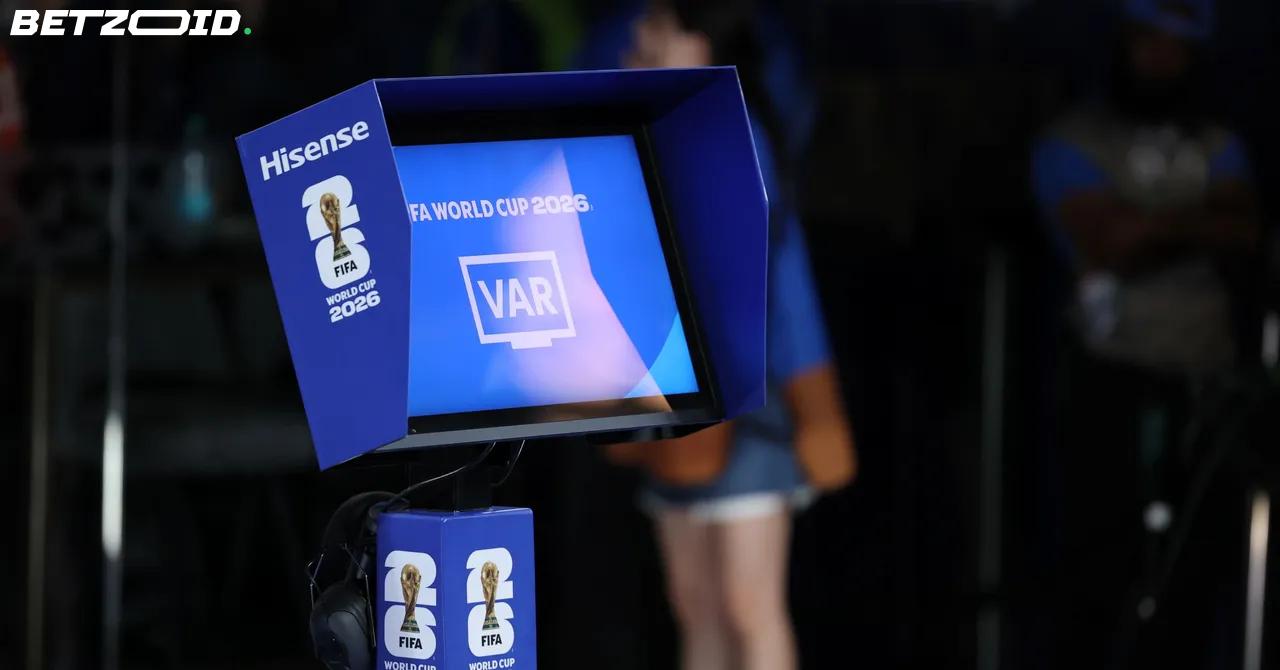
"The Egyptian Football Association cannot remain silent." That's the official line after Argentina eliminated Egypt 3-2 in the Round of 16 — a match Egypt led by two goals before watching it unravel under a cloud of disputed refereeing calls. The Egyptian FA has now filed a formal protest with FIFA, citing what it called "the failure to properly use VAR."
Whether or not FIFA takes action, the protest points to something real. VAR controversies have followed this World Cup like a shadow from the opening round, and the Argentina-Egypt match just turned up the volume.
The cameras work. The humans are the variable.
Here's the part that gets lost in every VAR argument: the technology is not broken. Forty-two broadcast cameras, including eight super-slow-motion feeds and four ultra-slow-motion feeds. Semi-automated offside detection. A dedicated team of four VAR officials reviewing separate angles simultaneously. FIFA even expanded VAR's remit for this tournament — second yellow card errors, pre-set piece infractions, and the new "Prestianni-Vinícius Rule" penalizing players who cover their mouths during confrontations.
The infrastructure is serious. The problem is the interpretation.
Armando Archundia, a former Mexican World Cup referee, puts it plainly: "It is the individual judgment of each referee that makes the decision, because not even VAR is going to support them in that regard." All those cameras feed into a system that still ends with a human being making a call shaped by their experience, their biases, and how well they actually know the tool they're using.
And that's where the 2026 World Cup has a structural problem. According to Archundia, only 20 percent of the countries whose referees are participating in this tournament have VAR in their domestic leagues. FIFA runs training camps — around four per year across the four-year cycle between World Cups — but training sessions and actually officiating VAR-reviewed matches week in, week out are not the same thing.
Consistency is the real crisis
Sports analyst Fernando Galván, host of the podcast Más que Tres Puntos, identifies the deeper issue: refereeing is a fragmented profession with no unified global standard. "Achieving unanimous criteria on a global level is almost impossible," he says. That was true before VAR existed. VAR didn't fix it — it just gave everyone higher-definition footage of the inconsistency.
Galván also traces an uncomfortable pattern from previous tournaments: referees who stopped making decisions and outsourced everything to VAR, creating a different kind of error — delay, confusion, and matches ground to a halt for reviews that ended up confirming what the referee should have called in real time. FIFA's updated guidelines for 2026 are designed to push authority back toward the on-field official, using VAR as a check rather than a replacement. A reasonable idea in theory. In practice, it only works if the referee was well-equipped to make the call in the first place.
None of this makes Egypt's elimination more or less deserved. But the broader pattern — teams watching goals wiped or penalties waved away through VAR interventions that feel inconsistent from match to match — is why complaints like Egypt's land with weight even when the specifics are disputed.
VAR was supposed to bring certainty to the moments that matter most. Eight years after its World Cup debut, it's brought more cameras, more review time, and the exact same arguments — just in higher resolution. Anyone pricing markets on "controversial VAR decisions" has had a busy tournament.
"Refereeing and soccer will continue to be played by humans," Archundia says, "and humans will surely continue to officiate them as well — until soccer changes its name."