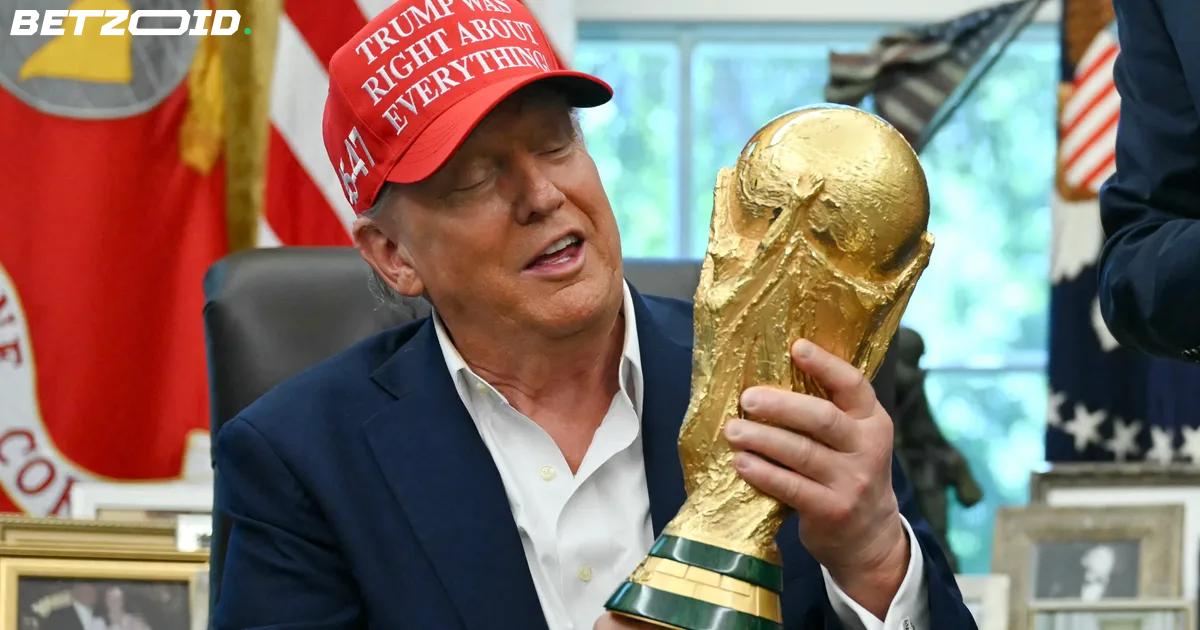
"The worse that Donald Trump's approval ratings get, the more incentive he has to cling to sports as a sort of political life raft." That's not a opposition talking point — that's Jules Boykoff, a Pacific University professor, former U.S. under-23 international, and one of the sharper minds in international sports politics.
With the FIFA World Cup less than a month away, Boykoff has laid out in forensic detail — in his new book Red Card — exactly how Trump is using the tournament to engage in sportswashing. The comparison he reaches for isn't flattering: Benito Mussolini's handling of the 1934 World Cup.
"If you look at the way Mussolini cozied up to the athletes at the World Cup in 1934, he just wanted to be around these kinds of macho guys," Boykoff told HuffPost. "You can see the same kind of thing that Trump does all the time."
The FIFA Peace Prize says everything
The most glaring example of the arrangement Boykoff describes is the FIFA Peace Prize, handed to Trump by FIFA president Gianni Infantino months before U.S. military action in Iran — with Infantino citing Trump's "unwavering commitment to advancing peace and unity" as justification. The prize didn't previously exist.
"As ludicrous as the prize might sound to a lot of people, to him, he looks important," Boykoff said.
It's a transaction that fits Boykoff's broader framing of FIFA as a "grift machine" — a federation still trailing the stench of its mid-2010s corruption scandal — now lending institutional credibility to a president whose domestic approval is under pressure. Trump's also been spotted at UFC events, invited Messi to the White House, and is planning a "Freedom 250" fight card on the South Lawn ahead of the tournament. The pattern is consistent.
Mussolini, for context, used the 1934 tournament to push fascism openly — even commissioning the Coppa del Duce, a trophy larger than the Jules Rimet itself, for the winning Italian side. The 1936 Berlin Olympics and the 1978 World Cup under Argentina's military junta followed the same template. Sportswashing didn't start in the 21st century. It just got rebranded.
The fan access problem FIFA won't address
Beyond the optics, there's a practical dimension that cuts against the tournament's stated ethos of inclusion. Supporters from qualifying nations including Haiti and Iran are barred from entering the U.S. under Trump's travel ban. Human rights groups have flagged the tournament as a potential sportswashing "bonanza," and the matches carry high-level special event security ratings — which means federal law enforcement presence at stadiums could be significant.
Boykoff's concern isn't abstract. He points out that this World Cup is the first since FIFA mandated that bidding countries outline human rights risks in their hosting bids — a direct consequence of the Qatar controversy. "And yet we can see that there are serious concerns over human rights," he said.
- Fans from Haiti and Iran blocked by travel ban from attending matches
- ICE presence at stadiums a growing concern for foreign supporters
- FIFA Peace Prize awarded to Trump months before the Iran conflict began
- 2026 is the first World Cup under FIFA's post-corruption human rights framework
"FIFA often says 'football unites the world,'" Boykoff said, "but Trump is obviously putting lie to that by not allowing many people from countries that have qualified into the United States to even watch matches."
For anyone pricing up the tournament's broader political atmosphere — and the scrutiny that will follow every U.S. government interaction with it — Boykoff's framework is the clearest lens available. The World Cup arriving in North America next month isn't just a football event. It's a stage, and the staging is deliberate.