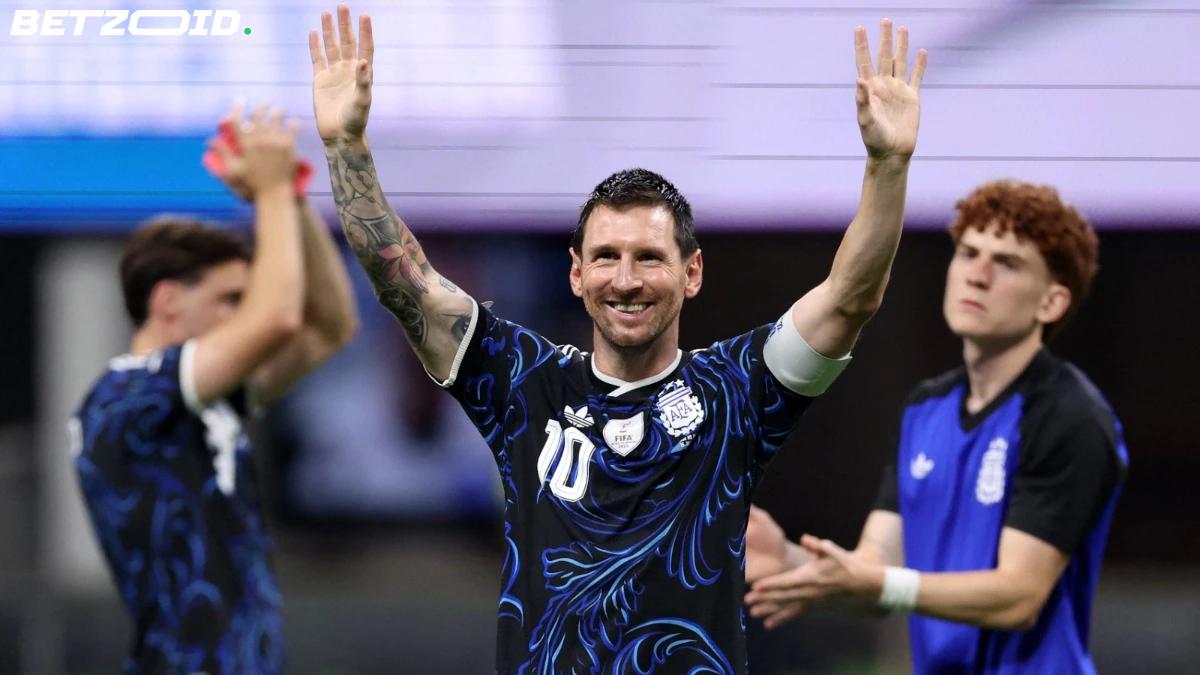
Three days from his third World Cup final, Lionel Messi remains the most misread leader in modern sport. Not because people stopped watching. Because they kept looking for the wrong thing.
For years, Argentina measured captaincy against Diego Maradona — magnetic, volcanic, impossible to ignore. Messi was none of that. He rarely gave rousing speeches. He didn't dominate dressing rooms. Critics called it absence. What it actually was took a little longer to understand.
He is 39 years old. He has won the World Cup, two Copa Americas, the Finalissima, and is three days away from another final. The debate about whether he could lead Argentina feels almost embarrassing in hindsight.
Failure built this version of Messi
The strongest leadership stories don't start with trophies. They start with the moment everything falls apart.
Messi lost the 2014 World Cup final to Germany in Rio. Then back-to-back Copa America finals in 2015 and 2016. Each defeat sharpened the criticism. After the Copa America Centenario final loss, he announced his international retirement. That was the lowest point — not a defeat, but a withdrawal.
What followed said everything. Campaigns launched across Argentina urging him to return. Politicians appealed. Former players pleaded. The reaction revealed that even amid the criticism, an entire nation had built its football identity around him without fully realising it. He came back. And the transformation that followed was not of his talent — that was never the question — but of his relationship with the shirt.
When Lionel Scaloni took charge after Argentina's chaotic 2018 World Cup exit, he didn't build a team that depended on Messi. He built a team that trusted him. The difference is not semantic. One creates fragility. The other creates culture.
Players like Rodrigo De Paul, Emiliano Martinez, Enzo Fernandez, Alexis Mac Allister, and Julian Alvarez emerged as genuine leaders in their own right. De Paul has half-jokingly called himself Messi's on-pitch bodyguard. Martinez has spoken repeatedly about the squad's desire to win for Messi. Giuliano Simeone — son of Diego, winger for Atletico Madrid — got emotional talking about him ahead of this final: "Leo is 39 years old, he has everything a footballer could dream of and is still fighting like the best. So for us, there's only one thing left: give everything we have, run for him and for Argentina."
That's not admiration for a great player. That's trust in a leader.
Leadership is contextual — PSG proved it
The Paris chapter complicates the narrative in useful ways. When Barcelona's financial collapse forced Messi out in 2021, he joined PSG — a rational decision on paper. Competitive project, global platform, financial security. It never worked.
He later admitted he didn't enjoy the period. And while it's tempting to treat PSG as a blip, it's actually one of the more instructive parts of the story. Paris already had multiple power centres, competing egos, and a culture built around superstar individualism. The same qualities that made Messi the emotional anchor of Argentina produced nothing comparable at PSG. He was still a world-class footballer. He just wasn't the right fit for what that environment needed — or what it was willing to become.
Harvard Business School examined a version of this when Anita Elberse built a case study around David Beckham recruiting Messi to Inter Miami — not as a football story, but as an organisational transformation story. The findings tracked what happened when Messi arrived in 2023: attendance surged, merchandise sales soared, MLS's global visibility expanded measurably, and Inter Miami began operating less like a developing franchise and more like an emerging brand. Messi didn't just add value. He changed what the organisation thought was possible.
Argentina did the same thing, over a longer timeline, with higher stakes.
- 2021 Copa America — Argentina's first major title in 28 years
- 2021 Finalissima — beat Italy, the European champions
- 2022 World Cup — Qatar, the one everyone remembers
- 2024 Copa America — back-to-back continental titles
- 2026 World Cup Final — three days away
This is not a coincidence of talent. Argentina have always had talent. What changed was the culture around him, and the leadership he modelled inside it.
Whether Argentina lift another trophy on Sunday will dominate the headlines. It won't change what his career already demonstrates: that the captain who was criticised for being too quiet built the loudest legacy in Argentine football history. Quietly, consistently, and on his own terms.