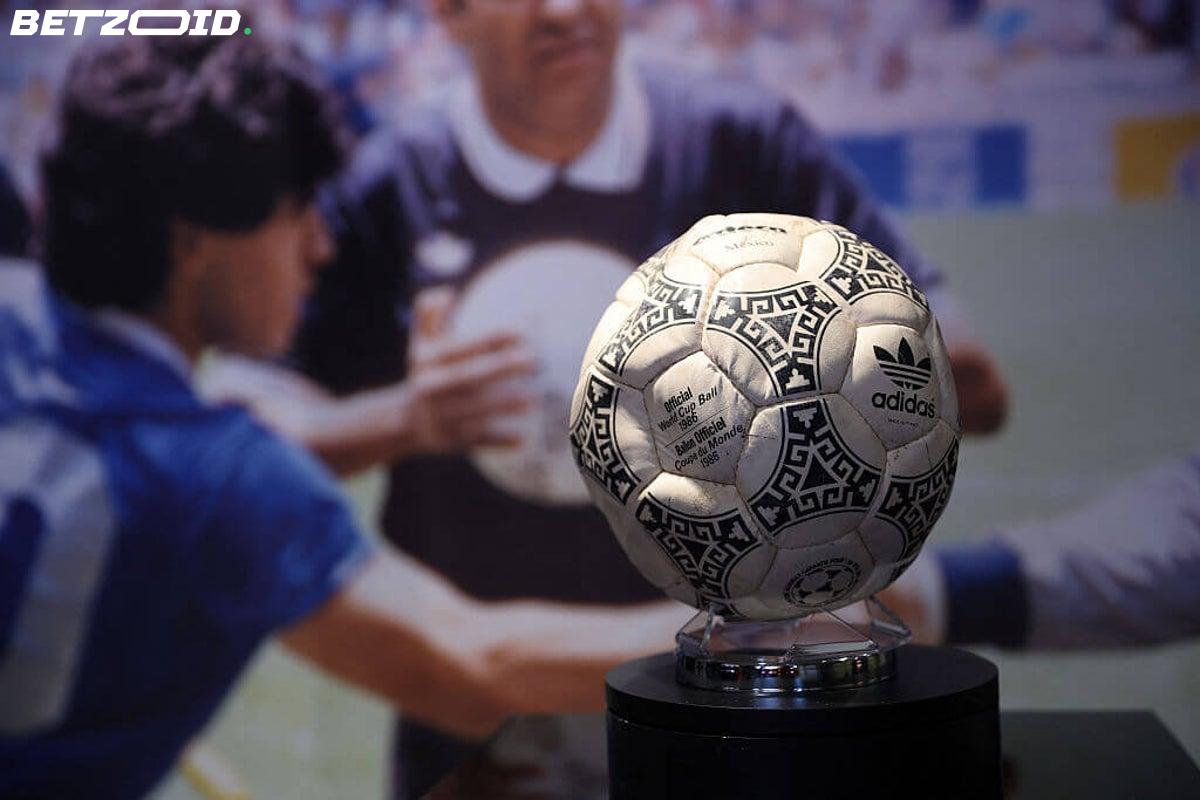
"It just shut down the whole department." That's Heritage Auctions production manager Mike Provenzale describing the moment the 1986 World Cup match ball arrived at his office — the same ball Diego Maradona used to score two of the most talked-about goals in football history within four minutes of each other.
It's heading to auction at Heritage starting at the end of July, with bidding closing the weekend of August 21-23. The estimate? $10 million.
That number isn't pulled from thin air. Maradona's shirt from that same Argentina vs England quarter-final sold for $9.28 million at auction in 2022, making it the most expensive football jersey ever publicly sold. Provenzale's argument is straightforward: the ball touched the net twice that afternoon. The shirt was just along for the ride.
Why this one is different from the 2023 attempt
This isn't the ball's first time on the block. Goldin auctioned it in February 2023 and received a final bid of $2.04 million — but it never sold. The consignor had set an undisclosed reserve price that the bidding failed to reach. Heritage's auction will also carry an undisclosed reserve, though Provenzale describes it as "modest based on the importance of the item."
What's changed since 2023 is the photo-matching. The ball has now been forensically verified to both the Hand of God and the Goal of the Century — two separate goals, same ball, same match. That dual verification is what gives the current owner leverage to hold out for a price that reflects the full weight of what this object witnessed.
The ball originally ended up with Ali Bennaceur, the Tunisian referee who officiated the match. FIFA's own policy, at least as stated in 2014, is that World Cup match balls go to referees, teams, host cities, and partners as souvenirs. At some point it was sold privately, and the current consignor has been sitting on it ever since — waiting, as Provenzale puts it, "for technology to catch up" so the photo-matching could be confirmed.
The context you can't separate from the price
June 22, 1986. Azteca Stadium, Mexico City. Argentina vs England, four years after the Falklands War. The match already had political weight before a ball was kicked. Then Maradona punched it into the net past Peter Shilton in the 51st minute — a handball the referee missed, a goal that stood. Four minutes later, he picked the ball up in his own half, ran 60 metres, beat six England players, and scored what FIFA later named the Goal of the Century. Argentina won 2-1 and went on to lift the World Cup.
Maradona eventually admitted the first goal was deliberate. By then it didn't matter. The "Hand of God" had already embedded itself into football's identity in a way no other single moment has managed.
The ball is now deflated — naturally, over time — and Provenzale sees that as part of its authenticity. "If it was a $1,000 soccer ball, I'm sure someone would have repaired the bladder inside," he said. The repair would cost about $100. Nobody's touched it.
Also up for auction separately, at Sotheby's: the captain's armband Maradona wore in the same match and the 1986 World Cup final against West Germany. As of Tuesday's bidding, it had reached $130,000 — which, next to a $10 million ball estimate, almost looks like a bargain.