Spain are world champions. But the tournament that ended at MetLife Stadium will be remembered less for the football and more for the chaos that surrounded it — a relentless series of controversies that started before the opening whistle and ended with punches thrown on the pitch in New York.
Here's what actually happened.
Trump called Infantino. Balogun played. Belgium won 4-1 anyway.
The single most surreal story of the tournament: USMNT forward Folarin Balogun received a red card against Bosnia and Herzegovina after a VAR review confirmed his cleat caught Leeds United centre-back Tarik Muharemović's ankle. Standard stuff. He'd miss the round of 16 against Belgium. Also standard.
Then Donald Trump held a White House press conference and claimed he personally called FIFA president Gianni Infantino to request a review of the suspension. The next day, the ban was lifted. Balogun was in the starting XI against Belgium.
Belgium were "astonished." Their appeal was denied hours before kickoff. And then — with the world watching to see whether the political intervention mattered — Belgium dismantled the United States 4-1. Balogun was kept quiet from the opening minutes.
Pochettino defended the outcome. Balogun, to his credit, was honest about it afterward: "I knew it was going to cause a lot of controversy. And I could almost see within my teammates a bit of nerves because it's something that is so unique." That quote tells you everything about the atmosphere inside the camp. The suspension reversal didn't help them win. It just made losing messier.
VAR's worst tournament yet
VAR was supposed to remove the controversy. At World Cup 2026, it generated most of it.
The Argentina-Egypt round of 16 match is where it got genuinely ugly. Egypt led 2-0 with 11 minutes left — on the verge of eliminating the defending champions — when VAR recalled an incident from 17 seconds before Mostafa Ziko's goal: Egypt's Marwan Attia stepping on Lisandro Martínez's foot. The goal was ruled out. Argentina scored three times in the closing stages, including in the 92nd minute, to win 3-2.
The Egyptian Football Association filed a formal complaint against French referee Francois Letexier and his assistants. Their frustration extended beyond the disallowed goal — the players had also appealed for a penalty when Hamdy Fathy went down in the Argentine box, and Letexier waved it away moments before Argentina's winner. Professor Simon Chadwick put it bluntly to Al Jazeera: "A sense of injustice was induced by the VAR decision. This technology was supposed to minimise doubt and bring consistency. Instead, its use during this match had significant cognitive and behavioural effects."
Germany were next to feel the VAR axe. Facing Paraguay in the round of 32 with the game level at 1-1 in extra time, Jonathan Tah headed what looked like a winner — only for VAR to rule that Waldemar Anton had fouled the Paraguay goalkeeper in the build-up. Germany lost on penalties, 4-3. Thomas Müller, now playing his club football at Vancouver Whitecaps, was incandescent: "We, the Germans, feel used and cheated. This is wrong. This is daylight robbery on the biggest stage in football."
Norway's quarter-final exit against England involved yet another disallowed goal, this time Erling Haaland ruled to have pushed Elliot Anderson to the floor before a corner kick. And in the final itself, Nico Williams' opening goal for Spain was ruled out after VAR spotted Mikel Merino fouling Nicolas Otamendi during the build-up.
Four major VAR reversals across four different matches at the knockout stage. The pattern doesn't suggest bad luck. It suggests a tool being applied inconsistently enough that no team can trust what counts and what doesn't.
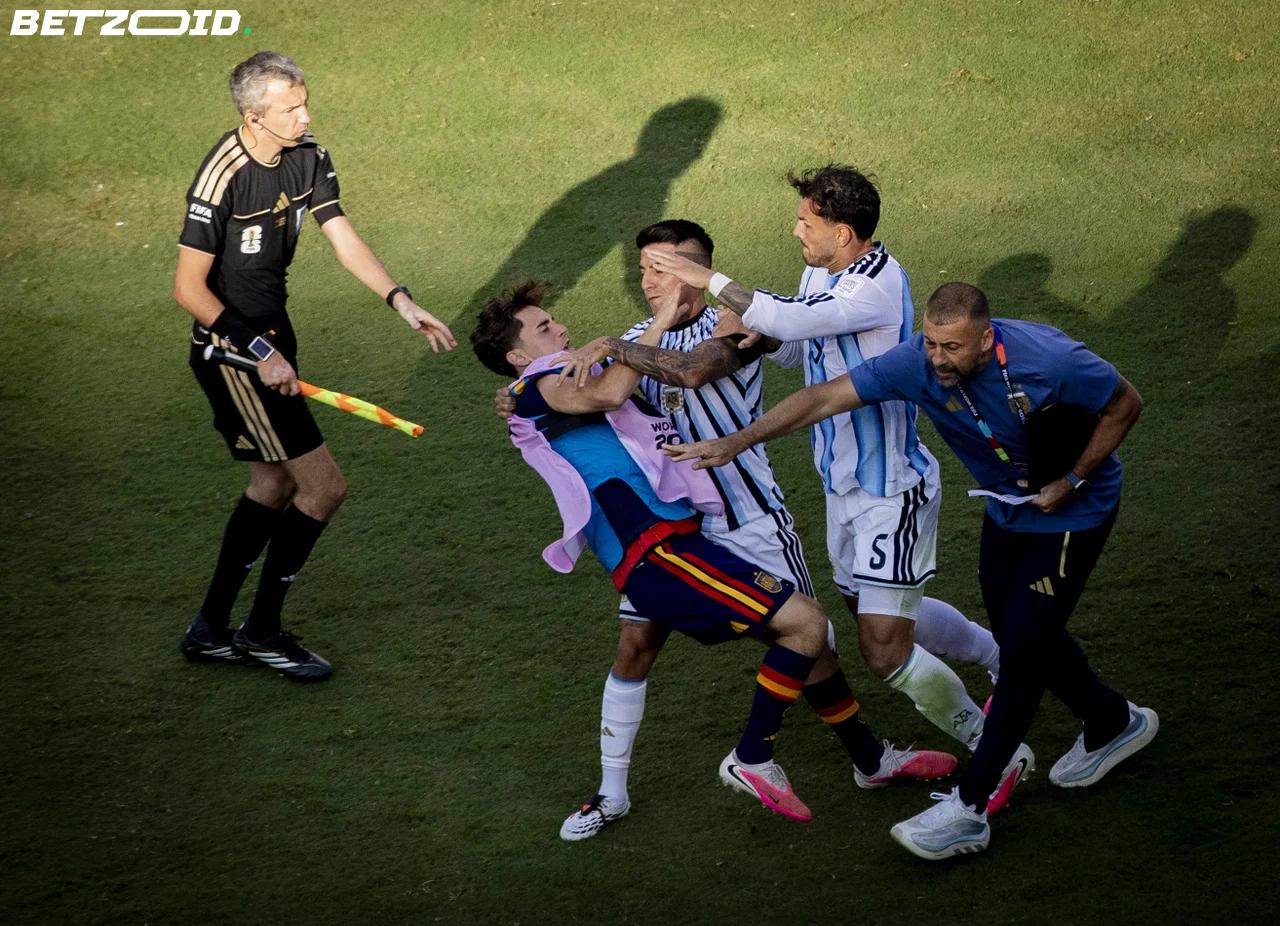
The final ended with Molina throwing punches at Rodri
Argentina went into the final as defending champions and managed two shots — both late in extra time, when they were already losing. Enzo Fernández was sent off with two yellow cards, reducing them to ten men at the worst possible moment.
When the final whistle confirmed Spain as champions, it didn't cool tempers. Nahuel Molina, Leandro Paredes, and Thiago Almada were all involved in a mass brawl involving players from both sides. Molina drew the most attention: replays appeared to show him punching Spanish captain Rodri, triggering the chaos.
It was likely Lionel Messi's last World Cup. That's the context around those final minutes — a generational player's career ending not with a title defence but with a 1-0 defeat and a teammate throwing punches at the opposition captain.
Elsewhere: FIFA refused to let France players wear black armbands to honour Didier Deschamps' mother, who passed away during the group stage. The FFF had formally requested permission. FIFA said no. The mandatory hydration breaks — new to this tournament — drew boos from stadium crowds and criticism from coaches including Deschamps and Norway's Ståle Solbakken, though opinion shifted slightly as the tournament moved to hotter venues.
Spain won the World Cup. The officiating, the politics, and the punches will take longer to settle.