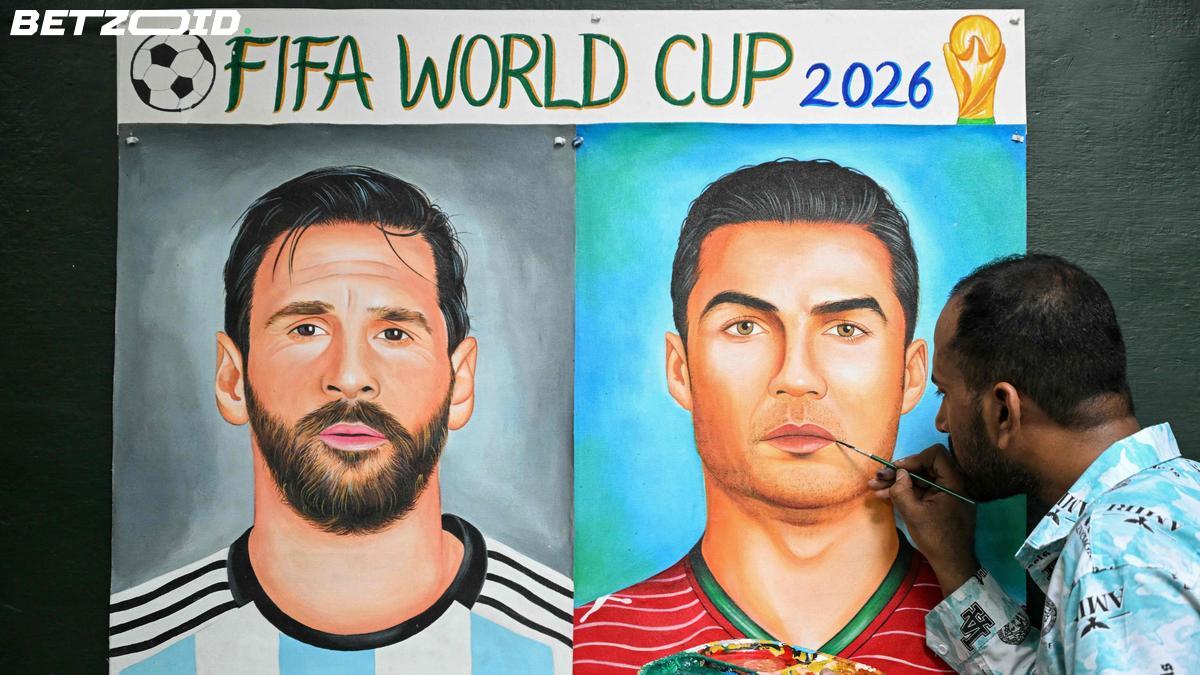
The two greatest players of their generation — possibly of any generation — have shared nearly every stage imaginable. La Liga title races. Champions League finals. Ballon d'Or ceremonies. And yet, at the one tournament bigger than both of them, they have never once played each other.
That's not misfortune. That's football being genuinely poetic for once.
Messi and Ronaldo are heading into a record sixth World Cup in 2026, and the draw has set up a possible Portugal versus Argentina quarterfinal in Kansas. So the meeting everyone assumed would never come might actually happen. Whether it carries the weight people think it will is a different question entirely.
What the World Cup meant — and cost — each of them
For Messi, the World Cup was always the wound that wouldn't close. Six La Ligas. Four Champions Leagues. Eight Ballon d'Ors. And for years, none of it felt like enough because Maradona had done the one thing Messi hadn't. That shadow followed him from Germany in 2006 — where he arrived with a dodgy knee and the weight of a nation's expectations — all the way through four more heartbreaks before the release finally came at Lusail in December 2022. He got there. He won it.
Ronaldo's World Cup record is a stranger story. He's gone to five tournaments, reached the semifinal at his first in 2006, and never bettered it. Not a single knockout-stage goal across the following four editions. There are iconic moments — the wink after Rooney's red card, the hat-trick against Spain in 2018 — but as a body of World Cup work, it's thin. He enters 2026 still chasing a legacy the tournament has never quite let him build.
A quarterfinal showdown that arrives four years too late
If Portugal and Argentina do meet in Kansas, it will be a spectacle. It won't be a rivalry-defining moment. That window closed somewhere around 2022, when both players were still operating close to their peaks and the result would have carried genuine historical stakes. Now, at whatever age Messi and Ronaldo have quietly reached in the Saudi and MLS eras respectively, a win would be a footnote — significant for the tournament, less so for how either man's career is ultimately remembered.
The game has moved on. The next generation of football is less built around singular gods and more around collective systems. Messi and Ronaldo remain exceptional — anyone claiming otherwise is performing cynicism — but they are no longer the axis around which world football turns.
Which makes 2026 something else: not a final chapter, exactly, but a coda. A chance to watch two players who defined an era play one last World Cup in a world that has already started writing the next one. The poetry isn't in whether they finally meet. It's in the fact that even now, they're both still here.