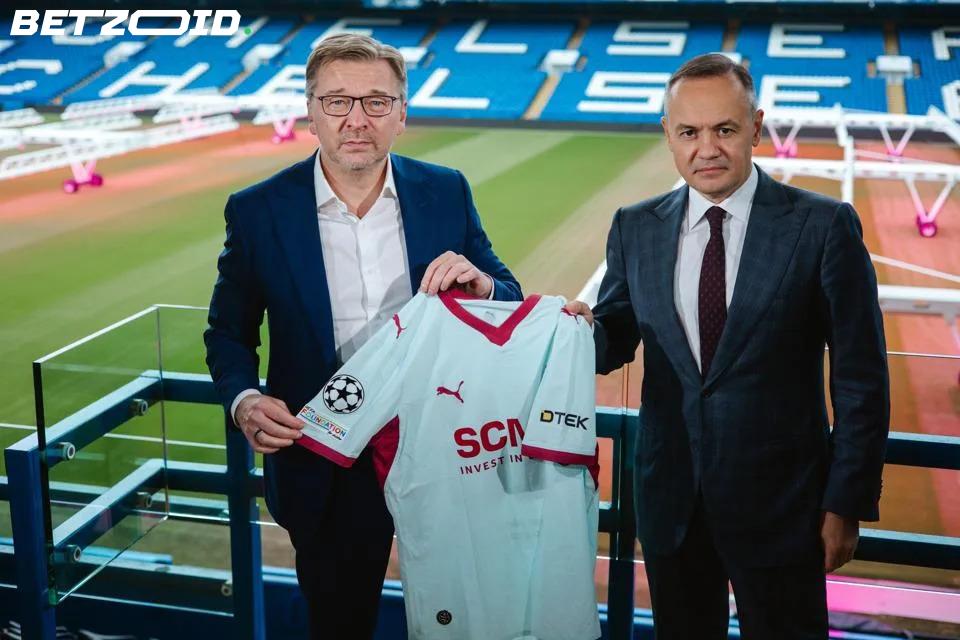
Shakhtar Donetsk will play their first Champions League home game of the season at Chelsea's Stamford Bridge, hosting Greek side AEK Athens on Wednesday, October 14. It is the latest stop in a search for a temporary home that has continued every season since the club was forced out of Donetsk.
Shakhtar's last match at the Donbas Arena was on May 2, 2014, after which the club played its domestic home games in Lviv, Kharkiv and Kyiv. Since Russia's full-scale invasion in 2022, Ukrainian league matches have continued behind closed doors. The club's European home has moved almost every year since: Warsaw in 2022/23, Hamburg in 2023/24, Gelsenkirchen in 2024/25 and Krakow in 2025/26. Stamford Bridge became available because Chelsea failed to qualify for Europe this season.
In early August, a Russian ballistic attack destroyed a PUMA logistics warehouse near Kyiv that housed the supply of Shakhtar's fan jerseys, leaving the club with limited stock to play in.
Two sources of income
CEO Serhii Palkin, in the role since 2004, says running the club in wartime bears no resemblance to peacetime. "We had many sources of income, like ticketing, sponsors, partnerships, broadcasts," he says. "Now we lost all this. We have just two sources of income: sales of players and bonuses from UEFA."
Palkin says Shakhtar's income reached up to $400 million across the four seasons since the invasion. "Having in mind that we have war in our country, these are quite good results," he says. "It's helping us to survive from a financial point of view."
Every club in the Champions League league phase receives a starting fee of €18.62 million, plus €2.1 million per win and €700,000 per draw, a significant step up from the Conference League, where Shakhtar spent last season, reaching the semi-finals before losing to eventual champions Crystal Palace, and where a league-phase win is worth €400,000. Shakhtar reached this season's Champions League by winning the Ukrainian title last season, their third since the invasion, in a league played behind closed doors.
The club is now coached by Arda Turan, who told Sky Sports of the unique demands of the job: "at a regular club, you can go back to your house a few hours after a trip, but here, it is not like that. Sometimes it takes more than a day and you can only start working again after 48 hours."
The Mudryk benchmark
Developing and selling young talent remains central to Shakhtar's model. Palkin calls the sale of Mykhailo Mudryk to Chelsea in January 2023, for €70 million up front plus up to €30 million in bonuses, the biggest sale in Ukrainian soccer history. "If you're selling a player for €100 million during wartime, for us it's a big change," he says. According to CNN, owner Rinat Akhmetov put $25 million of the proceeds into Heart of Azovstal, a fund for soldiers and their families.
The war initially disrupted that pipeline. FIFA allowed foreign players in Ukraine to suspend their contracts after the invasion, and most of Shakhtar's Brazilian players left for nothing. The club sought at least €50 million in compensation from FIFA over a ruling Palkin described as "unfair," according to the BBC.
Since then, deals have followed a pattern of smaller fees with long-term upside. Goalkeeper Anatoliy Trubin joined Benfica for €10 million, with Shakhtar keeping 40% of any future sale, according to A Bola. Midfielder Heorhii Sudakov followed to Lisbon in 2025 on a €6.75 million loan with an obligation to buy for €20.25 million, with Shakhtar retaining a 25% sell-on clause, according to Ukrainska Pravda. Palkin says Shakhtar now has the youngest squad in the Champions League, fielding players aged 19 and 20. "It's our strategy and we know how to manage it," he says.
Planning one day at a time
"The biggest challenge we have at this moment is uncertainty," Palkin says. "You cannot plan even for one day, for two days. I'm not talking about years." With UEFA money now one of Shakhtar's two remaining income streams, the Champions League also serves as a shop window. "We need to show very good, attractive football," he says. "For us it's very important to be visible on this stage."
Palkin describes Shakhtar's attacking style as the club's DNA, saying effort matters as much as results. "We can even lose, but give our 100% on the pitch," he says. "For people sitting in Ukraine and watching a Ukrainian club playing on this level, it's unbelievably important."
Playing in London carries its own significance, Palkin says: "a lot of Ukrainian refugees live there, so in the end, we have a good connection with all our diaspora and I believe all of them will come to our games, to our stadium, which means it's very important to have this kind of connection with people living in England and, for them, our club is like a connection to Ukraine, and this is the most important thing."
The long-term owner
Rinat Akhmetov has owned Shakhtar since 1996. His investment group SCM has been the club's title and front-of-shirt sponsor since 2006, and SCM says its businesses have invested more than $4.3 billion in Ukraine since the full-scale invasion.
Palkin calls Akhmetov "an architect of our strategy" and says the club is "part of his soul," adding that owners who remain in place for decades are rare. "If you check owners of clubs who stay more than 30 years, maybe you will find three or four guys in the world," he says.
DTEK on the shirt
This season, Akhmetov's energy company DTEK appears on Shakhtar's Champions League shirt for the first time, alongside an "Invest in Ukraine" message. DTEK CEO Maxim Timchenko, from Donetsk, says his family had "no other choice" but to support Shakhtar, and that most of DTEK's 55,000 employees back the club "not because of corporate rules, but by heart." He explains the connection: "Shakhtar is Ukrainian for 'coal mine', so, from the beginning of DTEK, 21 years ago, we were of course part of football, because of coal mining and Shakhtar."
Timchenko does not call the arrangement a sponsorship. "It's partnership," he says. "Thanks to Shakhtar and the president of Shakhtar, we have such outreach and access to hundreds of millions of people." He says DTEK has invested €2.4 billion in Ukraine since the full-scale invasion, more than any other company, repairing damage from Russian attacks and building new projects. According to DTEK's own data, Russian attacks have damaged 80-90% of its thermal generation capacity over four consecutive winters, its grid business distributes 40% of Ukraine's electricity, and 484 of its employees have been killed at work or while serving in the armed forces. "We need to move from words of support to real actions," Timchenko says.
The road home
Timchenko draws a parallel between the two organizations. "Shakhtar is already playing Champions League," he says. "I think DTEK, to some extent, is among the Champions League of energy companies of Europe."
Palkin describes the path home in stages: first bringing European soccer back to Ukraine, then eventually returning to Donetsk and the Donbas Arena. "We believe in this," he says. "It's difficult to live without a dream. Having this kind of dream gives you the resources to survive, to develop, to compete and to be ready to return one day back to Donetsk."