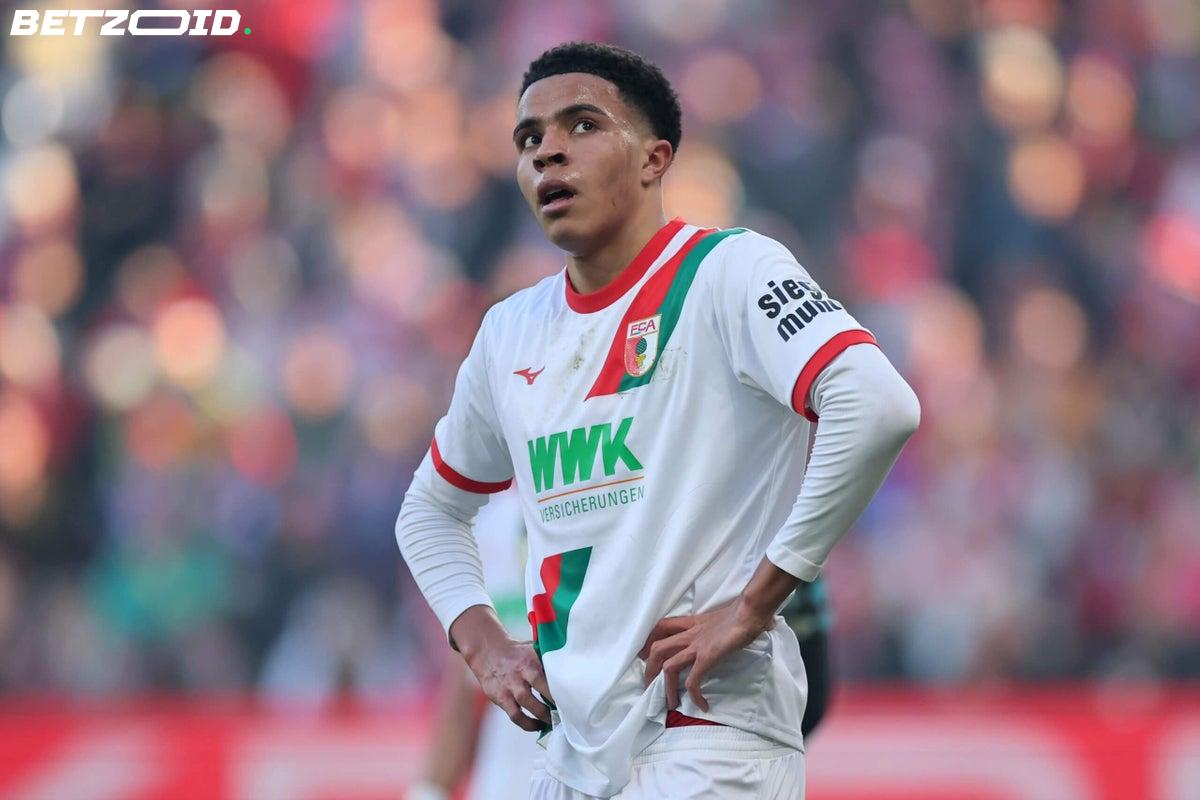
"I don't want to make my decision dependent on a World Cup." Noahkai Banks said that to Sky Sport Germany, and it's the most honest thing anyone has said in this entire conversation.
Banks is 19, plays central defence for FC Augsburg in the Bundesliga, and has been a dual national his entire life — born in Hawaii, raised in Bavaria since he was seven weeks old. His German is native. His English carries a German accent. He came through the Augsburg academy and has never lived in the United States as anything other than a visitor. And yet a significant corner of American soccer fandom is treating his hesitation over the USMNT like a personal betrayal.
Pochettino is recruiting, but Banks isn't ready
U.S. head coach Mauricio Pochettino has been actively courting Banks and confirmed as much after releasing his squad for March friendlies in Atlanta — a squad Banks was not part of. Pochettino described himself as something closer to a father figure in those conversations, which tells you everything about how he's reading the room. Banks got a look at the senior setup in September without being an active matchday player. He's clearly on the radar. He's just not ready to commit.
"He is thinking a lot," Pochettino told reporters. "He is in a situation that is not easy for him. He was very clear he was not available to be selected."
That's a 19-year-old being careful. That's not a red flag.
Banks has already represented the U.S. at U-17, U-18, and U-20 level, so this isn't a player who has shown indifference to the American program. But Germany hasn't formally come calling yet, and the possibility remains real. A four-time World Cup winner with a storied program isn't an easy thing to walk away from — especially when it's the country where you actually grew up.
Landon Donovan's take misses the point
Landon Donovan weighed in on his podcast, and while his passion for the USMNT is genuine and earned across 150-plus caps and three World Cups, his proposed solution — that players should only be eligible for the country where they were born — would gut the current U.S. player pool. Antonee Robinson, Sergiño Dest, Gio Reyna, Malik Tillman, Sebastian Berhalter, Cameron Carter-Vickers: all born abroad. Gone under Donovan's system.
The painful irony is that Donovan's own bitterness about being cut from the 2014 U.S. squad — a Jurgen Klinsmann team built significantly around German-Americans — appears to be doing some of the talking here. In his memoir, Donovan wrote that he believed some of those players "wouldn't give a f-- if we go out after three games." That's a real grievance. But projecting it onto Banks, who has played for U.S. youth teams and spoken diplomatically about feeling connected to both nations, isn't fair.
FIFA's one-time switch system exists precisely for situations like this. It works. Banks is entitled to use it.
The 2026 World Cup on home soil adds an obvious layer of urgency from the American side. A home tournament of that scale, with Banks potentially becoming one of its youngest players, is a genuine selling point. But if he's not certain, rushing him in on the back of tournament hype is exactly the kind of recruitment that produces half-committed players — which, to be fair, is the core of Donovan's concern.
Banks put it plainly: "I feel connected to both nations." That's not a dodge. For someone raised entirely in Germany but born American, it's just the truth. Whatever he decides, the reaction to that decision will say more about the people reacting than it does about him.