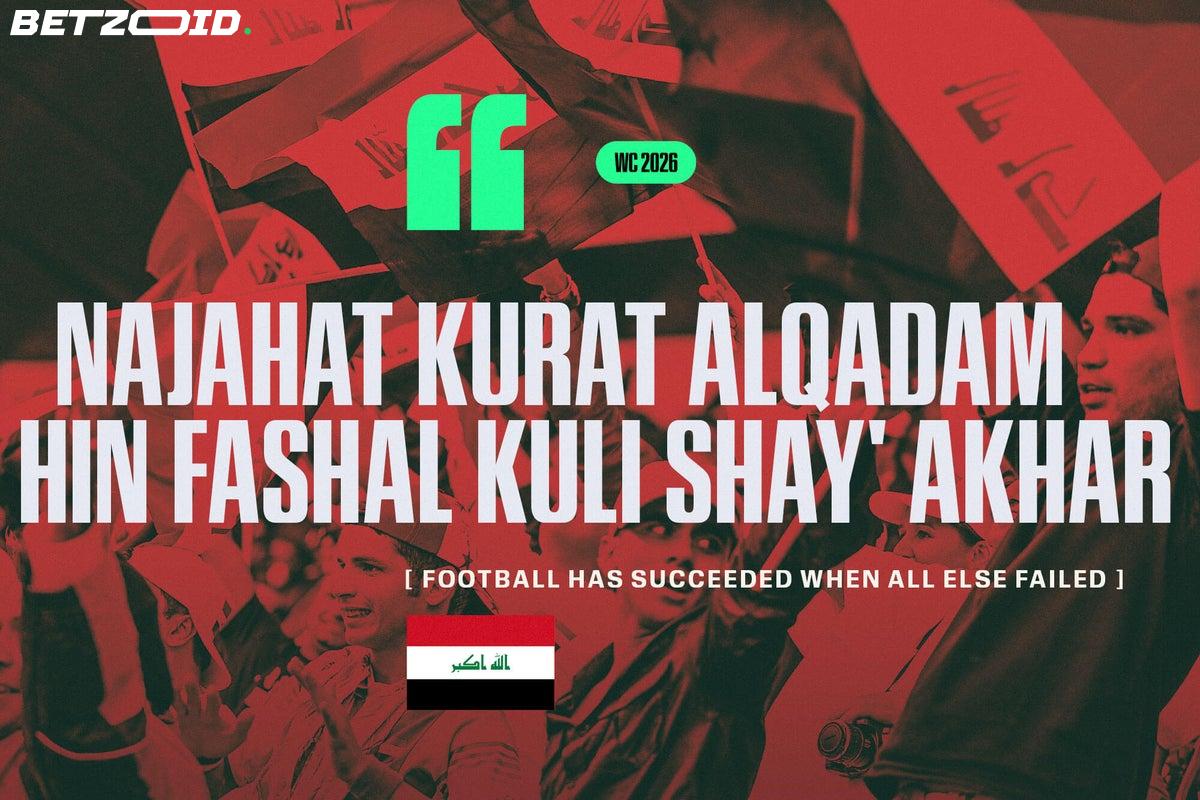
"The national team is the one thing where you'll have Sunnis, Shias, Kurds, Christians all working together." That's Hassanane Balal, host of the Iraq Football Podcast, speaking after watching Iraq qualify for their first World Cup since 1986 in Monterrey. He flew in from London. Thousands more made similar journeys. When Iraq beat Bolivia 2-1 in the inter-confederation play-off final at the end of March, the scenes at the stadium were matched by a two-day public holiday back home declared by Prime Minister Mohammed Shia al-Sudani.
Forty years. Two wars. A dictatorship overthrown. A diaspora scattered across continents. And through all of it, one thread holding — the national football team.
A squad that looks like modern Iraq
Graham Arnold's group for the Bolivia qualifier included 10 Europe-based players. Ali Al-Hamadi, raised in Liverpool, is back in the Premier League with Ipswich Town. Zidane Iqbal, a Manchester United academy product, is now with Utrecht. Assistant manager Rene Meulensteen has spent years mapping Iraqis displaced by conflict and scattered across the globe — and the results are on the pitch.
The squad's diversity isn't just a feel-good detail. It's a direct consequence of what Iraq has been through. Players praying side by side — Shia with hands down, Sunni with hands folded at the abdomen — has become a symbol of something the country's political structures have repeatedly failed to achieve. "The reason the team is how it is is not coincidental," Balal says. "It's a reflection of the trauma that Iraq has faced."
Lana Al-Namee, an Iraqi living in Chicago who will attend the opening group game against Norway in Foxboro with her mother and two sisters, puts it plainly: "No matter your social status, your religion, your ethnic background, your politics — those things disappear when you've got that shared heartbeat."
Group I and what comes next
Iraq face Norway, France and Senegal in Group I. On paper, it's a tough draw. France are among the tournament favourites. Senegal are no pushover. But anyone pricing Iraq purely on football logic is missing the point of why this squad is dangerous — they are 21 qualifying matches deep into a marathon campaign, they traveled by bus through Jordan just to reach the play-off final after bombs fell near the Iranian border, and they still got the job done.
Aymen Hussein's winner in that 21st qualifier, watched by Iraqis rising before dawn at home, triggered scenes that no club result could replicate. Over 150,000 Iraqis live in the United States according to the 2023 census. The stands in Foxboro, and wherever else Group I plays out, will reflect that.
Arnold has spoken about this tournament changing how the world sees Iraq. That ambition isn't hollow — it's earned. The question now is how far this team can take it.
"That ability to make 45 million people happy back in Iraq is priceless," says Ali Shekarchi, who followed the team through qualifiers against the UAE and Saudi Arabia. "I don't think there's anything better than being the reason why other people are happy."
Hard to argue with that. Iraq are back.