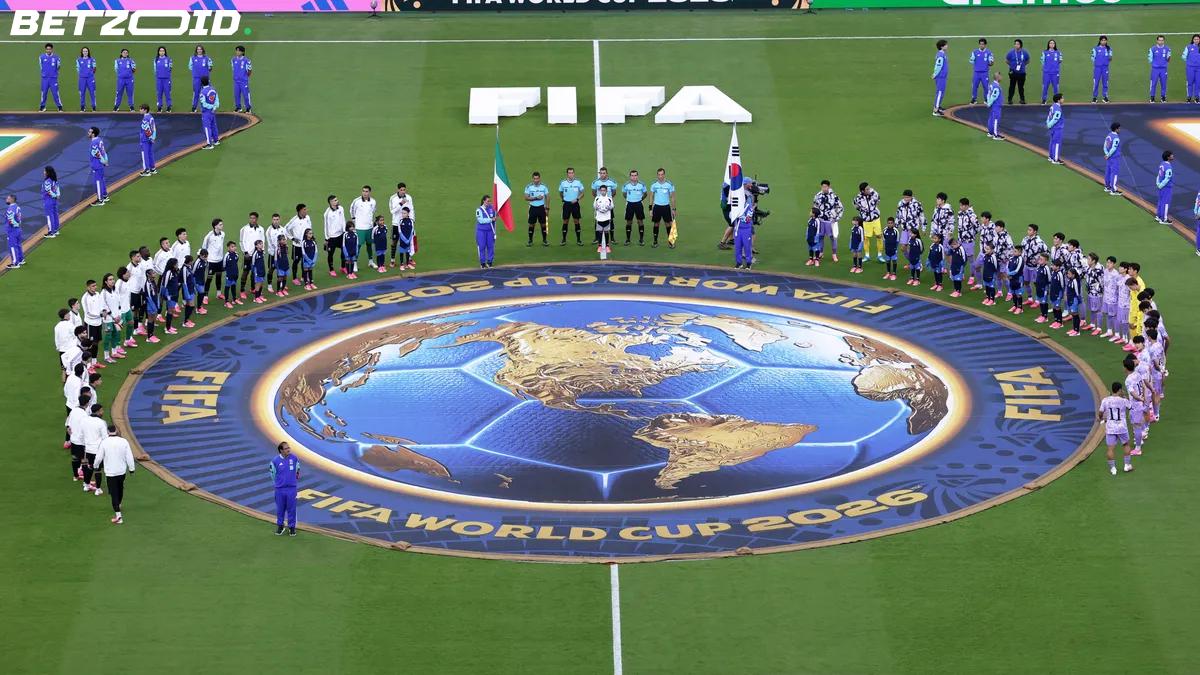
Messi has a hat trick. The USMNT are already through. Switzerland put four past Bosnia in 23 minutes. The 2026 World Cup is barely a week old and it's already delivering. Here's how the rest of it works.
How the group stage works
48 teams. 12 groups of four. Every team plays its three groupmates once — three points for a win, one for a draw, nothing for a loss. The top two from each group advance automatically to the Round of 32. The eight best third-placed teams across all 12 groups also go through, giving the knockout round its full complement of 32 sides.
If teams finish level on points, FIFA works through goal difference, goals scored, a conduct score, and ultimately FIFA world ranking to separate them. Tiebreakers between teams who played each other are settled first on head-to-head points, then head-to-head goal difference, then head-to-head goals scored.
Yellow card slates get wiped clean after the group stage and again after the quarterfinals — so players need two bookings within a three-game window to earn a suspension. Red cards trigger an automatic one-match ban, with FIFA's disciplinary committee able to extend that if the offense warrants it. Crucially for 2026, VAR can now review second-yellow dismissals — a rule change that didn't exist in previous tournaments.
The knockout stage: straight elimination from the Round of 32
Once the bracket is set, it's single elimination. Lose and you're done. The Round of 32 kicks off June 28, working through the Round of 16, quarterfinals, and semifinals before the third-place play-off and the final at MetLife Stadium in New Jersey on July 19.
Knockout ties level after 90 minutes go to 30 minutes of extra time — two 15-minute halves, no golden goal. If it's still level, penalties decide it: five kicks each, different takers, highest score wins.
One structural note: hydration breaks at the 22-minute mark of each half are mandatory for every match, regardless of weather or venue. Broadcasters love them. Purists don't. Either way, they're happening.
Who's favoured — and where the value might be
Spain lead the outright market at +450 with BetMGM, which makes sense after a clean sheet against Cape Verde and a 4-0 demolition of Saudi Arabia in the group stage. France (+500) and England (+700) follow close behind.
- Spain: +450
- France: +500
- England: +700
- Portugal: +800
- Argentina: +900
- Brazil: +900
- Germany: +1400
- Netherlands: +2000
- Belgium: +3300
- Norway: +3300
- Colombia: +4000
- Morocco: +4000
- Japan: +5000
- United States: +5000
- Mexico: +6600
- Uruguay: +6600
Germany at +1400 looks interesting after that 7-1 opening against Curaçao, though the competition stiffens rapidly from the Round of 16 onward. Norway at +3300 — with four goals past Iraq already — is the kind of long-shot that punters will point to smugly in three weeks if Haaland keeps scoring.
The tournament runs across 16 venues in three countries: 11 in the United States, three in Mexico, and two in Canada. It's the longest World Cup in history — 104 matches over five-and-a-half weeks. The final is July 19 at MetLife. A lot has to happen between now and then.