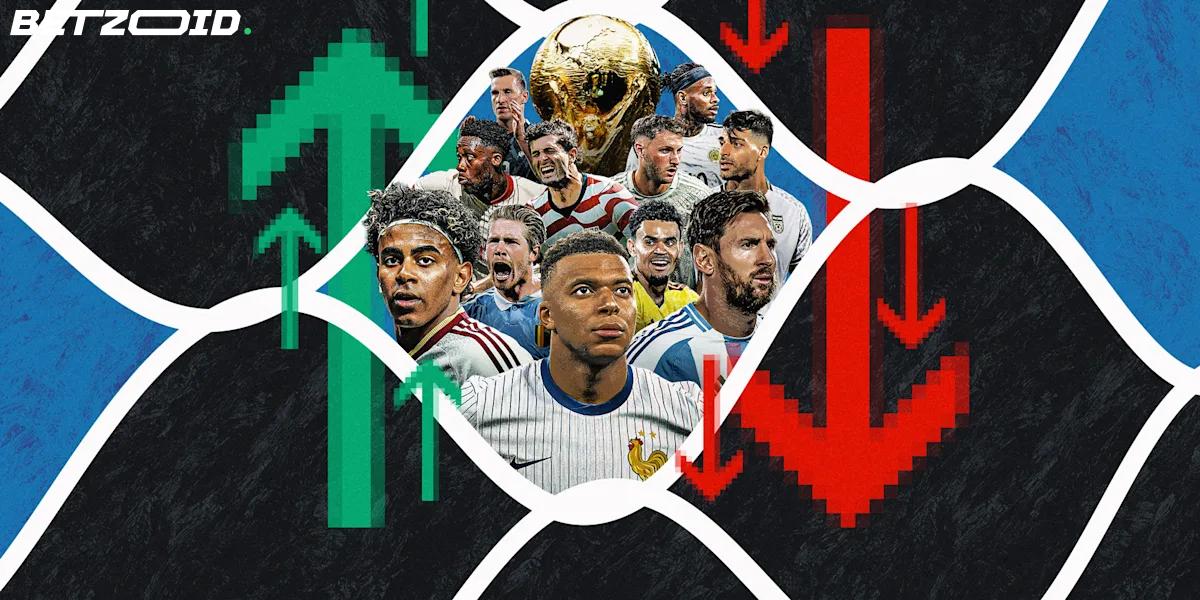
France are the team to beat at the 2026 World Cup — not because they're the betting favorite right now, but because no squad on the planet has their ceiling. If Didier Deschamps actually lets Mbappé, Olise, Dembélé, Cherki and Thuram loose at the same time, it's not a football team. It's a problem with no solution.
With the tournament expanded to 48 teams and two weeks from kickoff across the United States, Canada and Mexico, here's how all 48 nations stack up — separated into five honest tiers.
Tier 1: The teams that can actually win it
France top the list, but Spain were the betting favorite before Lamine Yamal's injury pushed their odds back. This isn't the tiki-taka Spain of 2008–2012 — it's sharper, more vertical, and they outscored opponents 15-4 at EURO 2024 while scoring at least twice in every knockout game. They'll cruise a group containing Cape Verde and Saudi Arabia.
Argentina arrive as defending champions with Messi turning 39 during the tournament. He doesn't need to carry the team the way he did in Qatar — the depth is there — though a patchy defence could be the weak link. England, under Thomas Tuchel rather than the cautious Gareth Southgate, should be more attack-minded, centre-back injuries aside. Portugal's depth of talent around Bruno Fernandes is genuinely frightening, even if a 41-year-old Cristiano Ronaldo limits their tactical flexibility whenever he's on the pitch.
Brazil complete the top six, though there are real concerns in midfield. Ancelotti is a genius of game management, but an ageing Casemiro and Fabinho may not hold things together for a full month. Germany, ranked seventh, looked like this before 2014 and won the whole thing — but they've also gone out in consecutive group stages since, which was previously unthinkable. Netherlands round out this tier: disciplined at the back, Frenkie de Jong pulling strings in midfield, and Memphis Depay still a danger at 32.
Tier 2: Genuine dark horses
Belgium are transitioning generations — Jeremy Doku leading the new wave — and how Rudi Garcia's backline holds up under pressure is the open question. Colombia are the most exciting team outside the top eight: Luis Díaz, James Rodríguez, Jhon Arias and Richard Ríos make up an attack built on flair and movement, and a runner-up finish at Copa América two years ago wasn't a fluke.
Morocco are no longer an underdog story. Since their 2022 semi-final run, they've lost just once on the field, and that result was overturned. Hakimi and Belammari give them arguably the best pair of attacking full-backs in the tournament. Senegal carry experience throughout the squad and a front line — Mane, Nicolas Jackson, Iliman Ndiaye — that can punish anyone on a good day.
Ecuador are the most underrated team in the draw. Five goals conceded in 18 qualifiers. Moises Caicedo anchoring midfield. The only genuine concern is attack — Enner Valencia, 36, scored six of their 14 qualifying goals. If 19-year-old Kendry Paez can fill that gap, Ecuador beat anyone. Uruguay have the midfield spine — Valverde, Ugarte, Bentancur — but Darwin Núñez has gone 13 caps without a goal. Croatia are in this tier by reputation and sheer stubbornness. At 40, Modrić is still running things. This is probably the tournament where it ends. Probably.
Tier 3: The Cinderellas
Norway make their first World Cup since 1998 and will be everyone's sleeper pick the moment the draw is discussed. Haaland and Ødegaard is a combination that has no obvious answer — and Norway won all eight qualifiers 37-5, including two wins over Italy by a combined 7-1. Their group draw put them against France and Senegal, so the ceiling might be a round-of-32 exit. But the Norway-France match alone is worth the ticket price.
Japan quietly upset Spain and Germany four years ago and haven't slowed down — they beat England 1-0 at Wembley in March. Even without the injured Mitoma, the squad is stacked with European-based players who press relentlessly and move the ball with precision. Switzerland are the definition of a side that never embarrasses themselves and occasionally pulls off something unexpected. The United States, as hosts, have a structural advantage: a favourable group, home crowds, and a knockout draw that could hand them a run deep into the tournament if they find that attacking edge they showed in a pre-tournament win over Senegal.
Mexico need home advantage to matter again — their only quarterfinal appearances came on Mexican soil in 1970 and 1986. Türkiye have two of the most exciting young players in the tournament in Kenan Yildiz and Arda Güler, both 21, both capable of dragging their team somewhere unexpected. South Korea have Son Heung-min in what he's called his final World Cup, and they've never been easy to beat. This tier also includes Switzerland, all of whom have realistic knockout-stage ambitions.
Tier 4: Optimistic because the format lets them be
The expanded format is genuinely kind to this group. Iran defend deep and hit on the counter — Mehdi Taremi gives them a genuine goal threat. Ghana have Semenyo and Kudus as legitimate Premier League-level wide players and will back themselves to cause problems in a group with England and Croatia. Austria's high press under Ralf Rangnick can wreck teams on a good day. Ivory Coast didn't concede a single goal in 10 qualifying matches. Paraguay's defensive structure is among the tightest in CONMEBOL, and Almiron plus 22-year-old Enciso gives them an attacking outlet.
Egypt have Mo Salah and Omar Marmoush on the flanks — two of the most in-form players on the planet — but they'll need far more around them to win a first-ever World Cup match. Canada, in a soft group, have no excuses: going out in the group stage again would be a genuine embarrassment. Australia, Bosnia-Herzegovina, Algeria, Czechia, Sweden, Panama and South Africa all sit in this tier — each with a plausible path to the Round of 32 if the draw falls right and a key player delivers on the day.
Tier 5: First timers and long shots
Four debutants — Cape Verde, Curaçao, DR Congo and Qatar (qualifying properly for the first time) — make up part of this final group alongside Iraq, Jordan, Uzbekistan and New Zealand. None have ever won a World Cup match. New Zealand have one point — three draws in 2010 — across their entire World Cup history.
- Cape Verde — First World Cup. Could steal a result against Saudi Arabia.
- Curaçao — Smallest nation (153,000 people) ever to qualify. Possession-based, but Group E with Germany and Ecuador is unforgiving.
- DR Congo — Knocked out Cameroon and Nigeria to get here. Need to limit damage early, then beat Uzbekistan on matchday 3.
- New Zealand — Chris Wood is everything. Without him functioning, a first World Cup win stays out of reach.
- Qatar — Julen Lopetegui in charge. Conceded three or more in four away qualifiers. Defence needs fixing fast.
- Uzbekistan — Fabio Cannavaro coaching, Man City's Khusanov in central defence. Youth talent is there. Whether it's ready is another question.
- Iraq — Last team to qualify, drawn into a group with France, Norway and Senegal. Need to find goals from somewhere.
- Jordan — Defending hard and hitting on the counter got them here. A point in Group J alongside Argentina, Algeria and Austria would already be a success story.
Realistically, the trophy goes to one of six or seven teams. France, Spain and Argentina are the most likely names on the final. But 48 teams means 48 stories — and at least a handful of them will be worth watching.