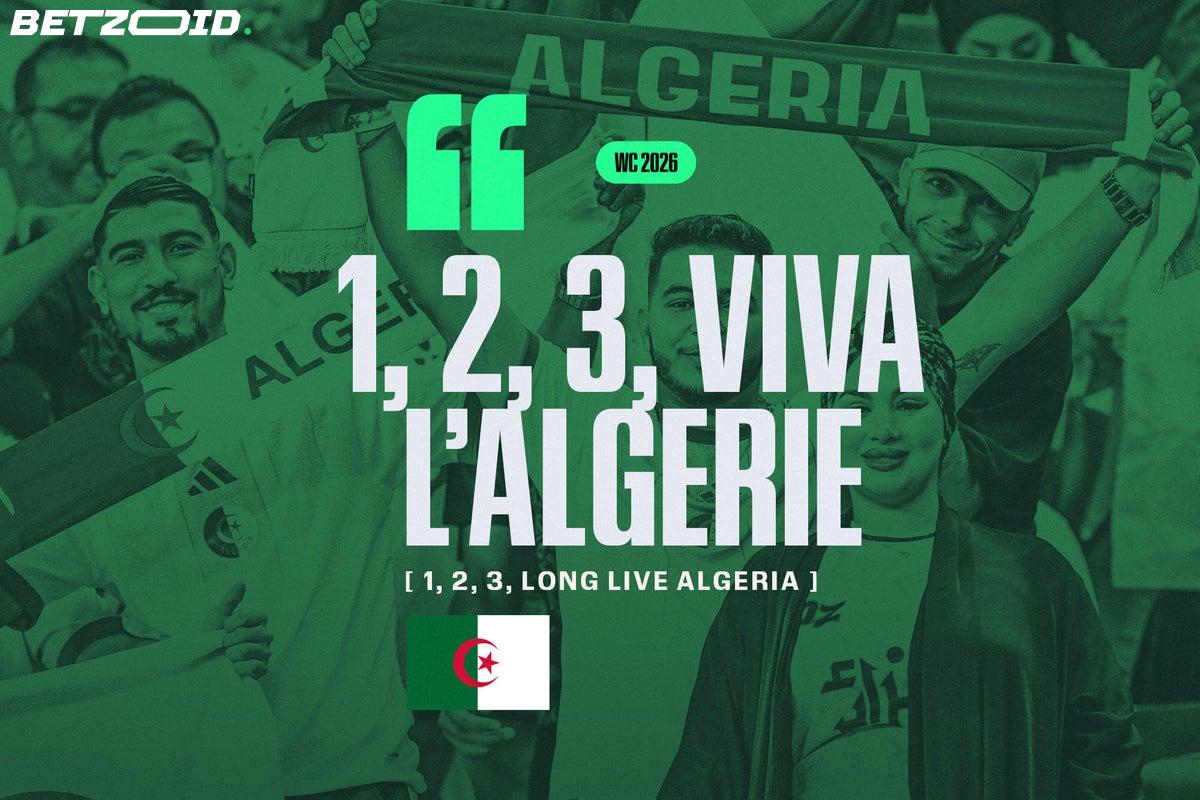
You don't need to speak French, Arabic, or Darija to understand what '1, 2, 3, viva l'Algérie' means the moment a crowd starts singing it. It hits differently from any other fan chant in football — because it was never just about football.
The most repeated origin story places it at the port of Algiers during French colonial rule. Locals reportedly wanted to shout '1, 2, 3, free Algérie' at a passing American ship — a plea for recognition, for independence. The Americans misheard it as '1, 2, 3, viva l'Algérie.' After independence in 1962, the version that stuck was the one that celebrated rather than begged. A small linguistic accident that became a generational anthem.
Football as proof of existence
Algeria's national team roots go deeper than most. The side traces its origins to the National Liberation Front — the main nationalist movement during the War of Independence in the 1950s and early '60s. That context shapes everything about how Algerians follow their team.
"Supporting the national team is related to the history of Algeria," says Amine Kabbes, a 38-year-old film director. "We have a desire to be in the world because, before 1962, we didn't exist. With football, we can exist and prove we are here. For me, every victory is an opportunity for the world to write about Algeria."
That desire to be seen explains one of Algerian football culture's most distinctive quirks: the flag. At Champions League finals, Copa América matches, random mid-season league games with no Algerian team in sight — you will find someone holding a green-and-white flag with a red crescent. Not as a stunt. As a reflex.
"It's their oxygen," says Mohamed Benhassir. "It'll always be their oxygen, either the national team or domestic football. The majority of the population's source of happiness is football."
The diaspora that follows niche leagues and never forgets Gijon
Algeria's diaspora — concentrated heavily in France, but spread across London, Madrid, and the United States — means the chant gets sung far from North Africa on matchdays. For many of those fans, following the national team becomes a deep dive into obscure football. Yassine Tebib, born and raised in London, recalls tracking Mohamed Amoura — now at Wolfsburg — through the Swiss league with Lugano and Belgian football with Union Saint-Gilloise, just to watch an Algeria player perform.
"I was watching really random games, just to follow the players," he says. That kind of obsessive investment is the norm, not the exception.
The 2026 World Cup group draw handed Algeria a genuinely difficult task: Argentina, Jordan, and Austria. Games split between Kansas City and Santa Clara, California. But Algerian fans will be there — Tebib confirmed it — and they'll spend considerable energy educating anyone who'll listen about the Disgrace of Gijon. The 1982 West Germany-Austria result that eliminated Algeria despite two wins remains an open wound more than four decades later. It's also the reason all final group-stage matches are now played simultaneously. Algeria fans know they changed that rule. They'll tell you.
"If Algeria win, there is going to be a party in the streets — everyone is going to be honking in their cars and waving the flag," says Adam, an Algerian-American traveling to all three group games. Those streets will be in Algiers, Paris, London, and Kansas City at the same time.
The chant will be the same in all of them. It always is.