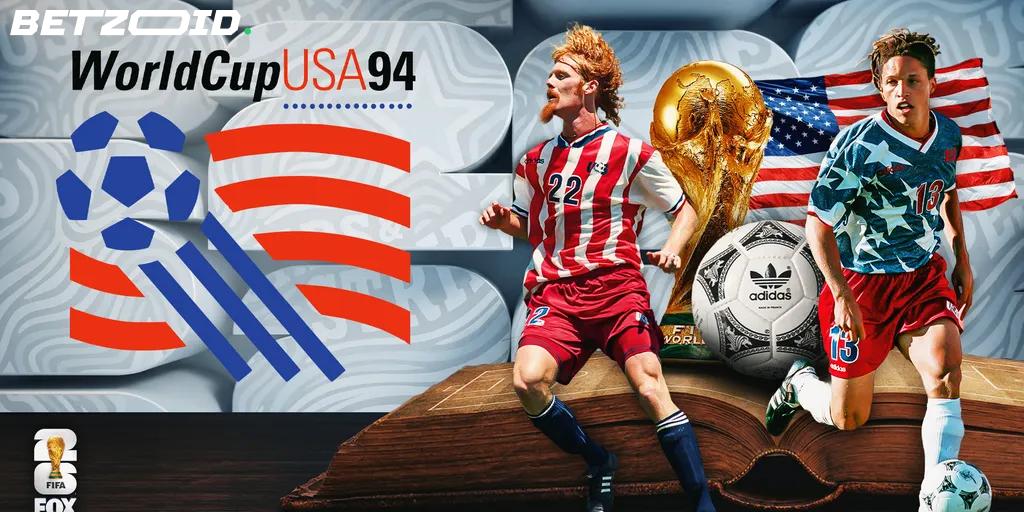
Before a ball was kicked at the 1994 World Cup, the verdict from European and South American football circles was already in: the United States had no business hosting this tournament. No top-tier professional league. A population that didn't "get" the game. What could possibly go wrong?
Everything the skeptics predicted turned out to be wrong. Every single thing.
3.6 million spectators showed up across venues from Los Angeles to New York — a World Cup attendance record that still stands today, more than three decades later. The tournament didn't just survive on American soil. It thrived.
The matches that defined a summer
The U.S. men's national team arrived as hosts with limited expectations but maximum motivation. They'd gone winless through the 1990 World Cup in Italy and needed a statement. They got one — though not without some chaos first.
Their opener against Switzerland at the Pontiac Silverdome — the Detroit Lions' home stadium, retrofitted with a temporary grass pitch — was the first indoor match in World Cup history. No air conditioning. Stifling heat. Thomas Dooley later called it "the worst place I have ever played at." Then Eric Wynalda curled in a wonder-goal, and none of that seemed to matter quite as much.
A 1-1 draw against Switzerland. A stunning 2-1 win over heavily favored Colombia. Then a 1-0 loss to Romania, which pushed the Americans into a Round of 16 date with Brazil on the Fourth of July at Stanford Stadium. Brazil won 1-0, with Bebeto scoring the only goal. Even a man down for part of the match, the Brazilians were simply better.
Brazil then went on to win the whole thing — their fourth World Cup title and first since 1970 — by defeating Italy in the final after 120 goalless minutes. The match ended on penalties, and the image that burned itself into football history was Roberto Baggio sending his spot-kick over the crossbar. Italy's agony. Brazil's redemption.
Romario and Bebeto combined for eight goals throughout the tournament. Romario took home the Golden Ball, having scored five times including goals in all three group stage matches. He was the tournament's clearest individual force.
Records, exits, and the Golden Boot shared for the only time
The 1994 tournament also produced some of the most unusual individual storylines in World Cup history.
Russia's Oleg Salenko scored five goals in a single group stage game against Cameroon — a record that has never been matched. He finished the tournament with six goals total, all scored in the group stage before Russia were eliminated. That was enough to share the Golden Boot with Bulgaria's Hristo Stoichkov, who played four more matches to reach the same tally. It remains the only time in World Cup history that the Golden Boot has been shared.
Stoichkov's contribution was far more impactful in terms of team results. His brilliance drove Bulgaria to the semifinals, highlighted by a free-kick that eliminated defending champions Germany. Salenko won a record. Stoichkov changed a country's football history. Both finished on six goals.
Then there was Diego Maradona. His 1994 World Cup lasted exactly two matches. He scored an iconic goal against Greece, celebrated it with a wild-eyed sprint into the camera, and was then sent home after failing a drug test. The man who won the World Cup for Argentina in 1986 left the tournament in disgrace. It was his last.
- Golden Ball: Romario (Brazil) — 5 goals, defining performances in every knockout round
- Golden Boot: Oleg Salenko (Russia) and Hristo Stoichkov (Bulgaria) — 6 goals each, the only shared award in the history of the prize
- Golden Glove (then Lev Yashin Award): Michel Preud'homme (Belgium) — clean sheets against Morocco and the Netherlands before Belgium's Round of 16 exit
- All-time World Cup attendance record: 3.6 million spectators across the tournament, set in 1994 and never broken
The tournament's legacy extended well beyond the summer. MLS was born directly from the momentum of 1994, and now runs 30 clubs across 25 American and three Canadian cities. The player pool the U.S. can draw from today bears no resemblance to what existed when Alexi Lalas, Cobi Jones, and Marcelo Balboa — iconic hair and all — represented the country on home soil.
The 2026 World Cup returns to the United States as a co-host alongside Canada and Mexico, with the final scheduled for July 19 at MetLife Stadium in East Rutherford, New Jersey. The country hosting it looks nothing like the one that raised eyebrows in 1994. That transformation started that summer.