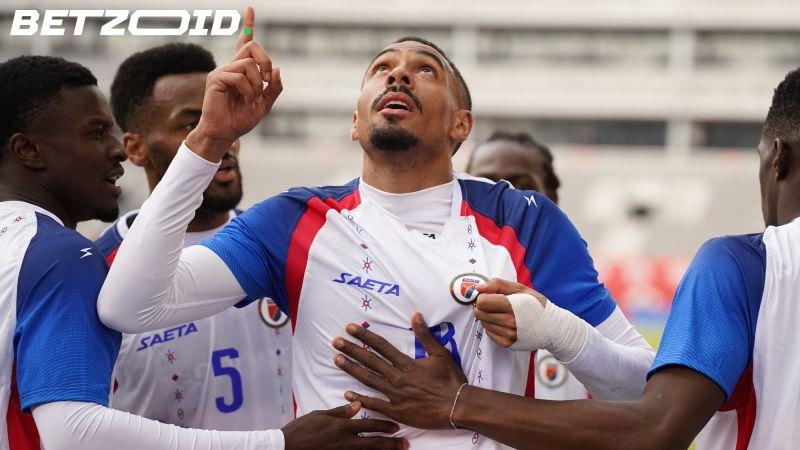
"It's been a long time since you see Haitian people united like this." That's Louicius Deedson, the FC Dallas midfielder who scored one of the two goals that sent Haiti to their first World Cup in over 50 years. When you know what the streets of Port-au-Prince look like right now, that sentence carries real weight.
The qualification came in November, via a win over Nicaragua in Curaçao — a neutral venue, because Haiti's own stadiums are either occupied by displaced civilians or controlled by armed gangs. The national team can't train in Haiti. Their French coach can't travel there. Players are preparing for the tournament in Florida and New Jersey. This is what qualifying for a World Cup looks like when 80 to 90 percent of your capital is under gang control, according to the UN.
A squad built in exile
Most of Haiti's squad was born and raised abroad — France, the United States, elsewhere — and plays in European leagues. Deedson grew up in Port-au-Prince's Tabarre district but moved to the US as a teenager. His childhood home was partially burned down in a gang attack last year. His family has had to flee.
Woodensky Pierre is the exception on this squad. He grew up in Cité Soleil, one of Port-au-Prince's most dangerous neighborhoods, plays for Violette Athletic Club in the Haitian national league, and is the only member of the World Cup squad still playing domestically. "There was a moment where I felt like I would never make it to this point because things were very difficult, I had no support, nothing," he said. "Football was all I had."
Pierre's team won the national championship final on May 10 at Parc Sainte-Thérèse in Pétionville — one of the few areas of the capital not entirely overrun by gangs. He's hoping his presence in the World Cup squad opens doors for other players coming through the Haitian league, a competition that somehow keeps running through all of it.
Talent that has nowhere to go
The FIFA Goal Center in Port-au-Prince — a training hub for youth athletes — was set on fire by gangs this year. Sylvio Cator stadium, where the national team trained for decades including before their only previous World Cup appearance in the 1970s, is now used as a shelter for people fleeing violence. Scouts can't travel to watch players. Agents work remotely. Kids with real ability have no facilities, no pathways, no safety net.
"I know there's a lot of Haitian kids that are very good and they just want the chance to show themselves," Deedson said. "There's a lot of talent there that's wasting right now."
The UN estimates roughly half of Haiti's gang members are minors. Haiti's Ministry of Youth, Sports and Civic Action has ambitions to build more sports facilities — partly as a direct intervention in that pipeline — but unrest has blocked most of it. "It's killing us, whenever we see a kid with a gun," the ministry's communications director Louis Alex Francois told CNN.
Pierre's former agent Jerome Salbert, based in France, scouted him entirely remotely. He describes the difficulty of signing Haitian players as structural: travel restrictions, security instability, and the psychological toll of growing up surrounded by gang violence all create barriers that have nothing to do with ability. "The fact that the country is in a humanitarian crisis, sometimes you can face a lot of instability with the players...because they are young, they don't trust easily, sometimes they live with gangs surrounding their houses."
Haiti are going to the World Cup. For a brief night in November, Port-au-Prince celebrated. The FIFA Goal Center is still ash.