"Our fire is love, not anger." That line, from broadcast journalist Ika Ferrer Gotic, cuts to the heart of what Bosnia and Herzegovina bring to the 2026 World Cup — and it's a more complicated, more interesting story than most neutrals will expect.
Bosnia have qualified for just their second World Cup ever. A nation of three million people, independent for barely three decades, shaped by a war that killed an estimated 100,000 people between 1992 and 1995. Football here isn't recreation. It's something closer to proof of existence.
"You don't support Bosnia because it is easy or successful," says Amila Sirco, a travel agency worker who has helped coordinate logistics for the national team. "You support it because it is yours."
A diaspora that shows up louder than most home crowds
The Bosnian War scattered millions across the globe. Around 400,000 people of Bosnian descent now live across the U.S. and Canada alone — and they travel. The BHFanaticos, Bosnia's largest organised supporter group, have followed the national team across football, basketball and handball since 2000, with chapters now spread across North America.
"We will see an invasion of Bosnians for every match," says Erva, a U.S.-based BHFanaticos member. "Many people underestimate Bosnia due to its size, but fans consistently show up in huge numbers abroad. We are known for our intense pyro atmosphere, non-stop chanting, and strong loyalty."
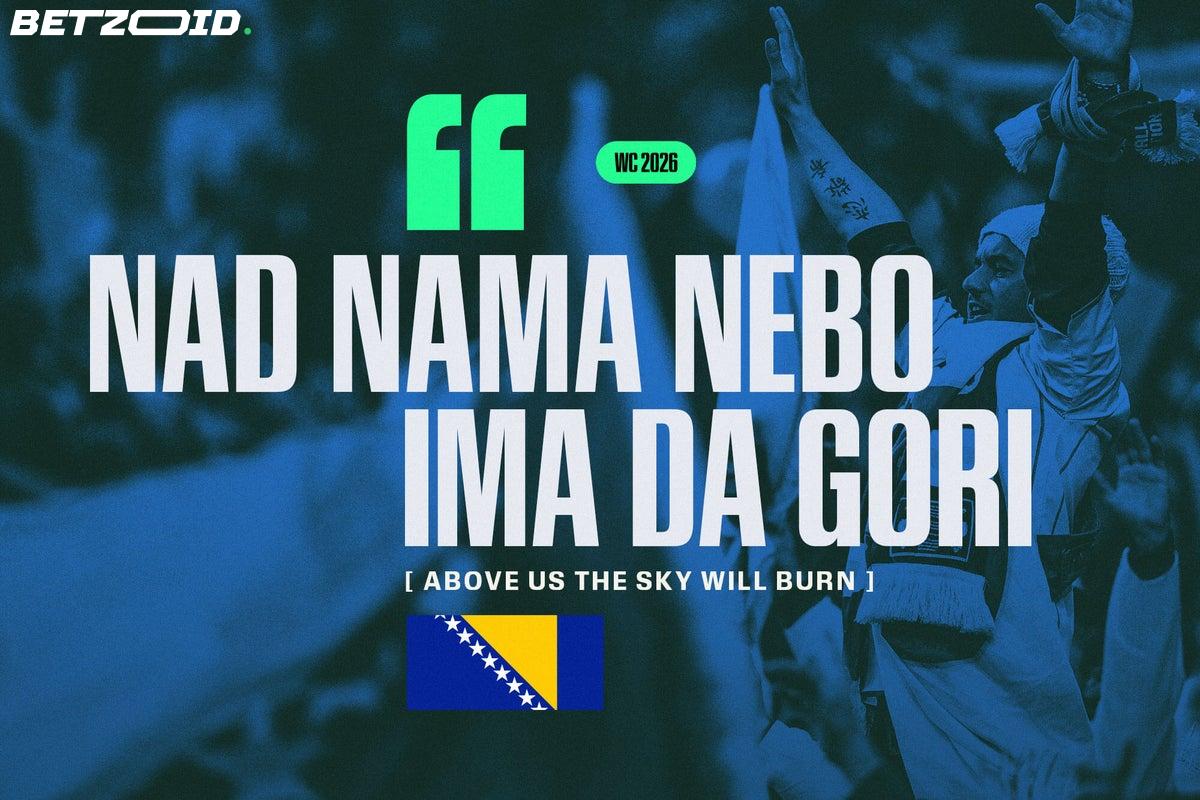
That atmosphere has a name. Nad nama nebo ima da gori — Above us the sky will burn. It's not a metaphor so much as a literal description of what happens when Bosnia play at home. Flares, noise, blue and yellow filling the stands. If you're near the stadium, you know.
The squad reflects the diaspora's reach. Esmir Bajraktarevic was born in Wisconsin, made one senior appearance for the USMNT, then declared for Bosnia in 2024. His family are originally from Srebrenica. The PSV winger is now one of the team's key players — his story is Bosnia's story in concentrated form.
Unity as defiance, not just sentiment
Bosnia's identity is genuinely complex. The 2013 census put the population at roughly 50% Bosniak, 30% Bosnian Serb, and 15% Bosnian Croat — three constituent peoples, two autonomous entities, a rotating three-member presidency. Part of the population actively identifies with Serbia or Croatia rather than Bosnia. The divisions are real and not going away.
Head coach Sergej Barbarez — whose mother comes from a Croat-Bosniak family and whose father was Serb — navigates all of it daily. "Religion and nationality never played a major role in my family," he has said. His background is almost a microcosm of the squad he manages.
For those who do back the national team, qualification carries weight that extends well beyond the group stage draw. TV journalist Semir Mustafic put it plainly: World Cup qualification "helps erase everyday problems" and "Bosnia celebrated together." Supporting the team, he says, is about "defiance, pride, and the fight to exist and be recognised."
- Bosnia's second-ever World Cup qualification
- An estimated 400,000 people of Bosnian descent in the U.S. and Canada
- The BHFanaticos active since 2000 across multiple sports
- Esmir Bajraktarevic — Wisconsin-born, Srebrenica-rooted, now a PSV winger
- Coach Barbarez: Croat, Bosniak and Serb heritage in a single family
On the pitch, Bosnia are an underdog. Their odds to progress deep into the tournament reflect that honestly. But the noise they generate off it? That's a different market entirely — and one the stadium cities of Canada and the U.S. are about to discover firsthand.
"Supporting the country is carrying the nation's soul in your chest, like a heartbeat," Gotic says. Above Bosnia matches, the sky will burn. It has for decades. This summer, it burns on the biggest stage.