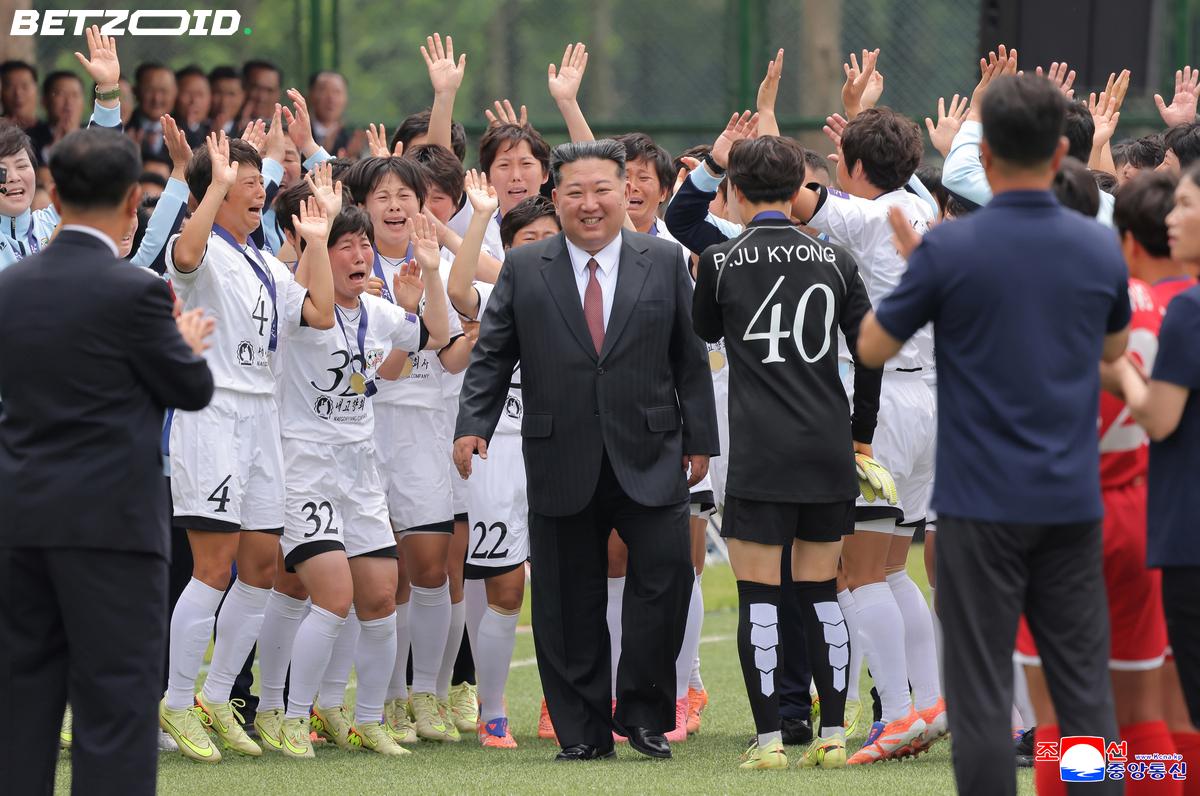
Kim Jong-un watched a football match last week. That's the surface. Underneath, it was a masterclass in authoritarian optics — and North Korea's women's footballers, whether they wanted the role or not, were the main prop.
State media reported that Kim attended a demonstration match between Naegohyang Women's FC and the U-17 national team, held as the closing event of the 80th anniversary of the Workers' Party Central Cadres School. Both teams arrived with hardware: Naegohyang had just won the AFC Women's Champions League — the semifinal and final staged in Suwon, South Korea — while the U-17 side claimed the AFC Women's Asian Cup. Kim met the players beforehand, congratulated them, and posed for photos. Published images show players in gold medals, some visibly crying with emotion, Kim smiling at the centre of it all.
The message behind the match
The timing and venue weren't coincidental. The Central Cadres School is North Korea's premier institution for training party officials — the people who run the apparatus. Having them watch gold-medal-winning athletes perform, framed explicitly as a product of party leadership, is political theatre with a very specific audience in mind.
Yang Moo-jin, a distinguished professor at the University of North Korean Studies, put it plainly: "By linking the achievements of women's soccer to the consideration and benevolence of the supreme leader, they sought to elicit loyalty. By showing participants in the Central Cadres School event the lesson that international successes come under the Party's leadership, it appears they aimed to strengthen regime cohesion."
Rodong Sinmun, the state newspaper read by ordinary North Koreans, covered the event across pages one through four of a six-page edition. That's not coverage — that's a directive.
The younger generation problem
Kim's speech at the anniversary event revealed what's actually worrying the regime. He spoke at length about ideological slippage among younger cadres — officials who, unlike their predecessors, never lived through war or post-war reconstruction. "Young people who lack Party refinement and whose sensibilities differ from those of the previous generation now constitute the main force of the cadre ranks," he said.
He called for harder ideological education, higher standards, and more intense "Party tempering" specifically targeting younger officials. The football spectacle — emotional players, gold medals, a packed stadium draped in North Korean flags — wasn't a reward ceremony. It was a demonstration of what devotion to the state supposedly produces.
For Naegohyang, their AFC Champions League win is a genuine footballing achievement, earned in competition held on South Korean soil. Whether the players had any say in how that achievement gets used back home is a different question entirely.