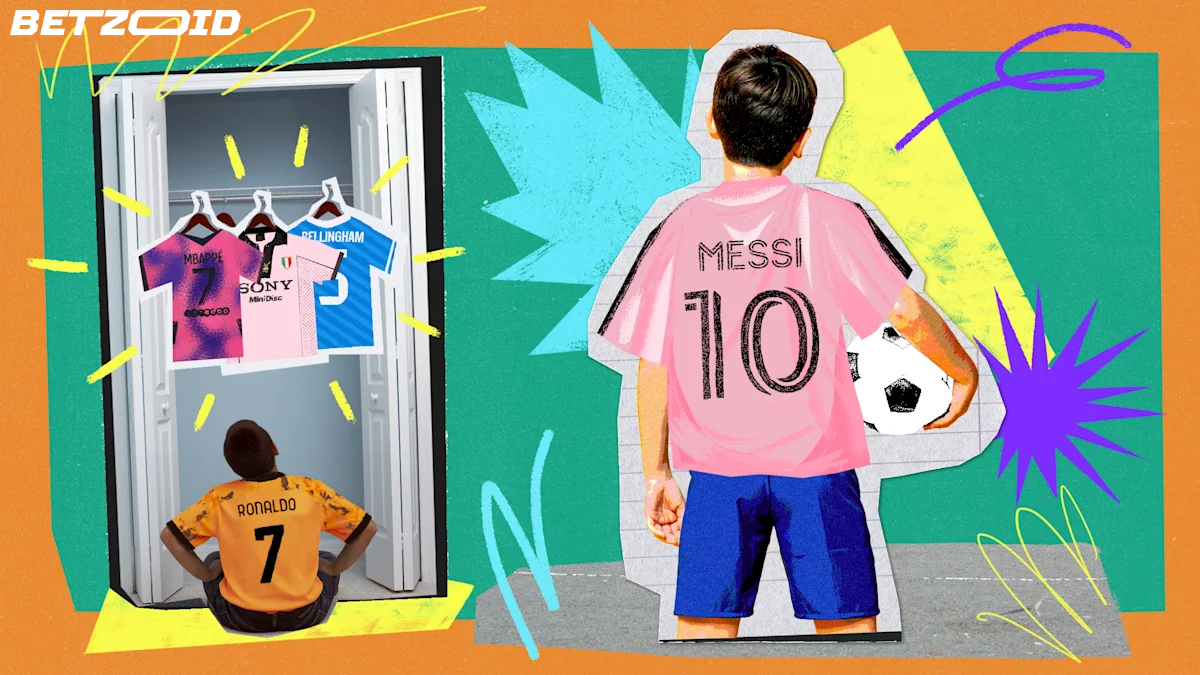
Before we find out who wins the 2026 World Cup, one winner is already confirmed: the soccer jersey as everyday clothing. Nike sold two and a half times more national team shirts ahead of this tournament than it did before Qatar 2022. Adidas projected $570 million in World Cup gear sales in the first half of 2026 alone — then watched its May sales jump roughly 70% year over year. On TikTok Shop, U.S. soccer jersey orders spiked 527% in the tournament's opening week.
"We saw a big peak coming," the director of consumer merchandising at Soccer.com said, "but the peak exceeded our expectations."
This isn't just a fashion moment
Yes, Olivia Rodrigo dropped a retro Barcelona kit. Yes, Miaou, Aimé Leon Dore and H&M have all made their moves. The style angle is real. But fixating on the fashion story misses the bigger one.
A generation of American kids is now growing up with soccer as a constant — not a quadrennial curiosity. They stream the Premier League on weekends, watch Champions League midweek, attend MLS matches locally, and wear the same shirts as the players they follow. One kid on a travel soccer team in LA has 12 jerseys in current rotation. So does his older brother. They're repping Club América and Tigres alongside the European giants. Their mom admits she now scours discount stores for deals and "goes a bit crazy" stocking up.
That's not a fashion trend. That's a culture shift.
For decades, the honest answer to why the U.S. men's team underperforms relative to the country's size and athletic depth has been cultural, not structural. Other nations produced better players because their kids were soaked in the sport year-round — watching it, arguing about it, playing it in the street, dreaming about it. American kids, broadly, weren't. They had other sports competing for that mental real estate.
What kit culture actually signals
The youth soccer jersey market is projected to hit $4.1 billion globally by the next World Cup cycle, up from $2.1 billion in 2019. North America's share sits at 18.9% and is growing. These aren't just sales figures — they're a proxy for how deeply the sport is embedding itself into the daily lives of the generation that will stock the USMNT rosters in the 2030s and beyond.
None of which changes the fact that the U.S. just lost to Belgium in the Round of 16 and the post-mortems were, as always, uncomfortable. The usual structural debates — elite pay-to-play pathways, athlete pool dilution across other sports, development systems — are all valid. But the cultural deficit was always the root. Kids who wear Messi pink on the playground and can tell you the difference between a 4-3-3 and a 4-2-3-1 are a different input than previous generations.
A closet full of kits won't produce the next world-class American midfielder. But a generation that treats soccer as a way of life rather than a gym class activity just might.