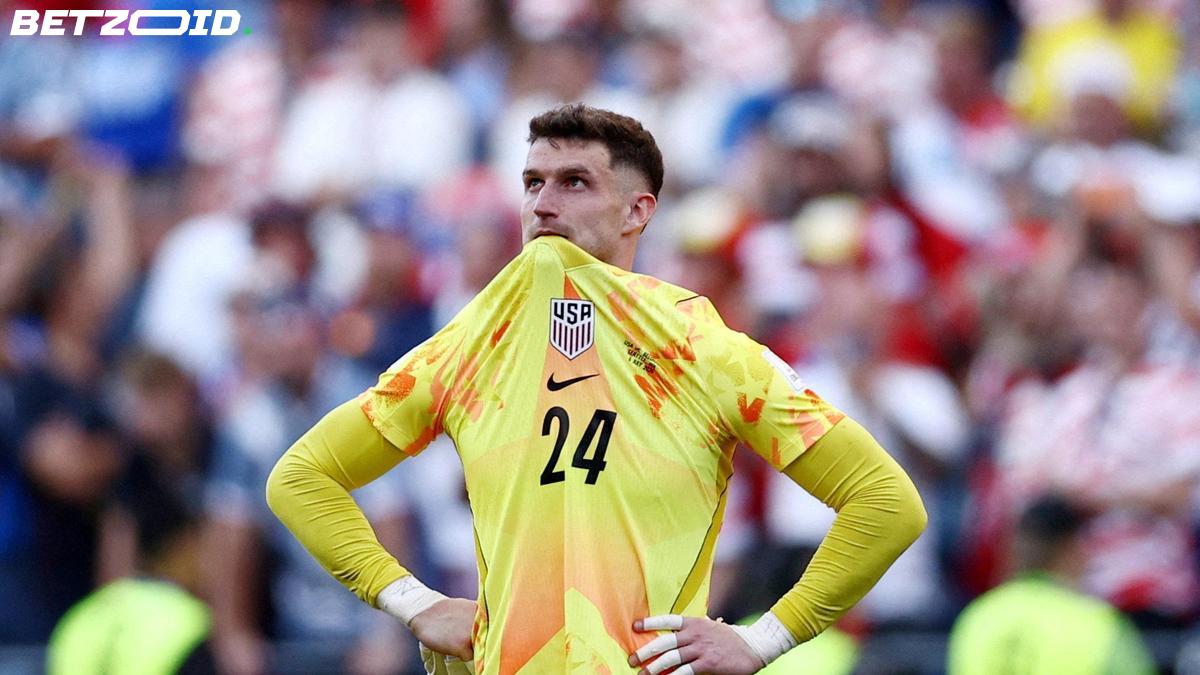
"Big losses in tough moments are things you never really get over because they stay with you for the rest of your career." Matt Freese said that. He meant it. And given what happened in the 57th minute against Belgium, he's probably right.
In the United States' Round of 16 exit at the 2026 World Cup — a 4-1 defeat that was far more comfortable for Belgium than the scoreline even suggests — Freese rushed well out of his box to clear a long ball, hesitated under pressure, and Belgium turned the hesitation into a goal that made it 3-1. Game effectively over. Tournament over. Freese's summer defined in one moment of indecision.
The backlash back home
American fans haven't moved on either. In his first MLS appearance since the World Cup, NYCFC supporters booed him every time he touched the ball in Columbus. That's not a minor inconvenience — that's a goalkeeper trying to reset his confidence while an entire stadium reminds him of the worst moment of his career.
His response, speaking to the Associated Press ahead of Wednesday's MLS All-Star Game in Charlotte, was measured. "It's important to not let bad things define you, but I think it's also important not to let good things define you either. It's important to be a consistent presence with consistent energy." Whether he can maintain that consistency under scrutiny is what NYCFC's season might hinge on — and what any futures market on their defensive record should factor in.
Freese is one of four USMNT players selected for the All-Star Game, alongside veteran defender Tim Ream and wing-back Max Arfsten, among others.
What comes next for the USMNT
Ream, honest as ever, admits there's no formula for getting the US past the quarterfinals. "You put your head down and do as much as you possibly can. And, at some point you will break through that barrier. It just takes work, more work and more work." That's not an inspiring soundbite — it's an accurate one. The US have now exited at the Round of 16 in a home World Cup, against a Belgian side that, for all their talent, aren't the 2018 version of themselves.
Arfsten pointed to something more structural: the pipeline. With most of the 2026 group stage played on US soil, the spotlight on the sport has never been brighter domestically. More kids playing, more competition, more pathways to Europe — the argument makes sense on paper. It just won't help the current generation.
Freese put it plainly: "It's important for us to be aware of the positive outcomes that happened in the tournament as well as use that to inspire new generations to continue to get better — to get past that round of 16, to get past the quarterfinals and make it to the semis and the finals."
He's right that the next generation might benefit. He's also the one who has to live with the mistake that ended this one.